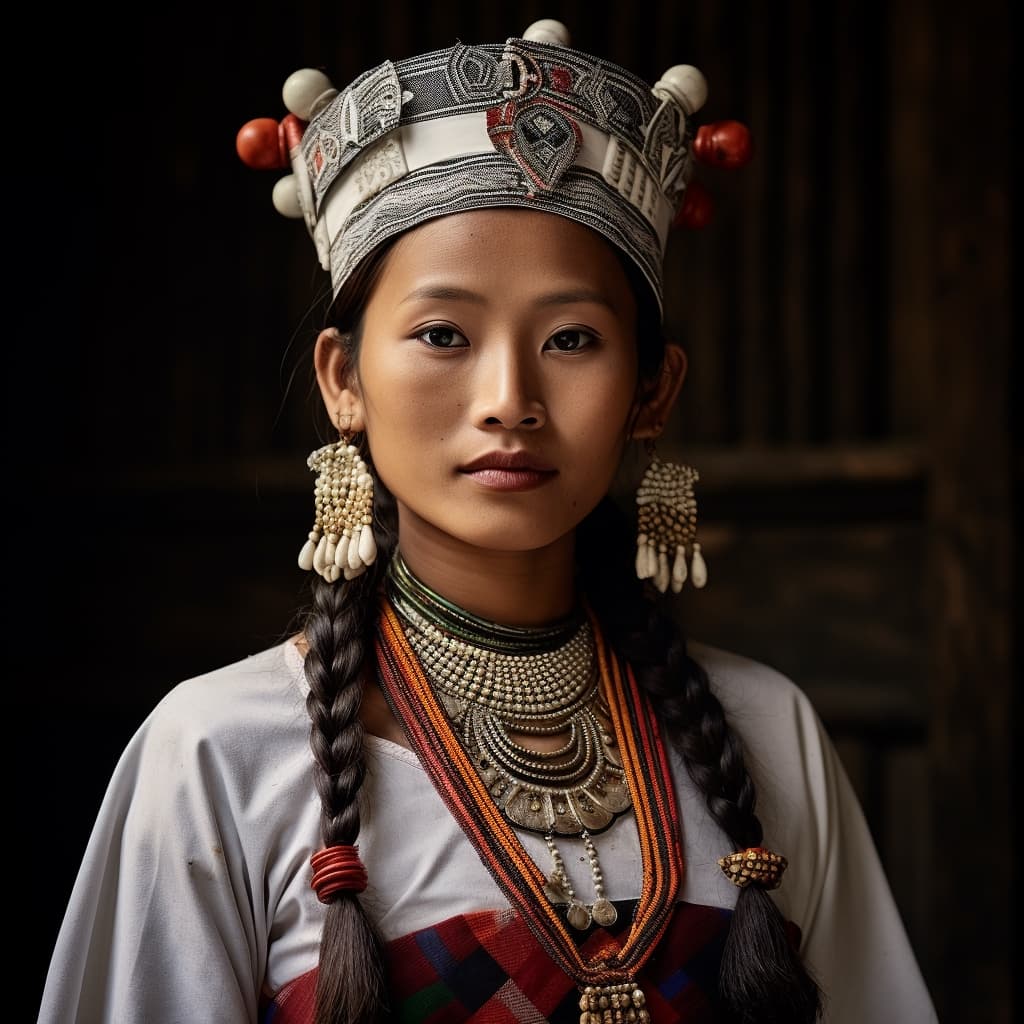
Meitei Erotic
Manipur (India)
Sino-Tibetan / Kuki-Chin–Naga / Meitei
Hinduism / Vaishnavism
Loi
Southern Asia
About Meitei People
The Meitei are the people of the Imphal Valley — a flat oval of paddy and wetlands ringed by hills in the Indian state of Manipur. That geography matters: the valley is a rare patch of lowland in a region otherwise defined by ridges, and the Meitei have lived as a settled, rice-growing, state-forming people surrounded by hill communities with very different ways of life. The relationship between valley and hills runs through almost everything in Manipur, from cuisine to politics, and the Meitei sit firmly on the valley side of it.
Their language, Meiteilon (often called Manipuri), is Tibeto-Burman, but it has long been the lingua franca of the wider region and was admitted to the Eighth Schedule of the Indian Constitution in 1992. It carries its own script, Meitei Mayek, recovered and revived over the last century after centuries in which Bengali script was the standard — a recovery project that is still actively unfolding in schools and signage. The older religion, Sanamahism, centers on household and ancestral deities and on Sanamahi himself, the deity of the hearth; it never fully disappeared. In the early eighteenth century, under King Pamheiba, Gaudiya Vaishnavism became the state religion, and a wave of conversions reshaped public life. What you see today is a layered religious landscape: most Meitei identify as Hindu and observe Vaishnava practice, but Sanamahi rites persist inside the same households, and a visible minority has returned outright to the pre-Hindu tradition.
The Loi are a recognized sub-grouping — historically communities that stood apart from the Hindu mainstream, often associated with specific occupations and villages, and who retained older religious and ritual practices when the valley converted. Their status has shifted over time and remains a live subject within Meitei society rather than a settled ethnographic footnote.
A few distinctive things worth knowing. Lai Haraoba, the "pleasing of the gods," is an annual ritual cycle of dance and invocation that predates the Vaishnava turn and is still performed across the valley. Ima Keithel in Imphal — a market run entirely by women, thousands of them, organized into stalls by trade — is not a tourist novelty but a centuries-old institution that continues to anchor the city's commerce. And the martial art Thang-Ta, built around the sword and spear, is taught seriously rather than performed for show. Manipuri classical dance, the most internationally visible Meitei art form, grew out of this same religious and ritual ground.
Typical Meitei Phenotypes
Reference for AI generation — hair, eyes, skin, facial structure, build
The Meitei phenotype sits at a genetic crossroads — predominantly East Asian/Tibeto-Burman in structure, with measurable South Asian admixture from centuries of contact across the Manipur valley. The result is a face that reads East Asian at first glance but with softer, less angular proportions than Han or Korean populations, and skin tones that run warmer than the Tibetan plateau average.
Hair is uniformly black to blue-black, straight to gently wavy, with the dense, coarse shaft typical of East Asian populations. Greying tends to come late. Body hair is sparse on both sexes. Eyes are dark brown to near-black; the epicanthic fold is present in the great majority but is often shallower and less pronounced than in Han Chinese or Korean faces, giving a more open, almond shape rather than a tightly hooded one. Double eyelids are not unusual. Skin tone spans Fitzpatrick III to V, with most adults landing in the IV range — a warm honey-brown to light bronze, with yellow-gold rather than olive undertones. Field-laboring Loi communities often skew darker through sun exposure rather than baseline pigmentation.
Facial structure is the most distinctive register. Cheekbones are high and broad, but the midface is shorter and the jaw narrower than in Northeast Asian groups, producing a heart-shaped or softly oval face rather than a square one. Noses are small to medium, with a low-to-moderate bridge and a rounded, fleshy tip — alar width is moderate, never broad. Lips are medium-full, often with a well-defined cupid's bow.
Build is compact and densely muscled. Average stature runs roughly 155–162 cm for women and 162–170 cm for men, but the population is anthropometrically known for low-center-of-gravity strength — visible in the disproportionate Olympic and Asian Games medal output in weightlifting, boxing, and archery from athletes like Mirabai Chanu. The Loi sub-group trends marginally darker and more robustly built; otherwise, sub-group phenotype variation is minor.
Data depth
59/100Coverage of image-grounded phenotype observations · drives AI generation diversity
- Sample size
- 14/40· 6 images
- Image quality
- 30/30· 67% high
- Confidence
- 15/20· mean 0.83
- Source diversity
- 0/10· wikipedia
- ·Small sample (n<10)
- ·Wikipedia-only source — not population-representative
Observed Distribution — Image Sample
Empirical observations from analyzed photographs · supplementary signal, not population truth
Sample: 6 images analyzed (6 wikipedia). Quality: 4 high, 2 medium, 0 low, 0 very_low. Avg analyzer confidence: 0.83.
Skin tone (Fitzpatrick): IV (100%)
Hair color: gray/white (50%), black (50%)
Hair texture: straight (100%)
Eye color: dark brown (100%)
Epicanthic fold: 83% present, 17% absent, 0% unclear
Caveats: Sample size 6 is small — observed distribution should be treated as suggestive, not definitive. Sample is 100% Wikipedia notable people — skews toward male, public-life, and modern figures, not population-representative.
Last aggregated: May 7, 2026
Explore phenotype categories
Structured taxonomy with peer-reviewed scales · 22 anatomical categories
Notable Meitei People
11 reference figures — sourced from Wikipedia
- Bombayla Devi Laishram — Archery, Padma Shri, Arjuna Award
- Dingko Singh — Boxing, Padma Shri, Asian Games Medallist
- Kunjarani Devi — Weightlifting, Padma Shri, Khel Ratna, Commonwealth Games Medallist
- Laishram Sarita Devi — Boxing, Asian Games Medallist
- Ningthoujam Pritam Singh — Football
- Saikhom Mirabai Chanu — Weightlifting, Olympic Medallist
- Elam Endira Devi — Padma Shri
- Haobam Ongbi Ngangbi Devi — Padma shri
- Laishram Nabakishore Singh — Padma Shri
- Aribam Syam Sharma — Padma Shri
- Ratan Thiyam — Theatre, Padma Shri
Generate Meitei AI Content
Use this ethnicity's phenotype data to create AI-generated content with accurate physical traits and cultural context.
Open Creator Studio