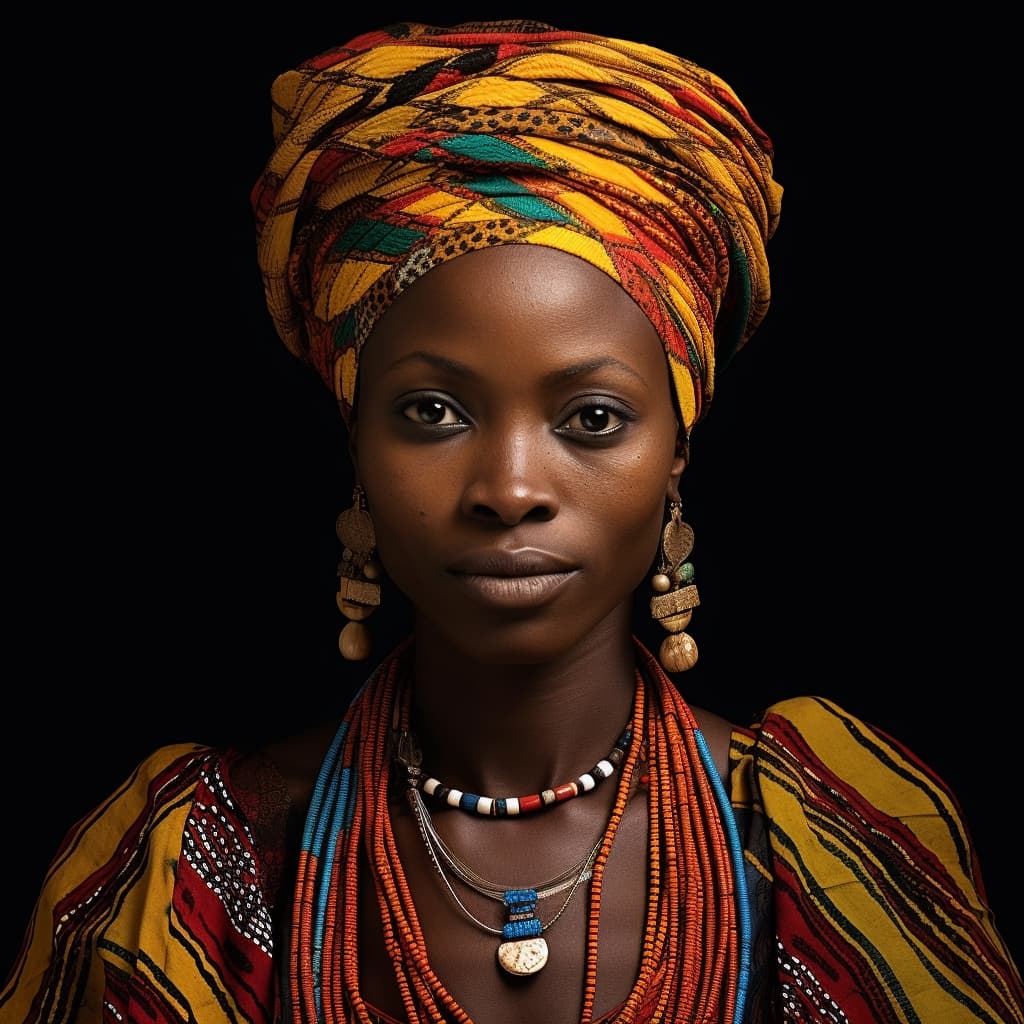
Mbaka Erotic
Central African Republic, Democratic Republic of the Congo
Niger–Congo / Ubangian / Mbaka
Christianity / Catholicism
Central Africa
About Mbaka People
The Mbaka are a Ubangian-speaking people of the forested borderlands where the Central African Republic meets the northern Democratic Republic of the Congo, concentrated in the Lobaye region around towns like Mbaïki and M'Baïki. Their language sits inside the Ubangian branch of Niger–Congo — a cluster that runs along the Ubangi River and includes Banda, Gbaya, and Zande — and although Sango functions as the everyday lingua franca across the CAR, Mbaka holds on at home and in the village, especially among elders and in agricultural life. They are not a numerically large group, but they have had outsized political weight in the country's modern history.
The Mbaka homeland is rainforest country broken by clearings: cassava, plantain, coffee, and palm oil shape the working year, and the forest itself supplies game, building material, and the raw caterpillars and mushrooms that remain a serious part of the diet rather than a curiosity. Catholicism took deep root here under French and Spiritan missionary work in the late nineteenth and early twentieth centuries, and it became the dominant religious frame for most Mbaka families — though, as elsewhere in the region, that frame coexists with a much older substratum of ancestor-respect, forest spirits, and ritual specialists whose role is more felt than advertised. Sunday Mass and the village healer are not understood as contradictions; they answer different questions.
Politically, the Mbaka are the group from which two of the CAR's defining post-independence figures emerged — Barthélemy Boganda, the priest-turned-nationalist who envisioned a federated central African state before dying in a 1959 plane crash, and Jean-Bédel Bokassa, his nephew, whose 1976 self-coronation as emperor became one of the more theatrical episodes of the post-colonial era. The two men sit awkwardly in the same lineage, and Mbaka self-understanding tends to claim Boganda warmly and treat Bokassa with more complicated feelings.
Social life leans on extended kinship and on the village as the operative unit; marriage practices historically involved bridewealth negotiated between families, and naming, mourning, and initiation still carry weight even in households that would describe themselves as straightforwardly Catholic. Mbaka identity today is less about isolation than about a particular position — a small forest people whose language, faith, and history have all been shaped by the Ubangi corridor and by the unusual political prominence the group has carried out of it.
Typical Mbaka Phenotypes
Reference for AI generation — hair, eyes, skin, facial structure, build
The Mbaka are a Central African Ubangian-speaking population concentrated in the Lobaye region of the southwestern Central African Republic and across the Ubangi River into the northwestern Democratic Republic of the Congo. Their phenotype sits within the broader Central African forest-margin cluster: deeply pigmented skin, tightly coiled hair, and the relatively gracile facial build that distinguishes Ubangian agriculturalists from their Bantu neighbors to the south and the Sara and Chadic groups to the north.
Hair is uniformly black and tightly coiled — Type 4B to 4C in the standard typing, with a dense, springy texture that holds shape when cut close and shrinks dramatically when dry. Graying tends to come late and stays sparse into middle age. Eyes are dark brown to near-black, almond-shaped with a clean upper-lid crease and no epicanthic fold; the brow ridge is moderate, set above eyes that read as wide-set rather than deep.
Skin tone clusters in the Fitzpatrick V–VI range, typically a deep warm brown with reddish or olive undertones rather than the cooler blue-black seen in some Nilotic populations. Sun exposure is steady year-round near the equator, so tone is consistent across the body with little seasonal shift. The nose is moderately broad with a low-to-medium bridge and rounded tip; alar width is generous but not as flared as in some forest-zone neighbors. Lips are full on both upper and lower, with a defined cupid's bow. Cheekbones sit medium-high, jawline is rounded rather than angular, and the overall facial impression is softer and more open than the elongated structure typical of Sahelian groups further north.
Build runs medium — adult men commonly fall around 168–172 cm, women around 158–162 cm — with proportionate limbs, a tendency toward lean muscularity in younger adults, and broader hip and bust development in women that holds through adulthood. The Lobaye-side population shows slightly shorter average stature and rounder facial features than Mbaka communities on the DRC side, who blend visibly with neighboring Ngbaka and Mongo phenotypes.
Data depth
0/100Coverage of image-grounded phenotype observations · drives AI generation diversity
- Sample size
- 0/40· 0 images
- Image quality
- 0/30· 0% high
- Confidence
- 0/20
- Source diversity
- 0/10
- ·No image observations yet
Explore phenotype categories
Structured taxonomy with peer-reviewed scales · 22 anatomical categories
Generate Mbaka AI Content
Use this ethnicity's phenotype data to create AI-generated content with accurate physical traits and cultural context.
Open Creator Studio