Masa Erotic
Cameroon, Chad
Afroasiatic / Chadic / Masana
Christianity, Islam[1]
Central Africa
About Masa People
The Masa live along the Logone River where it braids the border between Cameroon and Chad — a flat country of seasonal floodplains, fishing camps, and millet fields that vanish under water for part of the year and reappear cracked and dusty for the rest. They organize their world around that rhythm. Cattle move, settlements move, and a substantial portion of social life is timed to whether the river is rising or falling.
Their language, Masana, belongs to the Chadic branch of Afroasiatic — the same wider family that produced Hausa to the west and, much further afield, Arabic and Hebrew. Within Chadic it sits in a cluster of related tongues spoken by neighboring fishing and herding peoples of the Logone-Chari basin, and a Masa speaker can often follow the gist of a Musey or Marba conversation without much effort. Several internal sub-groups exist — Bugudum, Wina, Domo, Walia and others — distinguished mostly by locality and small differences of speech rather than by any sharp cultural break.
The Masa are best known abroad for the guru, a fattening retreat that young men undertake in seclusion, drinking large quantities of milk and red sorghum porridge over weeks or months to emerge visibly heavier. The point is not gluttony. A successful guru is a public statement about a family's cattle wealth, a young man's discipline, and his readiness to be taken seriously, and the return from seclusion is staged as a celebration with dancing and display. The institution has thinned in some areas under economic pressure and missionary disapproval, but it has not disappeared, and it remains the cultural marker most often cited when outsiders write about the Masa at all.
Religious life is layered. Christianity arrived through twentieth-century mission work, mostly Catholic and Lutheran, and Islam pressed in from the north with the trade and political weight of the Lake Chad region; both now claim significant Masa adherents. Underneath both, an older framework persists — ancestral observances, divination, and ritual specialists tied to the river and to particular lineages — and most Masa families negotiate the overlap pragmatically rather than treating the categories as exclusive. The cattle that anchored the old order still anchor much of the new one: bridewealth, prestige, and a great deal of everyday conversation continue to be denominated in head of zebu.
Typical Masa Phenotypes
Reference for AI generation — hair, eyes, skin, facial structure, build
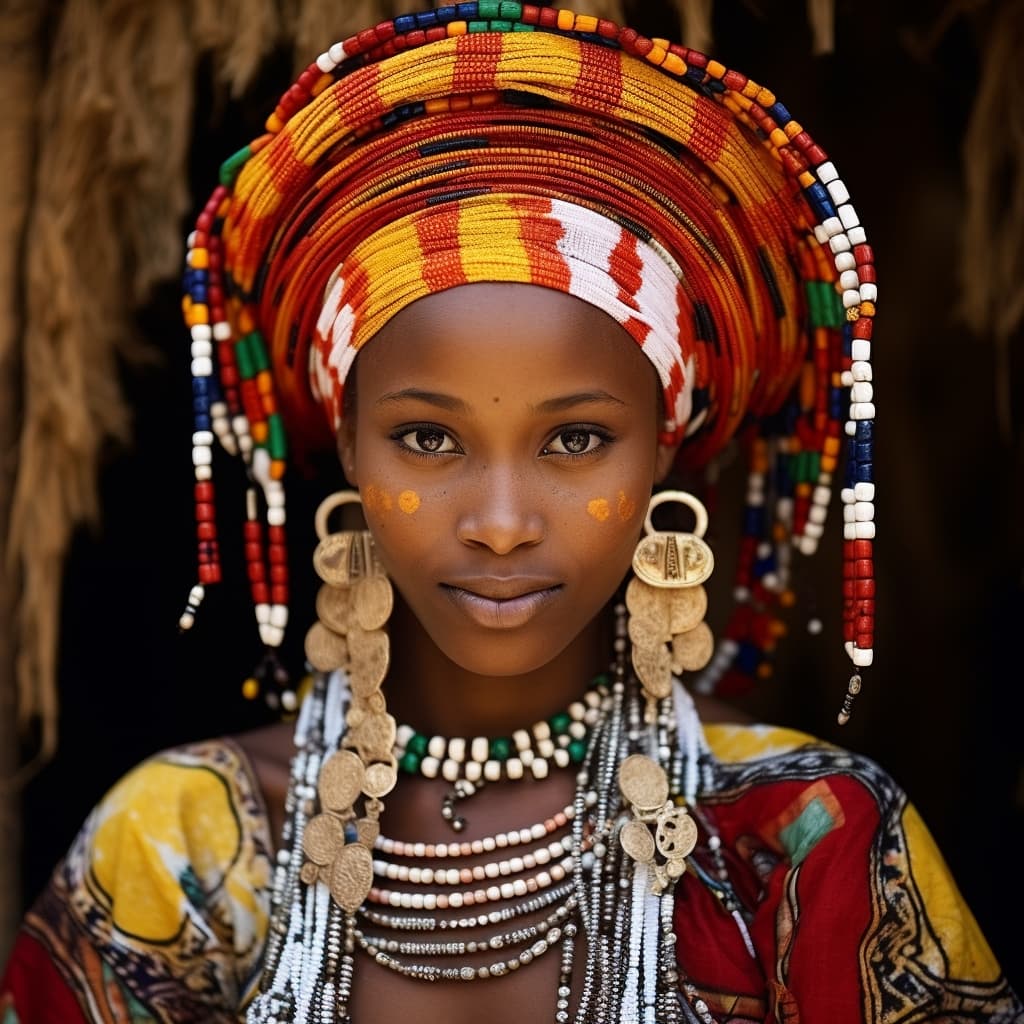
The Masa, settled along the Logone and Chari river floodplains of northern Cameroon and southwestern Chad, sit phenotypically within the tall, lean Sara-Bagirmi cluster of central Africa — closer to their Sara and Mousgoum neighbors than to forest-belt populations further south. The single most documented trait is stature. Adult men routinely stand 180–190 cm with slender, narrow-hipped frames; women trend correspondingly tall and long-limbed. Limb-to-trunk ratios skew long, shoulders are narrow rather than broad, and musculature reads wiry rather than bulky — a build often associated in the older literature with "Nilotic-type" body habitus, though the Masa are linguistically Chadic, not Nilotic.
Skin tone clusters at the deeper end of Fitzpatrick VI, with cool blue-black undertones rather than the red-brown registers common in West African coastal groups. Hair is uniformly Type 4 — tight coils, often kept very short on men and frequently braided, threaded, or sculpted on women. Natural color is jet black with little red or brown variation. Eyes are dark brown to near-black; epicanthic folds are absent, and the eye shape tends to be wide-set with prominent, slightly heavy upper lids.
Facial structure leans toward what anthropologists describe as elongated and narrow rather than broad. Foreheads are tall, cheekbones sit high but flat rather than projecting, and the jaw is firm with a pointed chin more often than a square one. Noses are typically straight-bridged and moderately broad at the nostrils — wider than East African Cushitic groups, narrower than forest-Bantu averages. Lips are full and well-defined, the upper lip often nearly matching the lower in volume.
The Masa proper, the Musey, and the closely related Massana subgroups overlap heavily in appearance. The most visually distinctive Masa practice is guru walla, a traditional male fattening rite in which young men consume vast quantities of milk and sorghum porridge over weeks to gain ceremonial weight — producing a temporarily rounded, soft-bodied physique strikingly at odds with the group's otherwise lean baseline.
Data depth
0/100Coverage of image-grounded phenotype observations · drives AI generation diversity
- Sample size
- 0/40· 0 images
- Image quality
- 0/30· 0% high
- Confidence
- 0/20
- Source diversity
- 0/10
- ·No image observations yet
Explore phenotype categories
Structured taxonomy with peer-reviewed scales · 22 anatomical categories






Generate Masa AI Content
Use this ethnicity's phenotype data to create AI-generated content with accurate physical traits and cultural context.
Open Creator Studio