Marathi Erotic
Maharashtra (India)
Indo-European / Indo-Aryan / Marathi
Hinduism
Mahar, Maratha, Kunbi, Dhangar, Bhoi
Southern Asia
About Marathi People
The Marathi are the people of Maharashtra, the broad shoulder of land where the Deccan plateau meets the Arabian Sea. Roughly 80 million speak Marathi as a first language, which makes it one of the larger languages on earth, though it sits in an awkward seat geographically — Indo-Aryan in family, but pressed up against the Dravidian south, and audibly shaped by that contact. Marathi took loanwords and rhythms from Kannada and Telugu, retained an older Sanskritic vocabulary that Hindi speakers find archaic, and developed its own script, Devanagari written with a distinctive flat horizontal line that locals call shirorekha. A speaker of Hindi will catch perhaps half of a Marathi conversation and confidently mistranslate the rest.
The group's self-image is bound up with the seventeenth century — specifically with Shivaji Bhonsle, who carved a Maratha kingdom out of the Deccan in defiance of the Mughals and built a navy on a coast that had been considered indefensible. The Maratha Confederacy that followed him eventually controlled most of the Indian subcontinent before losing it to the British in 1818. That history is not abstract. It still shapes regional politics, the iconography on government buildings, the names parents give their sons, and the way Maharashtrians talk about themselves relative to the rest of India: capable, martial, slightly outside the mainstream.
Internally the group is layered by caste and occupation rather than by region, and the sub-group names reflect that older social architecture. Maratha proper were the warrior-cultivator class that supplied the kingdom's officers; Kunbi are the closely-related farming caste, and the line between the two has been politically contested for generations. Dhangar are pastoralists, traditionally shepherds of the dry uplands. Bhoi were boatmen and palanquin-bearers along the rivers and coast. Mahar, historically placed at the bottom of the caste order, produced B.R. Ambedkar — the jurist who drafted India's constitution and led a mass conversion of Mahars to Buddhism in 1956, which is why pockets of Maharashtra are now Buddhist rather than Hindu in a country where that is unusual.
Religious life for most Marathi is Hindu and weighted toward the bhakti tradition: devotional poetry in the vernacular rather than priestly ritual in Sanskrit. The pilgrimage to Pandharpur, where worshippers walk for weeks behind palanquins carrying the sandals of medieval saint-poets, is the cultural event the calendar bends around. Ganesh Chaturthi — now a national festival — was reinvented as a public, street-level affair in Pune in the 1890s as a way of organising politics under colonial rule. It has stayed political, and stayed Maharashtrian, ever since.
Typical Marathi Phenotypes
Reference for AI generation — hair, eyes, skin, facial structure, build
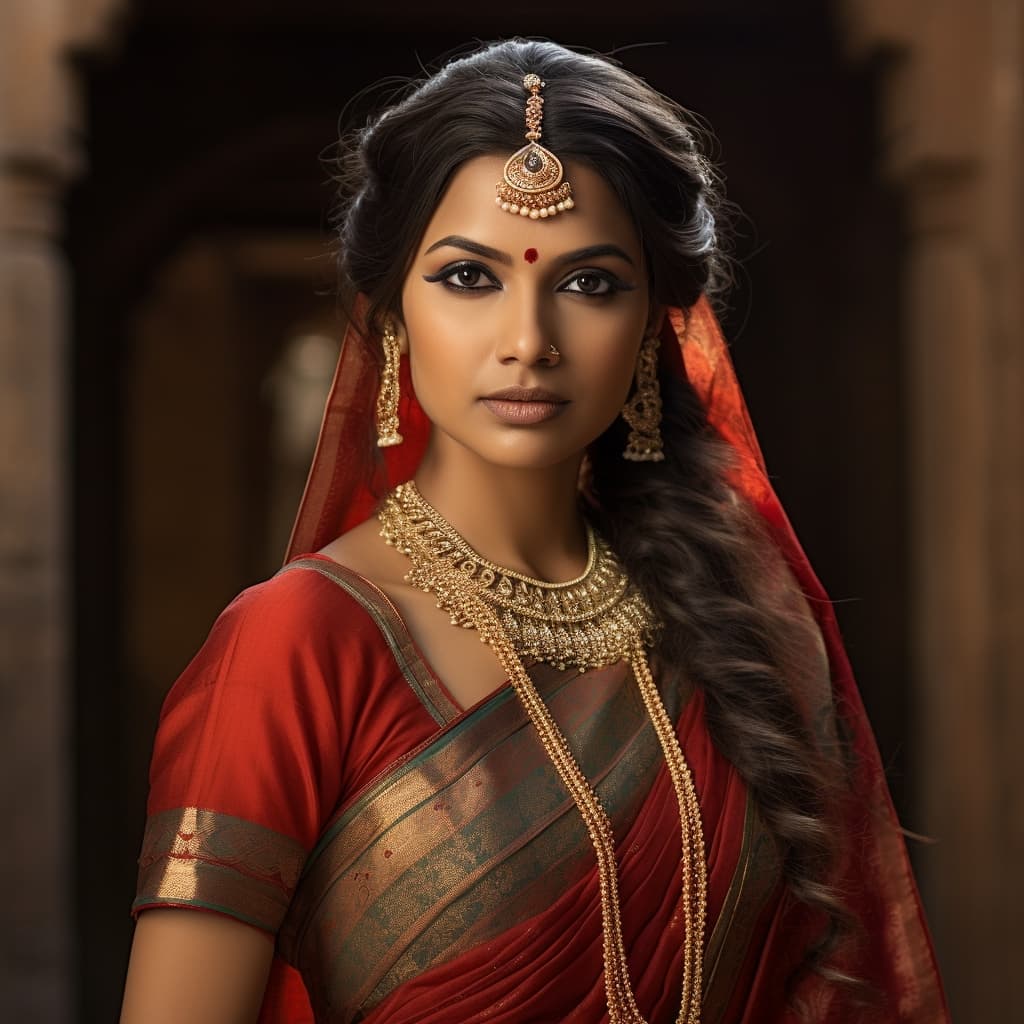
Marathi phenotype sits in the western Deccan stream of South Asian variation — broadly Indo-Aryan with a strong Dravidian substrate, producing a population that is visibly browner-skinned than Punjabi or Kashmiri groups to the north but lighter on average than coastal Tamil or Malayali populations to the south. The signature impression is medium-brown skin with warm olive-to-bronze undertones, dark eyes, and dense black hair — uniform enough that variation within the group reads in skin depth and facial structure rather than coloring.
Hair is near-universally black to very dark brown, thick-shafted, and ranges from pin-straight to loose wave; tight curl is uncommon but not rare in coastal and Konkan-adjacent lineages. Eyes are dark brown to near-black, almond-shaped, with no epicanthic fold and typically thick, dark lashes; lighter brown irises appear occasionally and hazel is genuinely unusual. Skin spans Fitzpatrick III to V — the Maratha and Kunbi agrarian core trends III–IV with a yellow-olive undertone, while Mahar and Bhoi populations skew IV–V with warmer red-brown undertones, and Dhangar pastoralists from the Sahyadri uplands often present a weathered tan over an originally lighter base.
Facial structure is moderately angular: nose bridges run from straight-medium to a pronounced aquiline arch (the classic Deccan profile seen in historic Yadava-era portraiture), alar width stays narrow-to-moderate, and lips are medium-full with a slightly fuller lower lip. Cheekbones are present but rarely high-set in the East Asian sense; jawlines are oval-to-square in men, softer and more tapered in women.
Build leans wiry-to-medium — Marathi men average around 165–170 cm, women 152–157 cm, with lean musculature and narrow hips; the bodybuilder Sangram Chougule represents a hypertrophied extreme rather than the norm. Dhangar and Maratha rural lineages tend toward broader shoulders and stockier frames from generations of pastoral and agricultural labor, while urban Brahmin-adjacent and Mahar populations more often present the slighter, finer-boned build common across the western Deccan.
Data depth
56/100Coverage of image-grounded phenotype observations · drives AI generation diversity
- Sample size
- 30/40· 25 images
- Image quality
- 16/30· 32% high
- Confidence
- 10/20· mean 0.66
- Source diversity
- 0/10· wikipedia
- ·Wikipedia-only source — not population-representative
Observed Distribution — Image Sample
Empirical observations from analyzed photographs · supplementary signal, not population truth
Sample: 25 images analyzed (25 wikipedia). Quality: 8 high, 10 medium, 6 low, 1 very_low. Avg analyzer confidence: 0.66.
Skin tone (Fitzpatrick): III (8%), IV (32%), V (48%), unclear (12%)
Hair color: black (68%), gray/white (24%), unclear (8%)
Hair texture: straight (72%), wavy (20%), unclear (8%)
Eye color: dark brown (84%), unclear (16%)
Epicanthic fold: 8% present, 80% absent, 12% unclear
Caveats: Sample is 100% Wikipedia notable people — skews toward male, public-life, and modern figures, not population-representative.
Last aggregated: May 7, 2026
Explore phenotype categories
Structured taxonomy with peer-reviewed scales · 22 anatomical categories
Notable Marathi People
48 reference figures — sourced from Wikipedia
- Arikesarin — a.k.a. Keshideva I
- Bhillama — a.k.a. Bhillamadeva
- Simhana — a.k.a. Singhaṇadeva
- Krishna — a.k.a. Kānharadeva
- Rāmachandra — a.k.a Rāmadeva
- Brigadier — John Dalvi
- Hemadri — a.k.a. Hemāḍi Panḍita or Hemāḍapanta
- D. R. Bendre — Considered as the greatest Kannada lyric poet of the 20th century.
- Gajanan Madhav Muktibodh — One of the pioneers of modern Hindi poetry.
- Kaloji Narayana Rao — One of the greatest Telugu poets. His birth anniversary is celebrated as Tela…
- Madhavrao Sapre — Writer and journalist in Hindi
- Aditi Mutatkar — Badminton
- Anjali Bhagwat — Shooter
- Ashish Mane — Mountaineer
- Brahmanand Sankhwalkar — Footballer
- Damayanti Tambay — Badminton
- Krushnaa Patil — Mountaineer
- Mahesh Gawli — Footballer
- Nandu M. Natekar — Badminton
- Nikhil Kanetkar — Badminton
- Rahi Sarnobat — Shooter
- Raju Gaikwad — Footballer
- Ramchandra Parab — Footballer
- Sameer Naik — Footballer
- Tejaswini Sawant — Shooter
- Tushar Khandekar — Field hockey
- Harsha Bhogle — Commentator
- Meghana Erande — Voice artist
- Shridhar Chillal — Longest fingernails
- Savitri Khanolkar — Designer of PVC
- Arundhati Pantawane — Badminton
- Tanvi Lad — Badminton
- Sundeep Waslekar — Strategic Foresight Group
- Jyoti Amge — Smallest women
- Bhimrao Kesarkar — Silver medalist in men's javelin at Summer Paralympics 1984
- Sangram Chougule — Bodybuilding
- Sunil Jadhav — Bodybuilding
- Leo Varadkar — Ireland P.M
- Zulekha Daud — UAE's first Woman Doctor
- Arun Gawli — Indian gangster turned politician
- Dawood Ibrahim Kaskar — Indian crime lord and terrorist who was founder of D-company.
- Shabir Ibrahim Kaskar — Indian gangster
- Rajendra Sadashiv Nikalje — often known as Chota Rajan), Indian gangster
- Maya Dolas — Indian gangster and former member of D-company
- Manya Surve — Indian gangster
- Dilip Buwa — Indian gangster and sharpshooter
- Ravi Pujari — Indian gangster and extortionist
- Chota Shakeel — Indian gangster and lieutenant of Dawood Ibrahim.
Generate Marathi AI Content
Use this ethnicity's phenotype data to create AI-generated content with accurate physical traits and cultural context.
Open Creator Studio