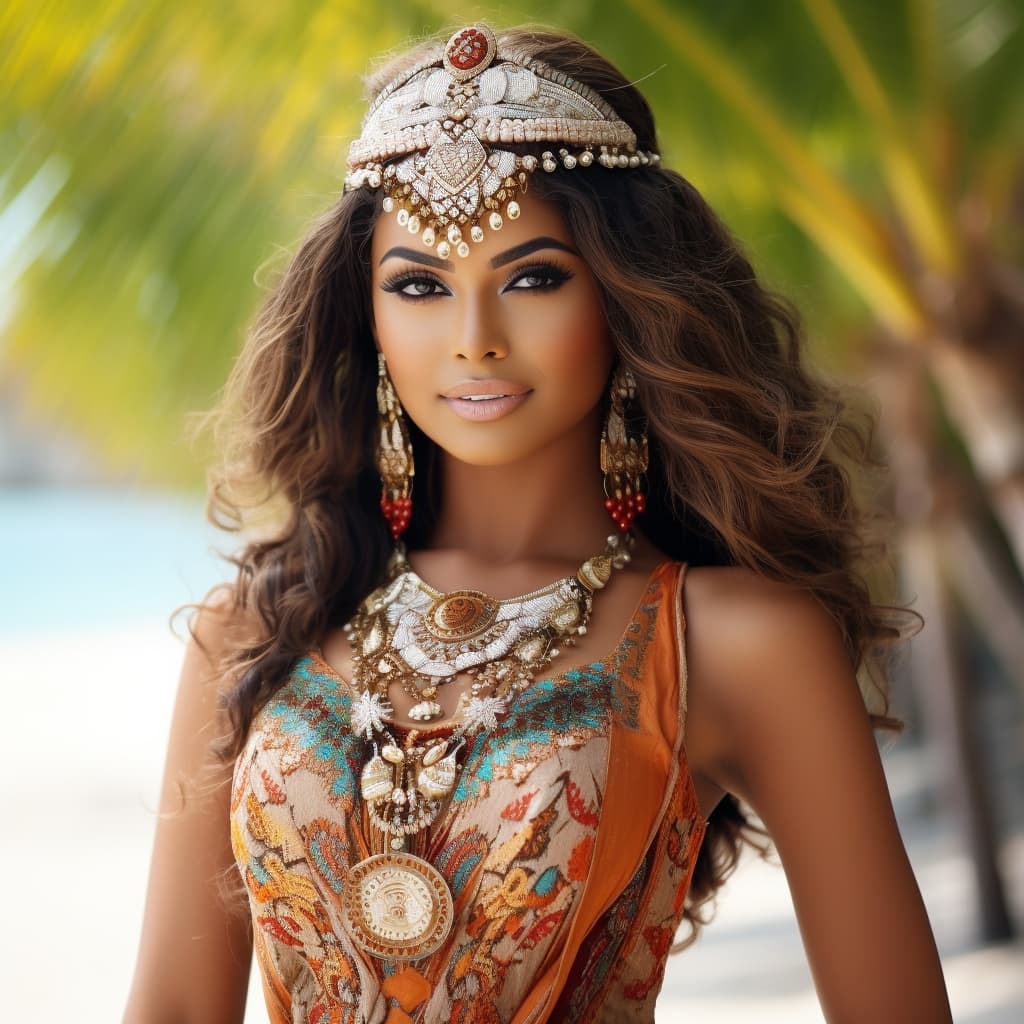
Maldivians Erotic
Maldives, Minicoy
Indo-European / Indo-Aryan / Maldivian
Islam / Sunni Islam
Mahls
Southern Asia
About Maldivians People
Maldivians are the people of a country that is mostly water. Their homeland is a chain of roughly 1,200 coral islands strung across some 800 kilometers of the Indian Ocean, grouped into 26 natural atolls — and almost none of it sits more than a meter or two above sea level. That fact shapes everything: settlement patterns, diet, architecture, the long maritime reach of Maldivian traders, and the political anxieties of the present. A separate community, the Mahls of Minicoy, lives on the northernmost island of the chain, which Indian administration placed in Lakshadweep rather than the Maldives proper; they remain culturally and linguistically Maldivian, with their own dialect, Mahl.
The language, Dhivehi, is Indo-Aryan — a southern offshoot of the same family that produced Sinhala, with which it shares its closest kinship — and it is written in Thaana, a script that runs right to left and was devised locally in the sixteenth century, partly to incorporate Arabic letters for religious vocabulary. Thaana is unusual among world scripts for having been deliberately invented rather than evolved. Dhivehi has noticeable dialect variation between atolls; the southern atolls in particular speak forms that other Maldivians find hard to follow.
Islam arrived in 1153, when the last Buddhist king converted, and the country has been Sunni Muslim ever since — officially and constitutionally so. Religion is woven tightly into civil life: citizenship is restricted to Muslims, the Friday prayer organizes the working week, and the older Buddhist and Hindu layers of Maldivian history survive mainly in archaeology and in loanwords. Before conversion the islands had been a node on Indian Ocean trade routes for over a millennium, exporting cowrie shells — used as currency from West Africa to China — and coir rope, which Arab and later European mariners considered the best in the world for rigging.
Day-to-day Maldivian life still runs on the sea. Skipjack tuna, caught pole-and-line in a fishery that remains one of the most sustainable in the world, is the staple protein, dried and smoked into rihaakuru and valhoa mas. The traditional dhoni, a curved-prow wooden boat, has been motorized but not replaced. Rising sea levels are not an abstract concern here; they are a national-survival question, and Maldivian diplomats have spent two decades making that case in forums that were not, originally, listening.
Typical Maldivians Phenotypes
Reference for AI generation — hair, eyes, skin, facial structure, build
Maldivians sit at a phenotypic crossroads — a small island population shaped by Sinhalese and South Indian (Tamil/Malayali) settlement, layered with Arab, East African, and Southeast Asian admixture from a thousand years of Indian Ocean trade. The result reads as recognizably South Asian but consistently darker and more maritime-looking than mainland Sinhalese, with a coastal slimness that distinguishes them from Dravidian neighbors to the north.
Hair is almost uniformly black or very dark brown, thick, and ranging from straight to loosely wavy. A meaningful minority — particularly in southern atolls with stronger African and Arab trade contact — show tighter waves or soft curls. Premature graying is uncommon; hair typically stays dense into middle age. Eyes are dark brown to near-black, with hazel or lighter shades very rare and usually pointing to recent foreign ancestry. Eyelids are typically open and almond-shaped without an epicanthic fold; brows are dark and well-defined.
Skin tone clusters in Fitzpatrick IV–V — warm olive-brown to deep brown — with golden or reddish undertones from constant equatorial sun exposure. True Type VI is uncommon but appears in southern atoll populations. Year-round UV exposure means most adults read several shades darker than their unexposed skin, and the contrast between covered and exposed areas is pronounced.
Facial structure tends toward soft features: medium-bridged noses with moderate alar width — narrower than typical South Indian, broader than Sinhalese — full but not heavy lips, and rounded rather than angular jaws. Cheekbones are moderate. The overall facial impression is gentler and rounder than Tamil phenotypes.
Build is consistently slim and small-framed. Average male stature sits around 5'5"–5'7", female around 5'1"–5'3" — among the shorter populations in South Asia. Body composition trends lean and wiry, historically shaped by a fish-and-coconut diet and seafaring life, though urbanization on Malé has shifted this toward heavier builds in younger generations. The Mahls of Minicoy are essentially indistinguishable phenotypically from southern-atoll Maldivians.
Data depth
53/100Coverage of image-grounded phenotype observations · drives AI generation diversity
- Sample size
- 3/40· 1 image
- Image quality
- 30/30· 100% high
- Confidence
- 20/20· mean 0.88
- Source diversity
- 0/10· wikipedia
- ·No image observations yet
- ·Wikipedia-only source — not population-representative
Explore phenotype categories
Structured taxonomy with peer-reviewed scales · 22 anatomical categories
Notable Maldivians People
1 reference figure — sourced from Wikipedia
- Abdulla Shamaal — Major General Abdulla Shamaal






Generate Maldivians AI Content
Use this ethnicity's phenotype data to create AI-generated content with accurate physical traits and cultural context.
Open Creator Studio