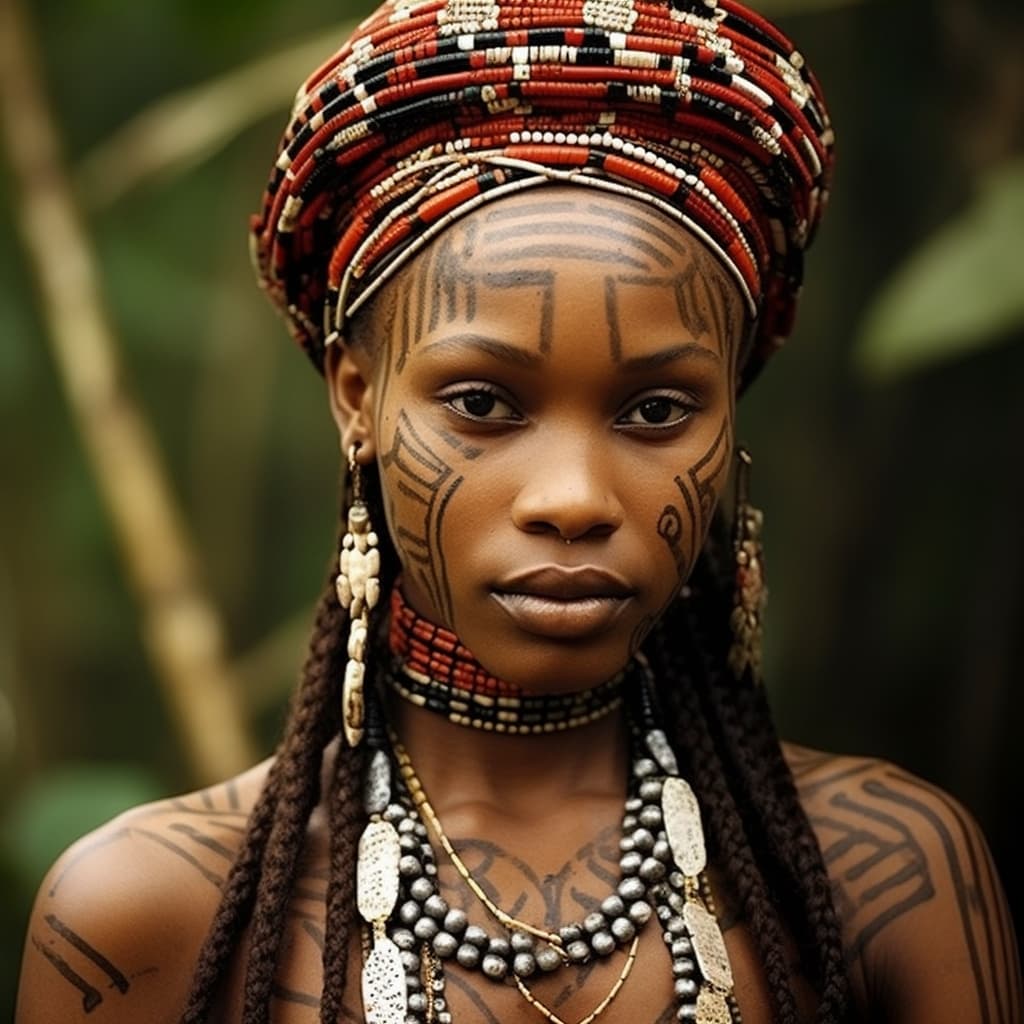
Lega Erotic
Democratic Republic of the Congo
Niger–Congo / Bantu / Lega
Traditional African religions
Central Africa
About Lega People
The Lega live in the dense forests of eastern Democratic Republic of the Congo, west of Lake Tanganyika, in the rugged country between the Lualaba and Elila rivers. They are sometimes called Warega or Balega in older sources. Their language, Kilega, sits within the Bantu branch of Niger–Congo and shares the linguistic neighborhood with Bembe and Songola peoples to the south and east. The terrain — broken hills, river valleys, equatorial forest — has historically kept Lega communities decentralized; there is no historical Lega kingdom, no paramount chief. Authority instead runs through lineage elders and, more decisively, through a ranked initiation society called Bwami.
Bwami is the organizing fact of Lega life, and it is what most distinguishes them from their neighbors. It is not a secret society in the conspiratorial sense but a graded school of ethics, open in principle to most adult men and, in a parallel structure, to their wives. A member ascends through ranks by demonstrating moral character, sponsoring feasts, and absorbing the proverbs and aphorisms attached to each level. The society is the reason for the carved ivory and wooden figures, masks, and small spoons that ended up in European museums after the colonial era — these were not idols or decorations but teaching objects, each one tied to a specific maxim about greed, restraint, kinship, or self-control. Stripped of their proverbs, the objects lose most of what they were for, which is part of why so much published commentary on Lega art misses the point.
Religion in the older sense is woven through this rather than sitting beside it. Lega cosmology recognizes a distant creator (Kaginga or Kalaga, depending on locality) and a more immediate world of ancestors whose approval matters for ordinary affairs. Diviners are consulted for illness and misfortune. Christianity and Islam have made inroads, especially in towns and along trade routes, but Bwami has shown unusual resilience even where formal religious affiliation has shifted.
The twentieth century was hard on the Lega. Belgian colonial authorities banned Bwami in the 1920s, fearing its hold on rural life; it survived underground and revived after independence. The wars that swept eastern Congo from the mid-1990s onward — Mobutu's fall, the two Congo Wars, the long aftermath of armed groups in the Kivus and Maniema — disrupted villages, displaced families, and damaged the slow apprenticeship that Bwami requires. The society persists, more quietly than before, in the same forests.
Typical Lega Phenotypes
Reference for AI generation — hair, eyes, skin, facial structure, build
The Lega are a Bantu forest people of the eastern DRC, concentrated in Maniema between the Lualaba River and the Mitumba range. Their phenotype reads as classic Central African forest-Bantu, shaped by generations in dense equatorial canopy rather than savanna or highland environments — generally less elongated than Nilotic neighbors to the east, less robust than Cushitic-influenced groups further north.
Hair is dark brown to true black, tightly coiled Type 4B–4C, dense and low-shrinkage, traditionally worn close-cropped or in compact braided patterns. Premature graying is uncommon; coppery sun-bleaching at the tips appears in those who work outside the forest cover. Eyes sit dark brown to near-black, almond-shaped with a clean upper lid and no epicanthic fold. The brow ridge is moderate — present but not heavy — and the orbits read open rather than deep-set.
Skin tone runs Fitzpatrick V to VI, deep brown through warm black-brown, with red-mahogany undertones rather than the cooler blue-black common in drier-climate Nilotic populations. The forest environment limits the bleached-shoulder/dark-extremity contrast you see in pastoralists; tone tends to be even across the body.
The Lega face is typically broad through the cheekbones with a softer, rounder jaw than the long oval common to Tutsi or Maasai populations. Noses are short to medium with a low, flat bridge and broad alar base — platyrrhine in classification. Lips are full on both upper and lower, with a pronounced philtrum and a defined vermilion border. Foreheads are vertical and unprojecting.
Stature is moderate — adult men typically 165–172 cm, women 155–162 cm — shorter than the cattle-keeping peoples of the Great Lakes corridor and noticeably so than the Tutsi. Build is mesomorphic and proportional, with strong shoulders, a relatively short trunk, and well-developed calves; body fat distribution in women is gluteofemoral, with full hips and thighs over a narrower waist. Hands and feet are proportionally smaller than in taller East African groups, an anthropometric pattern shared across the forest-Bantu belt.
Data depth
0/100Coverage of image-grounded phenotype observations · drives AI generation diversity
- Sample size
- 0/40· 0 images
- Image quality
- 0/30· 0% high
- Confidence
- 0/20
- Source diversity
- 0/10
- ·No image observations yet
Explore phenotype categories
Structured taxonomy with peer-reviewed scales · 22 anatomical categories






Generate Lega AI Content
Use this ethnicity's phenotype data to create AI-generated content with accurate physical traits and cultural context.
Open Creator Studio