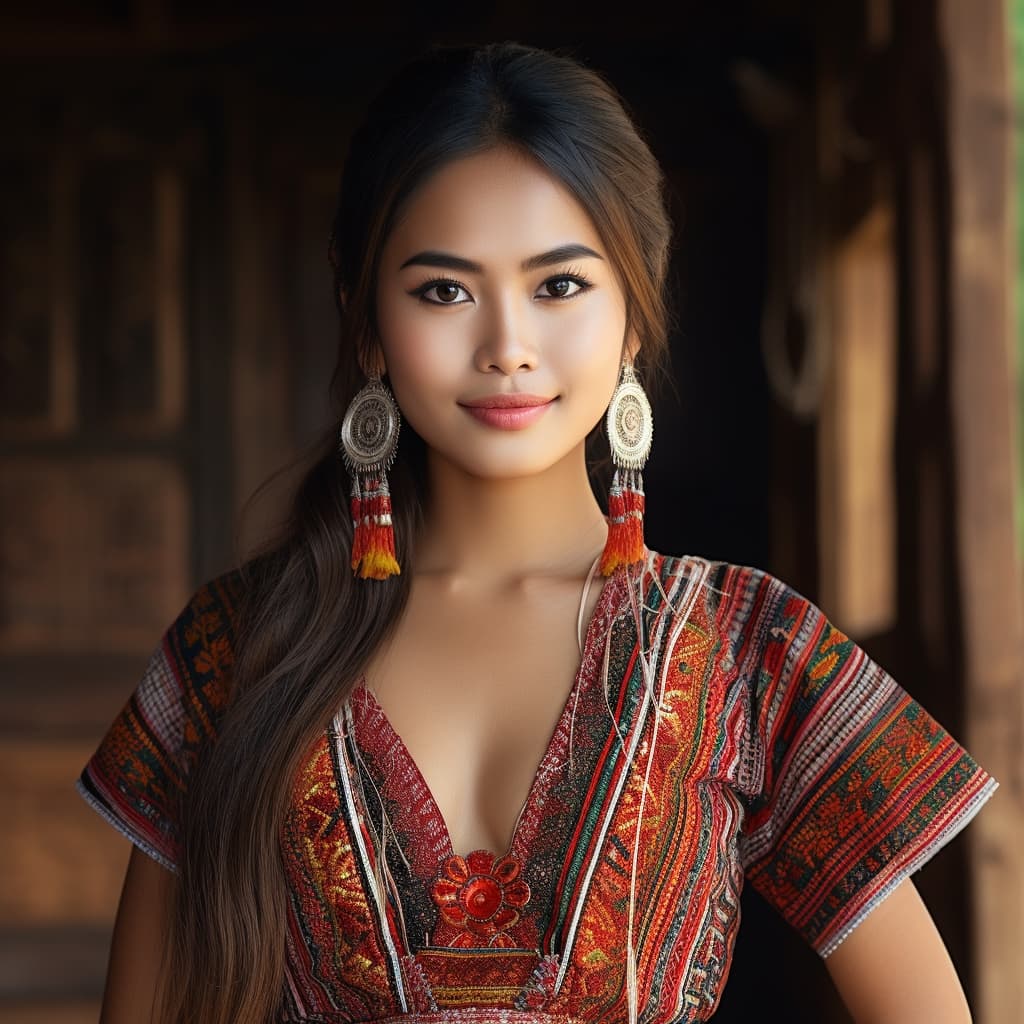
Lao Erotic
Laos
Kra–Dai / Tai / Lao
Buddhism / Theravada Buddhism
Southeast Asia
About Lao People
The Lao are the lowland majority of Laos and a significant minority across the Mekong's right bank in northeastern Thailand, where the region of Isan holds more ethnic Lao than Laos itself. They identify themselves less by the modern political border than by the river, the wet-rice plain, and the Tai-speaking village world that runs from Luang Prabang down through Vientiane and across into Ubon and Udon. Their language sits in the Kra–Dai family alongside Thai, Shan, and Zhuang; a Lao speaker and a northeastern Thai speaker understand each other without effort, while a Lao speaker and a Bangkok Thai speaker manage with adjustments. The script is its own — rounder, fewer letters than Thai, descended from the same Khmer-derived ancestor but simplified during the twentieth century.
Theravada Buddhism is the organizing frame of Lao life, layered over an older spirit-cult called satsana phi that no amount of monastic reform has dislodged. Households keep spirit shrines; villages keep guardian spirits; the baci ceremony, in which white cotton threads are tied around the wrists to bind the thirty-two souls of the body back into place, is performed at weddings, departures, recoveries from illness, and the welcoming of guests. Monks are central — most Lao men ordain at least briefly — but the spirit world is what people actually negotiate with day to day. Pi Mai, the April new year, drenches the country in water for three days and resets the religious calendar.
The Lao proper are usually distinguished from the upland Tai groups (Lao Theung and Lao Sung in older state taxonomy — Khmu, Hmong, Mien, and others), and within the lowland Lao there are regional branches: Lao Loum of the central plains, Lao Phuan around Xieng Khouang, Lao Wiang around Vientiane. The country's modern shape was forged by the eighteenth-century breakup of the Lan Xang kingdom into rival principalities, then by a century of French protectorate, then by the longest and most heavily bombed civil war of the Cold War era — a fact that still structures rural land use, since unexploded ordnance remains in the soil. Lao culinary identity is built on sticky rice eaten by hand, fermented fish sauce padaek, and laap, a minced-meat salad sharp with lime, chili, and toasted rice powder; the food travels with the diaspora and is one of the clearest cultural markers abroad.
Typical Lao Phenotypes
Reference for AI generation — hair, eyes, skin, facial structure, build
Lao phenotype reads as a softer, more rounded variant of mainland Southeast Asian features, distinct from the sharper bone structure of neighboring Vietnamese and the often taller, leaner Thai of the central plains. The lowland Lao Loum — the dominant Tai-speaking majority along the Mekong — anchors the central type, while upland Lao Theung (Mon-Khmer-speaking) and Lao Sung (Hmong-Mien and Tibeto-Burman highland groups) introduce visible variation that the catch-all label "Lao" tends to flatten.
Hair is uniformly black to very dark brown, thick, coarse in texture, and almost always straight to gently wavy — curl is rare and usually points to highland or mixed ancestry. Greying tends to come late. Eyes range from medium to dark brown, with near-universal epicanthic folds and a single eyelid (monolid) pattern more common than double-lid creases, though double lids are far from unusual. Eye shape tends toward almond with a slight upward outer canthal tilt.
Skin sits in the Fitzpatrick III–IV range for most lowlanders, leaning warm-olive to light golden-brown with yellow undertones; rural and farming populations along the Mekong run noticeably darker from sun exposure. Lao Sung highlanders, particularly Hmong, often present lighter — closer to Fitzpatrick II–III — with cooler undertones and occasionally rosier cheeks.
Facial structure is the giveaway: relatively flat midface, low to medium nasal bridge with a rounded tip and moderately wide alae, full but not heavy lips, and a softer, more oval jawline than the more angular Khmer or Vietnamese norms. Cheekbones are present but blend into the face rather than projecting sharply.
Build skews short and slight. Adult male stature averages around 162–165 cm and female around 152–155 cm — among the shorter averages in the region. Frames are slender with narrow shoulders and hips, low body-fat tendency in younger adults, and a torso-to-leg ratio that runs slightly long-torso, short-leg. Highland Hmong and Khmu populations tend to be even more compact and stockier through the chest and thighs than the lowland Lao Loum.
Data depth
0/100Coverage of image-grounded phenotype observations · drives AI generation diversity
- Sample size
- 0/40· 0 images
- Image quality
- 0/30· 0% high
- Confidence
- 0/20
- Source diversity
- 0/10
- ·No image observations yet
Explore phenotype categories
Structured taxonomy with peer-reviewed scales · 22 anatomical categories






Generate Lao AI Content
Use this ethnicity's phenotype data to create AI-generated content with accurate physical traits and cultural context.
Open Creator Studio