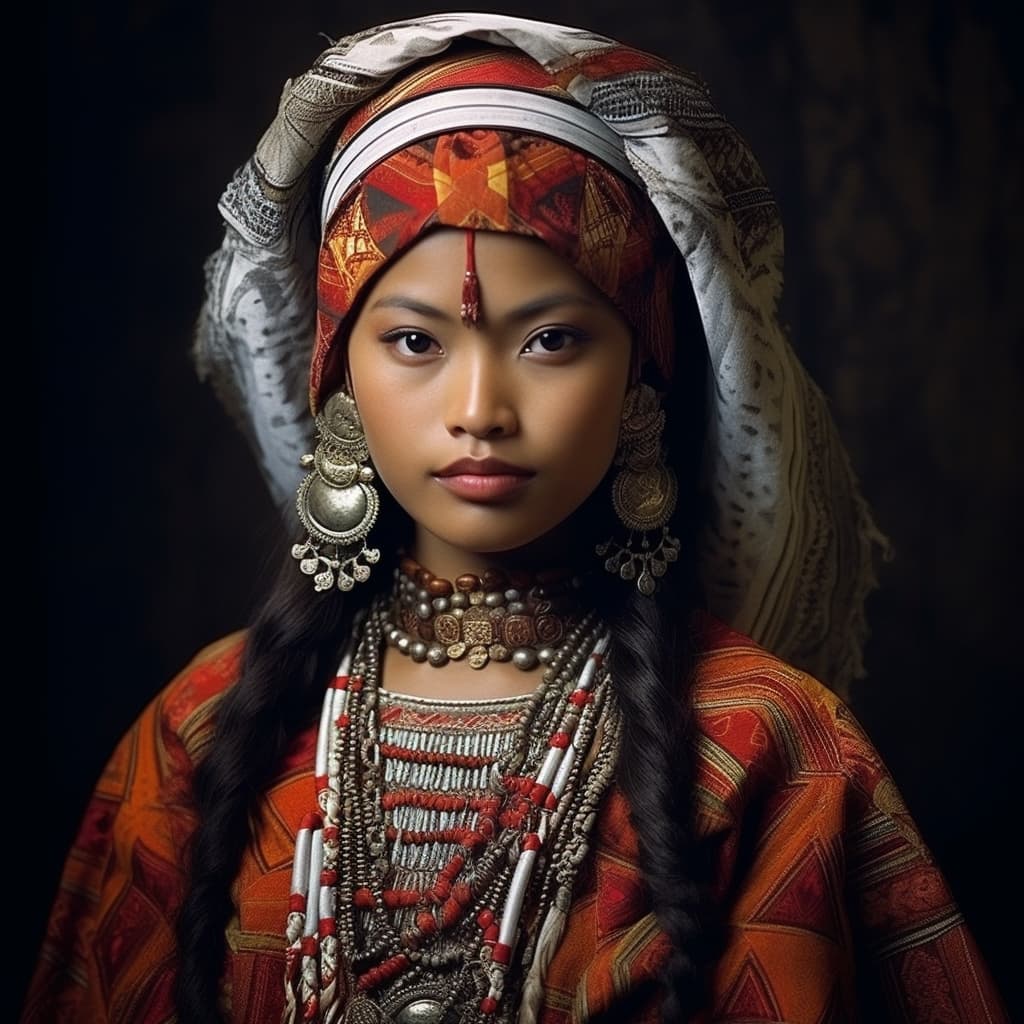
Lamaholot Erotic
Solor (Indonesia)
Austronesian / Flores–Lembata / Lamaholot
Christianity / Catholicism
Southeast Asia
About Lamaholot People
The Lamaholot are the people of the eastern tip of Flores and the small volcanic islands strung out beyond it — Adonara, Solor, Lembata — where the land runs out of Indonesia and the Banda Sea begins. They are not a single tribe so much as a constellation of related communities sharing a language and a way of reading the sea, divided historically into rival confederacies (the Demon and the Paji) whose old alliances still flicker through village politics and ceremony. The homeland is steep, dry, and volcanic; villages cling to slopes that fall straight into deep water, and most settlements have a foot on the beach and another in the gardens above.
The language, also called Lamaholot, sits inside the Flores–Lembata branch of Austronesian, but linguists have spent decades arguing over how Austronesian it really is. The grammar carries unusual features — clusivity distinctions, a heavy non-Austronesian substrate in the vocabulary — that suggest an older Papuan-affiliated population was absorbed rather than displaced when seafarers arrived from the west. There are perhaps a dozen mutually difficult dialects across the island chain, and speakers from opposite ends of the territory often switch to Indonesian to be sure of each other.
Catholicism arrived with the Portuguese in the sixteenth century, took deep root through Dominican missions on Solor, and survived the Dutch takeover largely intact; the Lamaholot are now overwhelmingly Catholic, and Holy Week processions on the islands — particularly the centuries-old Semana Santa at Larantuka — draw pilgrims from across Indonesia. But the older religion has not been overwritten so much as folded in. Ancestors are addressed at household altars, the volcano is treated as a presence with moods, and ritual specialists still preside over agricultural cycles alongside the parish priest.
The Lamaholot are best known abroad through the village of Lamalera on Lembata, where men hunt sperm whales from open wooden boats with hand-thrown harpoons — a subsistence whale fishery that predates contact and is regulated by lineage rights, not licenses. It is an outlier even within Lamaholot life, but it is emblematic of the wider pattern: small communities living off a difficult coast, organized by clan and obligation, balancing a Catholicism that is genuinely theirs against ritual practices that are older than any church.
Typical Lamaholot Phenotypes
Reference for AI generation — hair, eyes, skin, facial structure, build
The Lamaholot of Solor, Adonara, Lembata, and easternmost Flores sit on a phenotypic seam where Austronesian and Melanesian-Papuan ancestry meet, and their appearance reflects that mixing more visibly than most island Southeast Asian groups. Hair is overwhelmingly black, but the texture range is the giveaway — coarse straight hair sits alongside genuinely wavy and tightly curled hair within the same village, sometimes the same family. Children often show looser curls that tighten with age. Sun-bleached red-brown tips are common in fishing communities.
Eyes are dark brown to near-black. The epicanthic fold is present but inconsistent — many Lamaholot show only a partial inner fold or none at all, and the palpebral fissure tends to be wider and less almond-shaped than in western Indonesian populations. Brows are heavy in men, often meeting close above the nose.
Skin tones cluster around Fitzpatrick IV–V, warmer and browner than coastal Javanese, with red-bronze undertones from sun exposure on the volcanic slopes and beaches. Deeper V–VI tones appear in the Lembata interior and among families with stronger Papuan-side ancestry. Faces are broad through the cheekbones with a moderate-to-wide alar base, a low-to-medium nasal bridge, and lips that run fuller than the Javanese norm — a visibly thicker lower lip is typical.
Build is compact and wiry. Median male stature sits around 160–165 cm, female 150–155 cm. Bodies are lean with strong forearms and calves from terraced farming, weaving, and the famous Lamalera whaling tradition; visible adiposity is uncommon outside older women. Shoulders are square rather than narrow.
Sub-group variation runs roughly west-to-east: Solor and western Adonara skew lighter and more Austronesian-featured, while Lembata — especially the Kedang and southern coast — shows the curliest hair, deepest skin, and the most Melanesian facial structure. Within a single Lamaholot crowd you will see straight-haired and tight-curled people standing next to each other and reading as the same group.
Data depth
0/100Coverage of image-grounded phenotype observations · drives AI generation diversity
- Sample size
- 0/40· 0 images
- Image quality
- 0/30· 0% high
- Confidence
- 0/20
- Source diversity
- 0/10
- ·No image observations yet
Explore phenotype categories
Structured taxonomy with peer-reviewed scales · 22 anatomical categories




Generate Lamaholot AI Content
Use this ethnicity's phenotype data to create AI-generated content with accurate physical traits and cultural context.
Open Creator Studio