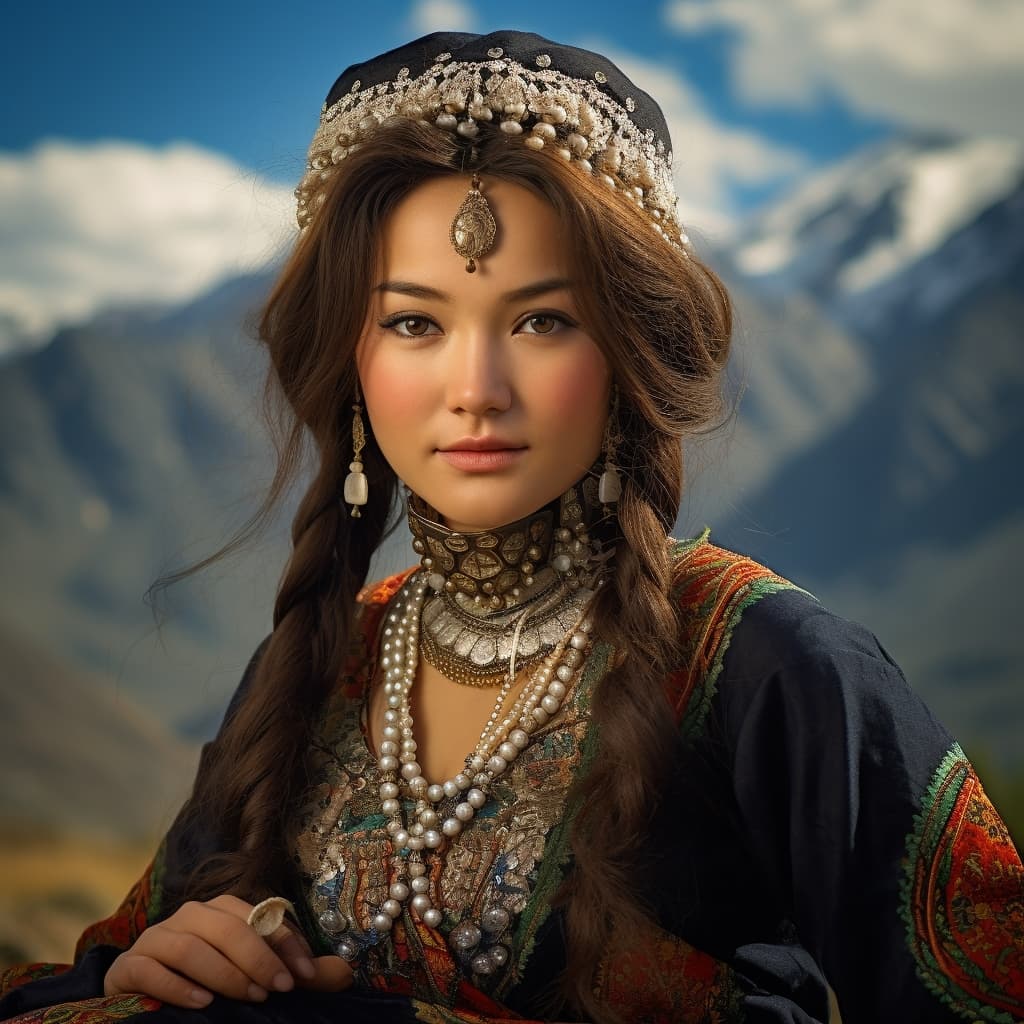
Kyrgyz Erotic
Kyrgyzstan
Turkic / Kipchak / Kyrgyz
Islam / Sunni Islam
Southern Asia
About Kyrgyz People
The Kyrgyz are a Turkic people of the high pastures — a population whose self-understanding is bound up with horses, mountains, and the long memory of moving between them. Their homeland is the Tien Shan and the Pamir-Alay, ranges that wall off Kyrgyzstan from its neighbors and push most settlement into a handful of valleys and the Issyk-Kul basin. Even now, with the majority living in towns and the capital Bishkek functioning as any post-Soviet capital does, the cultural center of gravity sits in the jailoo, the summer pasture, where families still take livestock up into the alpine grass and live in boz üy — the felt yurt that appears on the national flag.
The Kyrgyz language belongs to the Kipchak branch of Turkic, closer to Kazakh than to the Uzbek spoken across the Fergana Valley to the south, and the split tracks an older divide between steppe-nomadic and settled-oasis ways of life. Russian still does much of the administrative and urban work, a residue of the Soviet century that also reorganized clans into collective farms and pulled a largely illiterate population into mass schooling within two generations. Sunni Islam of the Hanafi school is the inherited faith, but it sits lightly on the surface of older layers — shamanic and animist instincts that survive in the way people speak about ancestors, mountains, and the spirits of place. Strict observance is uncommon outside the south; in the north, religion is more a matter of identity and rite-of-passage than daily ritual.
What sets the Kyrgyz apart in their own telling is the Manas — an oral epic of roughly half a million lines, longer than the Iliad and Odyssey combined, transmitted by reciters called manaschı who learn the poem in trance and perform it without instrumental accompaniment. The epic is genuinely load-bearing in the culture: it supplies a genealogy, a moral grammar, and a national myth of resistance. Tribal affiliation still matters in politics and marriage, organized into a northern and southern wing that have not always agreed on what the country should be. Hospitality is taken seriously to the point of obligation, horse games — kok-boru, the rough rugby played with a goat carcass — remain genuinely popular, and the eagle hunters of the Issyk-Kul region are not a tourist performance but a working tradition that survived the twentieth century mostly intact.
Typical Kyrgyz Phenotypes
Reference for AI generation — hair, eyes, skin, facial structure, build
Kyrgyz phenotype sits clearly within the Northeast Asian / Inner Asian cluster, with a Turkic-Mongolic substrate that distinguishes the group from neighboring Uzbeks or Tajiks. The defining structural traits are a flat, broad midface, prominent malar bones, and a relatively shallow nasal bridge — features visible in figures from Ormon Khan through Sadyr Japarov. Variation runs along a north–south gradient: northern Kyrgyz (Chuy, Issyk-Kul, Naryn) trend more strongly Mongoloid, while southern Kyrgyz around Osh and Jalal-Abad show greater Iranic admixture from centuries of contact with Uzbek and Tajik populations.
Hair is overwhelmingly straight, coarse, and black or very dark brown, with the jet-black, heavy-density texture typical of Inner Asian populations. Wave or light brown is uncommon and usually signals mixed ancestry. Greying tends to come late and silver rather than salt-and-pepper. Eyes range from dark brown to a warmer amber-brown; a true epicanthic fold is present in the majority, more pronounced in the north, softer and sometimes absent in the south. The palpebral fissure is typically narrow with a slight upward slant.
Skin sits in Fitzpatrick III–IV, with warm yellow-olive undertones rather than the pinker undertones of Slavic neighbors. Cheeks often carry a natural high-altitude flush from generations of life at 2,000+ meters. The nose is short to medium with a low-to-moderate bridge and a rounded, fleshy tip; alar width is moderate. Lips are medium in fullness, neither thin nor heavy. The jaw is square and broad rather than tapered, giving the face a roughly rectangular or slightly diamond outline.
Build is compact and sturdy — a legacy of pastoral, horse-bound life. Average male stature runs around 170 cm, female around 158 cm, with shorter limb-to-torso ratios than European norms and notably strong lower-body musculature. Body composition trends toward mesomorphic; obesity is historically rare but rising in urban centers. Folk singer Salamat Sadikova illustrates the classic northern facial type — broad cheekbones, narrow eyes, warm olive skin.
Data depth
63/100Coverage of image-grounded phenotype observations · drives AI generation diversity
- Sample size
- 18/40· 9 images
- Image quality
- 30/30· 78% high
- Confidence
- 15/20· mean 0.84
- Source diversity
- 0/10· wikipedia
- ·Small sample (n<10)
- ·Wikipedia-only source — not population-representative
Observed Distribution — Image Sample
Empirical observations from analyzed photographs · supplementary signal, not population truth
Sample: 9 images analyzed (9 wikipedia). Quality: 7 high, 2 medium, 0 low, 0 very_low. Avg analyzer confidence: 0.84.
Skin tone (Fitzpatrick): III (11%), IV (89%)
Hair color: gray/white (78%), black (22%)
Hair texture: straight (78%), covered (22%)
Eye color: dark brown (100%)
Epicanthic fold: 100% present, 0% absent, 0% unclear
Caveats: Sample size 9 is small — observed distribution should be treated as suggestive, not definitive. Sample is 100% Wikipedia notable people — skews toward male, public-life, and modern figures, not population-representative.
Last aggregated: May 7, 2026
Explore phenotype categories
Structured taxonomy with peer-reviewed scales · 22 anatomical categories
Notable Kyrgyz People
12 reference figures — sourced from Wikipedia
- Almazbek Atambayev — politician
- Ömürbek Babanov — businessman and politician
- Kurmanbek Bakiyev — politician
- Baitik Batyr — 19th-century politician
- Jantay Batyr — 19th-century statesman
- Sadyr Japarov — politician
- Ishenbai Kadyrbekov — politician
- Ormon Khan — 19th-century khan
- Ulukbek Maripov — politician
- Melis Myrzakmatov — politician
- Roza Otunbayeva — politician
- Salamat Sadikova — folk singer
Generate Kyrgyz AI Content
Use this ethnicity's phenotype data to create AI-generated content with accurate physical traits and cultural context.
Open Creator Studio