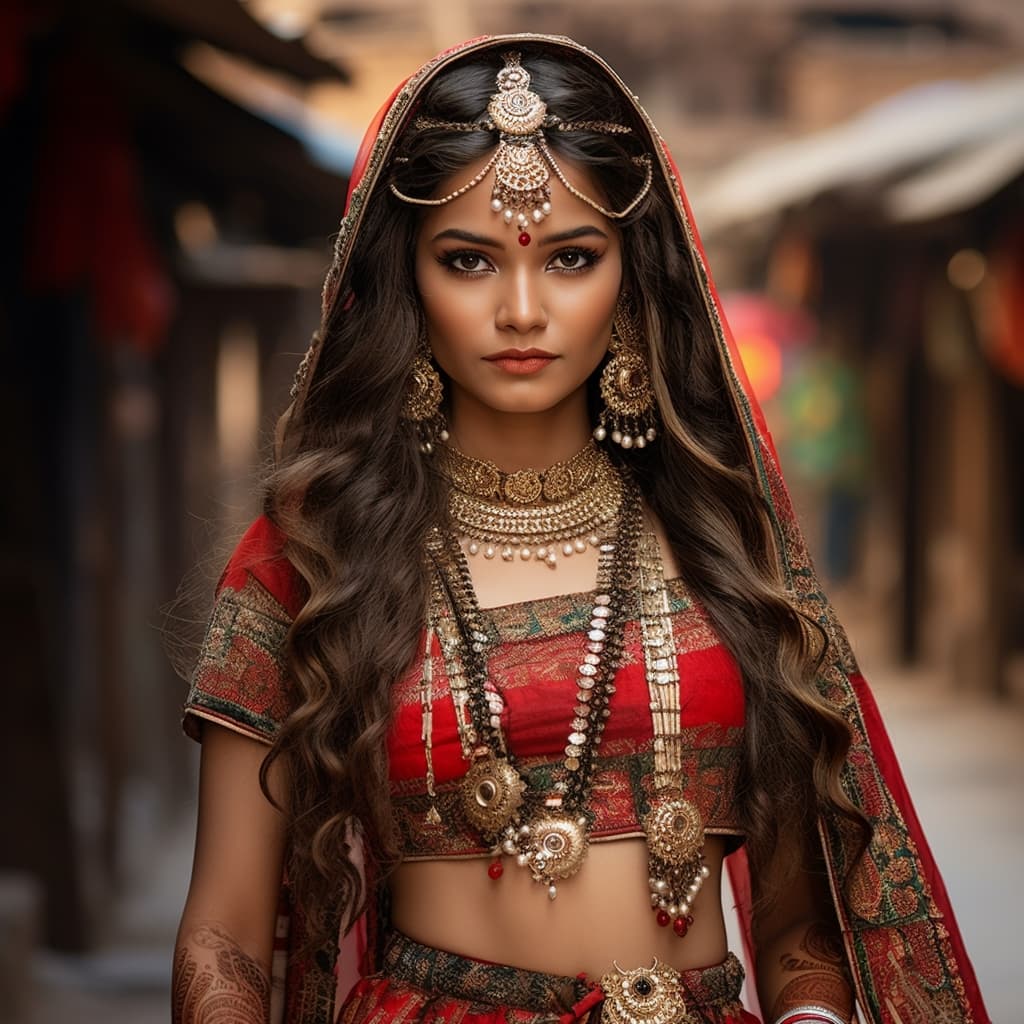
Kurukh Erotic
Chota Nagpur Plateau (India)
Dravidian / Kurukh
Sarnaism, Christianity, Hinduism, Animism
Kisan
Southern Asia
About Kurukh People
The Kurukh are a Dravidian-speaking people whose presence on the Chota Nagpur Plateau is, linguistically, an anomaly. Almost every group around them — Munda speakers to one side, Indo-Aryan speakers pressing in from the plains — belongs to a different language family entirely. Kurukh sits stranded in eastern India, separated by hundreds of miles from its nearest Dravidian relatives in the south. The standing explanation is that Dravidian languages were once spoken much further north, and the Kurukh and a few related groups (the Malto in the Rajmahal hills, the Brahui in Balochistan) are what remained when that earlier distribution receded. Whether or not the migration story holds up in detail, the linguistic isolation is real, and it shapes how the Kurukh have positioned themselves: a people who know they belong to the plateau but speak a language that doesn't.
The plateau itself — broken hills, sal forests, iron-rich red soil — has historically rewarded subsistence farming over surplus agriculture, and the Kurukh organized around that. Village land held in common, a recognized headman, a sacred grove (the sarna) at the edge of the settlement where the village deities are addressed and ancestors remembered. Sarnaism, the indigenous tradition built around those groves, is not a doctrinal religion so much as a practice of relationship — with the land, with named spirits, with the dead — and it remains the religious self-identification of a substantial share of Kurukh today, even as Christianity (largely from late-19th-century Lutheran and Catholic missions) and Hindu observance have made significant inroads. Many families practice elements of more than one. The Kisan, sometimes counted as a Kurukh sub-group and sometimes as a distinct community depending on who is doing the counting, are concentrated more in Odisha and have historically been associated with cultivation rather than the forest economy.
The political inflection point that shapes contemporary Kurukh identity is the long agitation for tribal land rights and statehood that culminated in the carving of Jharkhand out of Bihar in 2000. The Kurukh, alongside the Munda and Ho, were central to that movement, and the language has since gained official recognition in Jharkhand and West Bengal. A Kurukh-specific script, Tolong Siki, devised in the 1990s, is now taught in some schools — a deliberate move to give a long-spoken language its own written life rather than continuing to borrow Devanagari.
Typical Kurukh Phenotypes
Reference for AI generation — hair, eyes, skin, facial structure, build
The Kurukh are a Dravidian-speaking adivasi population of the Chota Nagpur Plateau, and their phenotype reflects that older South Indian substrate sitting on top of long isolation in the forested hills of Jharkhand, Odisha, and West Bengal — visibly distinct from the Indo-Aryan populations that surround them on the plains. Hair is uniformly dark — black to very dark brown — typically straight to gently wavy, fine to medium in thickness, with coarser textures appearing in some sub-pockets. Salt-and-pepper greying tends to come late. The Kisan branch reads broadly the same, with marginal differences in average build rather than in coloration or feature.
Eyes are dark brown to near-black; lighter eyes are essentially absent. The eye opening is typically almond-shaped with a moderately heavy upper lid and a soft, often partial epicanthic fold that gives the inner corner a gentler curve than is usual for plains North Indian groups — a feature noticeable in athletes from this community such as the hockey players in the Tirkey, Lakra, and Toppo lineages.
Skin runs Fitzpatrick IV to deep V, predominantly warm-brown with red-to-olive undertones; sun-exposed agricultural workers can read closer to VI on forearms and faces while remaining lighter on the torso. The defining facial signature is a low-bridged, wide-rooted nose with broad alae, full but not everted lips, and prominent malar bones over a relatively short, rounded jaw — features that, taken together, set Kurukh faces apart from Indo-Aryan neighbours. Foreheads are moderate, brow ridges soft, and chins typically receding rather than squared.
Build is compact and wiry. Men cluster around 160–168 cm, women 148–155 cm, with narrow shoulders, low body fat, and dense, well-tendoned limbs — the kind of frame that has produced a disproportionate number of national-level field hockey players and, more recently, sprinter Animesh Kujur. Hands and feet tend to be small relative to limb length; gluteofemoral fat deposition in women is moderate, with a generally lean, neotenous body shape carried into middle age.
Data depth
68/100Coverage of image-grounded phenotype observations · drives AI generation diversity
- Sample size
- 28/40· 22 images
- Image quality
- 25/30· 50% high
- Confidence
- 15/20· mean 0.78
- Source diversity
- 0/10· wikipedia
- ·Modest sample (n<25)
- ·Wikipedia-only source — not population-representative
Observed Distribution — Image Sample
Empirical observations from analyzed photographs · supplementary signal, not population truth
Sample: 22 images analyzed (22 wikipedia). Quality: 11 high, 9 medium, 2 low, 0 very_low. Avg analyzer confidence: 0.77.
Skin tone (Fitzpatrick): IV (23%), V (68%), VI (9%)
Hair color: black (50%), gray/white (41%), unclear (9%)
Hair texture: straight (64%), wavy (14%), coily (5%), covered (18%)
Eye color: dark brown (95%), unclear (5%)
Epicanthic fold: 5% present, 91% absent, 5% unclear
Caveats: Sample size 22 is modest — secondary patterns may not be reliable. Sample is 100% Wikipedia notable people — skews toward male, public-life, and modern figures, not population-representative.
Last aggregated: May 7, 2026
Explore phenotype categories
Structured taxonomy with peer-reviewed scales · 22 anatomical categories
Notable Kurukh People
48 reference figures — sourced from Wikipedia
- Joachim Baxla — Member of Parliament
- Ignace Beck — Member of Parliament
- Budhu Bhagat — freedom fighter
- Indra Nath Bhagat — Member of Parliament
- Jatra Bhagat — freedom fighter and social reformist
- Sudarshan Bhagat — Member of Parliament, central minister Government of india
- Sukhdeo Bhagat — Member of Legislative Assembly Government of Jharkhand, Member of Parliament …
- Albert Ekka — recipient of India's highest wartime gallantry award Param Vir Chakra
- Anosh Ekka — Minister Government of Jharkhand
- Deep Grace Ekka — Indian hockey player
- Madhu Mansuri Hasmukh — singer and activist
- Rajesh Kachhap — Member of Legislative Assembly Government of Jharkhand
- Jacinta Kerketta — journalist and poet
- Michael Kindo — hockey player
- Animesh Kujur — Animesh Kujur (born 2 June 2003) is an Indian sprinter. He is the current nat…
- Santiuse Kujur — MP of Assam
- Birendra Lakra — Indian hockey player
- Provat Lakra — Football player of West Bengal
- Sawna Lakra — Member of Legislative Assembly Government of Bihar and Government of Jharkhand
- Sunita Lakra — Indian hockey player
- Chamra Linda — Minister Government of Jharkhand
- Lilima Minz — Indian hockey player
- Mukut Minz — Mukut Minz is an Indian doctor. In 2017, he was awarded the Padma Shri by the…
- Sonajharia Minz — vice-chancellor to the Sido Kanhu Murmu University
- Jual Oram — Ministry of Tribal Affairs, India
- Dinesh Oraon — Indian politician currently serving as speaker of Jharkhand legislative assem…
- Kartik Oraon — Member of Parliament, Lok Sabha cabinet minister Government of India, founder…
- Rameshwar Oraon — former IPS officer and politician, cabinet minister Government of India, cabi…
- Sameer Oraon — . Former Member of Rajya Sabha and National President Bharatiya Janata Party …
- Simon Oraon — environmentalist & Padma Shri awardee
- Manisa Panna — football player
- Manoj Tigga — Member of Parliament Alipurduar
- Simon Tigga — politician
- Bandhu Tirkey — Minister Government of Jharkhand
- Bhushan Tirkey — Member of Legislative Assembly Government of Jharkhand
- Dasrath Tirkey — Member of Parliament
- Dilip Tirkey — President of the Hockey India
- Ignace Tirkey — hockey player
- Manohar Tirkey — politician
- Pius Tirkey — Member of Parliament
- Rupa Rani Tirkey — lawn ball player
- Shilpi Neha Tirkey — Minister Government of Jharkhand
- Biju Toppo — documentary filmmaker
- Binita Toppo — hockey player
- Namita Toppo — Indian hockey player
- Telesphore Toppo — Cardinal
- Abhay Xaxa — 1983–2020), Human rights activist, poet, and social anthropologist
- Pyari Xaxa — football player






Generate Kurukh AI Content
Use this ethnicity's phenotype data to create AI-generated content with accurate physical traits and cultural context.
Open Creator Studio