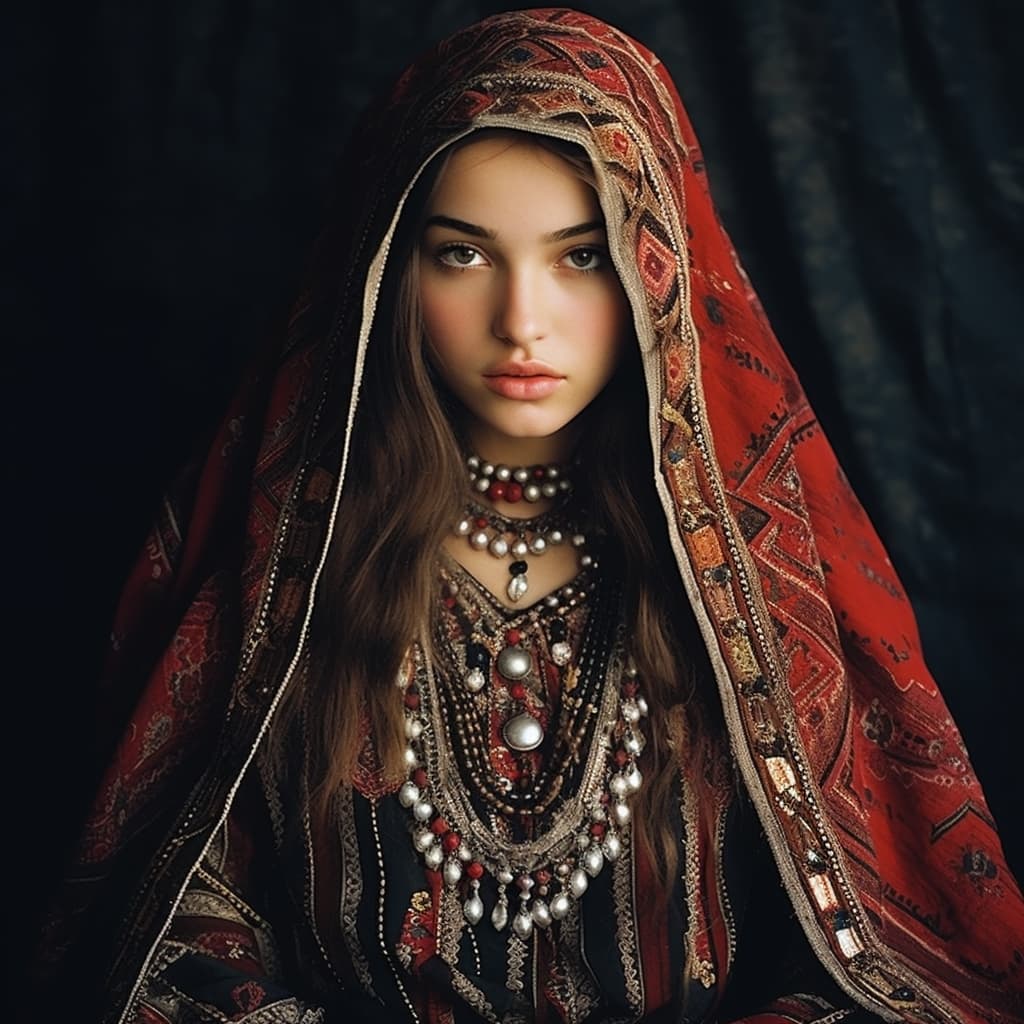
Kumyks Erotic
Dagestan (Russia)
Turkic / Kipchak / Kumyk
Islam / Sunni Islam
Southern Asia
About Kumyks People
The Kumyks are the Turkic people of the Dagestani lowlands — the flat, hot strip of land between the eastern slopes of the Caucasus and the Caspian Sea. That geography matters. While most of Dagestan's roughly thirty native peoples are squeezed into the mountains, each valley speaking its own unrelated Northeast Caucasian tongue, the Kumyks hold the plain. Their towns — Khasavyurt, Buynaksk, Makhachkala's older quarters — sit on the trade routes that for centuries funneled goods between the steppe and the highlands. Being on the road shaped them: historically, Kumyk functioned as the lingua franca of the North Caucasus, the language a Chechen merchant and an Avar shepherd might both fall back on when they needed to settle a price.
The language itself is Kipchak Turkic, in the same branch as Karachay-Balkar, Nogai, and (more distantly) Kazakh and Tatar. It is not closely related to the languages of the mountain peoples who surround the Kumyks on three sides, and that linguistic island-status is part of how Kumyks read their own identity — Turkic-speaking Muslims looking out from the plain at neighbors who speak something else entirely. Older Kumyk literature, especially the nineteenth-century poet Yirchi Kazak, is treated with real seriousness; he died in Siberian exile and is read today the way Georgians read Rustaveli or Chechens read Mamakaev.
Sunni Islam arrived early by Caucasus standards, and the Kumyks are usually counted among the more theologically settled of the region's Muslim peoples — less marked by the Sufi tariqa networks that organized resistance in the mountains under Imam Shamil, more aligned with the urban, scholarly Islam of the lowland madrasas. The nineteenth-century Caucasian War left the Kumyks in an awkward position: caught between the Russian advance from the north and Shamil's imamate in the highlands, with factions on both sides. Soviet-era boundary-drawing then handed much of their historic territory to neighboring republics or absorbed it into a multi-ethnic Dagestan in which they became one minority among many.
Today they number something over half a million, concentrated in northern Dagestan but with a sizable diaspora in Turkey descending from nineteenth-century muhajirs. Hospitality codes — the ritual obligations toward a guest, the seating order at a wedding, the careful protocols of mourning — remain unusually intact, and Kumyk weddings are still long, structured affairs where elders preside and the order of toasts is not improvised.
Typical Kumyks Phenotypes
Reference for AI generation — hair, eyes, skin, facial structure, build
Kumyks are a Turkic-speaking people of the lowland and foothill plains of Dagestan, and their phenotype reads as a Caucasian–Kipchak blend rather than a clean fit to either Caucasus highlander or steppe Turkic templates. Hair runs dark — black to dark brown dominates, with chestnut and dark-auburn tones common enough to be unremarkable. True blond is rare; subtle red or copper undertones surface in beards and in children's hair more often than in scalp hair as adults. Texture is typically straight to softly wavy, thick-shafted, with strong terminal beard and body hair growth in men.
Eyes are most often brown to dark brown, but the hazel-green and grey-green range is meaningfully represented, and clear blue does turn up — a Caucasus-region contribution rather than a steppe one. Eye shape is almond, set under a fairly straight or gently arched brow. Epicanthic folds are essentially absent; despite the Kipchak linguistic heritage, visible East Asian eyelid morphology is uncommon in modern Kumyks. Skin tone sits in the Fitzpatrick II–IV band — pale-olive to light-tan with warm undertones, tanning readily under Caspian sun rather than burning.
Facial structure is the most consistent marker. Noses tend to be straight or slightly convex with a defined bridge and moderate alar width — narrower than Pontic-Caucasian extremes, broader than Anatolian Turkish averages. Cheekbones are present but not flared; jawlines in men are square and well-defined, lips medium in fullness. The build is what the wrestling and combat-sport rosters make obvious: medium-tall stature (men commonly 175–183 cm), broad shoulders, thick wrists and necks, naturally muscular without being lean — see Bakhtiyar Akhmedov for the heavyweight end of the same body plan. Women trend toward hourglass proportions with fuller hips and bust relative to waist. Sub-group variation between lowland Kumyks and the Braguns or Mozdok groups is minor — slightly lighter pigmentation among northern communities with longer Cossack contact, but no sharp phenotype break.
Data depth
46/100Coverage of image-grounded phenotype observations · drives AI generation diversity
- Sample size
- 22/40· 14 images
- Image quality
- 14/30· 29% high
- Confidence
- 10/20· mean 0.58
- Source diversity
- 0/10· wikipedia
- ·Modest sample (n<25)
- ·Mostly low-quality source images
- ·Wikipedia-only source — not population-representative
Observed Distribution — Image Sample
Empirical observations from analyzed photographs · supplementary signal, not population truth
Sample: 14 images analyzed (14 wikipedia). Quality: 4 high, 6 medium, 3 low, 1 very_low. Avg analyzer confidence: 0.58.
Skin tone (Fitzpatrick): II (21%), III (36%), IV (29%), unclear (14%)
Hair color: gray/white (50%), black (36%), unclear (14%)
Hair texture: straight (43%), wavy (21%), coily (7%), covered (14%), unclear (14%)
Eye color: dark brown (50%), unclear (50%)
Epicanthic fold: 0% present, 79% absent, 21% unclear
Caveats: Sample size 14 is modest — secondary patterns may not be reliable. Quality skews toward older or low-resolution photos; phenotype detail may be lossy. Sample is 100% Wikipedia notable people — skews toward male, public-life, and modern figures, not population-representative.
Last aggregated: May 7, 2026
Explore phenotype categories
Structured taxonomy with peer-reviewed scales · 22 anatomical categories
Notable Kumyks People
56 reference figures — sourced from Wikipedia
- Murad al-Daghistani — pioneering Iraqi photographer, achieved international recognition for the qua…
- Nasreddin Murat-Khan — Pakistani architect and civil engineer. He is remembered most for designing t…
- Adil-Gerey Daidbekov — Kumyk noble (ozden), engineer and a public figure from Temirkhan-Shura, desig…
- Young Turks — Ahmed-Saib bey Kaplan — one of the prominent members of Young Turks movement,…
- Haidar Bammate — [ru] — politician, one of the ideologists and Foreign Minister of the Mountai…
- Rashid Khan Kaplanov — politician, one of the founders and Minister of Internal Affairs of the Mount…
- Djelal ed-Din Korkmasov — de facto founder of the Dagestan Autonomous Soviet Socialist Republic, its fi…
- Roza Eldarova — the first woman to hold the highest political office in Dagestan, elected cha…
- Imam Shamil — Shaykh Jemaleddin Gazikumuki - Imam Shamil's guide (murshid) and father-in-law.
- Najmuddin Bammate — [fr] — prominent French-Afghan writer, linguist, and Islamic scholar
- Fahrettin Kırzıoğlu — [tr] — Turkish historian and writer
- Murad Kaplanov — [ru] — radio communication engineer, Chief Constructor of Molniya communicati…
- Sultan-Mahmud of Endirey — [ru] — prominent leader and ruler, Shamkhal, who defeated Russian invasion of…
- Tashaw-Hadji — political, military, and spiritual leader of Caucasian resistance in the 1800…
- Uchar-hadji — 19th century mulla and elderman, who killed two Russian generals at once
- Abdulhakim Ismailov — USSR World War II soldier, he was photographed by Yevgeny Khaldei raising the…
- Al-Klych (Ali-Qılıç) Khasayev — [ru] — six-time world wrestling champion
- Saypulla Absaidov — 1980 Moscow Olympics wrestling champion in Lightweight category
- Magomedgasan Abushev — 1980 Moscow Olympics wrestling champion in 62 kg category, 1980 Prievidza Eur…
- Marid Mutalimov — 2008 Summer Olympics wrestling bronze medalist in 120 kg category
- Bakhtiyar Akhmedov — 2008 Summer Olympics wrestling champion in 120 kg category
- Nariman Israpilov — 2009 Vilnius wrestling European champion in 55 kg category, 2013 Budapest wor…
- Zaur Uguev — 2020 Summer Olympics wrestling champion in 57 kg freestyle category, 2018 Bud…
- Milana Dadasheva — bronze medalist of two wrestling European Championships
- Ibragim Kadiev — 2x U23 world champion in freestyle wrestling. 2026 European Champion at 86kg.
- Dinislam Bammatov — 1x U23 world vice-champion in greco-roman wrestling.
- Abubakar Khaslakhanau — Olympian, Bronze medalist at the 2024 European Championship in greco-roman wr…
- Dzhamal Adzhigerey — [ru] — wushu star and actor, 12-time European and 1-time world wushu champion
- Bozigit Ataev — many-time Wushu Sanda world champion.
- Muslim Salikhov — many-time Wushu Sanda world champion, "King of King-fu", often acknowledged a…
- Marat Gafurov — world pankration (2010), jiu-jitsu (2013) champion and former ONE FC featherw…
- Rustam Khabilov — Combat Sambo World Champion, MMA fighter
- Muhammad Mokaev — UK-based MMA fighter, IMMAF junior bantamweight world champion, UFC member.
- Nassourdine Imavov — France based - UFC middleweight fighter.
- Abdoul Abdouraguimov — [fr] — France based - two division ARES FC champion.
- Daguir Imavov — France based - ARES FC lightweight.
- Abus Magomedov — [de] — Germany based - UFC middleweight fighter.
- Uzair Abdurakov — ACA fighter
- Islam Murtazaev — ONE FC kickboxer, who challengend for the Lightweight title.
- Beybulat Isaev — ONE FC kickboxer.
- Elbrus Osmanov — [ru] — ONE FC fighter.
- Abdulla Dayakaev — former Muay Thai Factory champion and current ONE FC fighter.
- Salimsoltan Aminov — Muay Thai Factory champion.
- Medzhid Bektemirov — [ru] — light heavyweight titleholder among professionals under version WBC USNBC
- Arslanbek Makhmudov — Heavyweight WBC-NABF champion
- Arthur Biyarslanov — of Kumyk father and Chechen mother, olympian at 2016 Olympics Games represent…
- Sharabutdin Ataev — gold medalist at 2023 Tachkent boxing world championship in the cruiserweight…
- Dzhambulat Bizhamov — silver medalist at 2021 world championship, many time Russian national champi…
- Artur Akavov — challenged once for the WBO world title.
- Murad Chopanov — many-time Grand Slam's winner.
- Arsen Akayev — professional football player and coach
- Murad Magomedov — professional football player
- Alibek Aliev — professional Swedish football player
- Islamnur Abdulavov — professional football player
- Tymerlan Huseynov — first scorer, who made 100 goals in the Ukrainian Football League
- Tamerlan Musayev — CSKA Moscow player.
Generate Kumyks AI Content
Use this ethnicity's phenotype data to create AI-generated content with accurate physical traits and cultural context.
Open Creator Studio