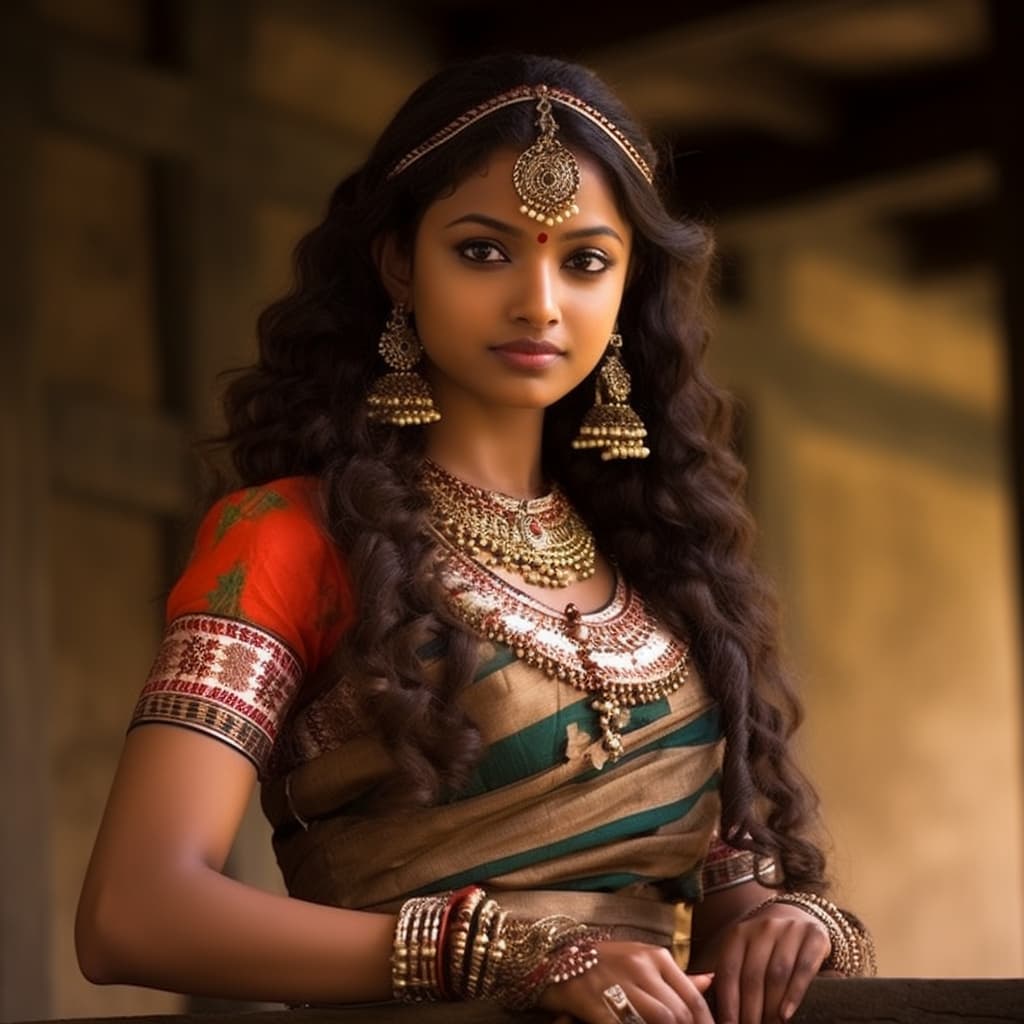
Konkani Erotic
Konkan (India)
Indo-European / Indo-Aryan / Konkani
Hinduism
Luso-Indians
Southern Asia
About Konkani People
The Konkani are the people of the Konkan, the narrow coastal strip pinned between the Western Ghats and the Arabian Sea on India's western flank. The geography is the first fact about them: a sliver of land roughly six hundred kilometers long, hemmed in by mountains on one side and ocean on the other, and that confinement shaped a maritime, mercantile, fish-eating culture distinct from the Deccan plateau immediately inland. Today Konkanis are spread across Goa, coastal Maharashtra, coastal Karnataka and northern Kerala, but the language and the cuisine track the coastline rather than any single state.
Their language, also called Konkani, is Indo-Aryan and sits in the same broad family as Marathi, with which it has a long and politically charged sibling relationship — for much of the twentieth century Konkani was treated administratively as a Marathi dialect, a classification its speakers fought and eventually overturned when Konkani was added to the Eighth Schedule of the Indian Constitution in 1992. It is unusual among major Indian languages in being written in multiple scripts depending on where you find it: Devanagari in Goa and Maharashtra, Kannada in coastal Karnataka, Malayalam in Kerala, and Roman script in the Catholic Goan diaspora. The same word looks like four different things in four different places.
Most Konkanis are Hindu, with traditions oriented toward coastal temple complexes and a strong household practice around kuldevatas — clan deities tied to specific ancestral villages, which Konkani families continue to visit for weddings and naming ceremonies even after generations of urban life elsewhere. The community has historically been stratified along caste lines that mirror but don't perfectly match the broader Indian system, with Saraswat Brahmins occupying a distinctive position as fish-eating Brahmins, an exception to vegetarian Brahmin orthodoxy that locals explain through migration mythology and outsiders find genuinely puzzling.
The Luso-Indian branch is the legacy of four and a half centuries of Portuguese rule in Goa, which ended only in 1961. Conversion campaigns under Portuguese ecclesiastical authority produced a Catholic Konkani population that kept the language, kept much of the food, and adopted Iberian surnames, churches and a sacramental calendar — so a Fernandes or a D'Souza in Mangalore or Mumbai is very often a Konkani-speaker whose ancestors came from Goa. The cuisine carries the contact history plainly: vinegar, pork, chilies brought by the Portuguese from the Americas, and coconut from the coast all sit together on the same plate.
Typical Konkani Phenotypes
Reference for AI generation — hair, eyes, skin, facial structure, build
Konkanis sit on India's western coast between Goa and Karwar, and their phenotype reflects that coastal Dravidian-Indo-Aryan border zone rather than a clean northern or southern Indian template. Skin tone runs across a wide band — most commonly Fitzpatrick IV to V, warm olive to medium-brown with golden or reddish undertones, deepening to V–VI in fishing and agrarian communities along the shore where sun exposure compounds baseline pigmentation. Goud Saraswat Brahmin and Chitrapur Saraswat lineages skew lighter, often a wheatish IV with cool olive undertones, while Kharvi and Konkan Muslim populations trend darker.
Hair is almost uniformly black or very dark brown, fine to medium in diameter, and predominantly straight to gently wavy — tight curls are uncommon. Greying tends to appear later than in European populations and often arrives as a salt-and-pepper distribution rather than a uniform fade. Eye color is overwhelmingly dark brown to near-black; lighter hazel or grey-green eyes occur but are rare enough to read as distinctive. Eyelids are open and almond-shaped with no epicanthic fold; brows are typically thick and well-defined.
Facial structure is the most identifiable feature. Konkanis often carry a narrow-to-medium nasal bridge with a slightly convex profile and moderate alar width — finer than the broader noses common further south, but not as high-bridged as northwestern Indo-Aryan groups. Lips run medium-full with a defined cupid's bow; cheekbones are softly prominent rather than sharp; jawlines tend to be oval rather than square. The combined effect is a softened, finely-featured face that photographers and casting directors have long flagged as distinctively Konkan.
Build is typically slender to medium, with average male stature around 5'5"–5'8" and female around 5'1"–5'4". Frames are light-boned with narrow shoulders and modest musculature in non-laboring populations; coastal fishing communities carry visibly denser builds. The Luso-Indian branch — descendants of Portuguese-Goan unions — introduces lighter skin (III–IV), occasional light eyes, and slightly higher nasal bridges, most visible among older Catholic families in Goa, Mangalore, and Bombay.
Data depth
8/100Coverage of image-grounded phenotype observations · drives AI generation diversity
- Sample size
- 3/40· 1 image
- Image quality
- 0/30· 0% high
- Confidence
- 5/20· mean 0.45
- Source diversity
- 0/10· wikipedia
- ·No image observations yet
- ·Low overall confidence
- ·Wikipedia-only source — not population-representative
Explore phenotype categories
Structured taxonomy with peer-reviewed scales · 22 anatomical categories
Notable Konkani People
2 reference figures — sourced from Wikipedia
- Sanskritised — The name of aboriginal mother goddess, which is sometimes Sanskritised to mea…
- Paraśurāma — Some scholars believe that Koṅkaṇa (कोङ्कण) comes from koṇa (कोण) "corner" an…






Generate Konkani AI Content
Use this ethnicity's phenotype data to create AI-generated content with accurate physical traits and cultural context.
Open Creator Studio