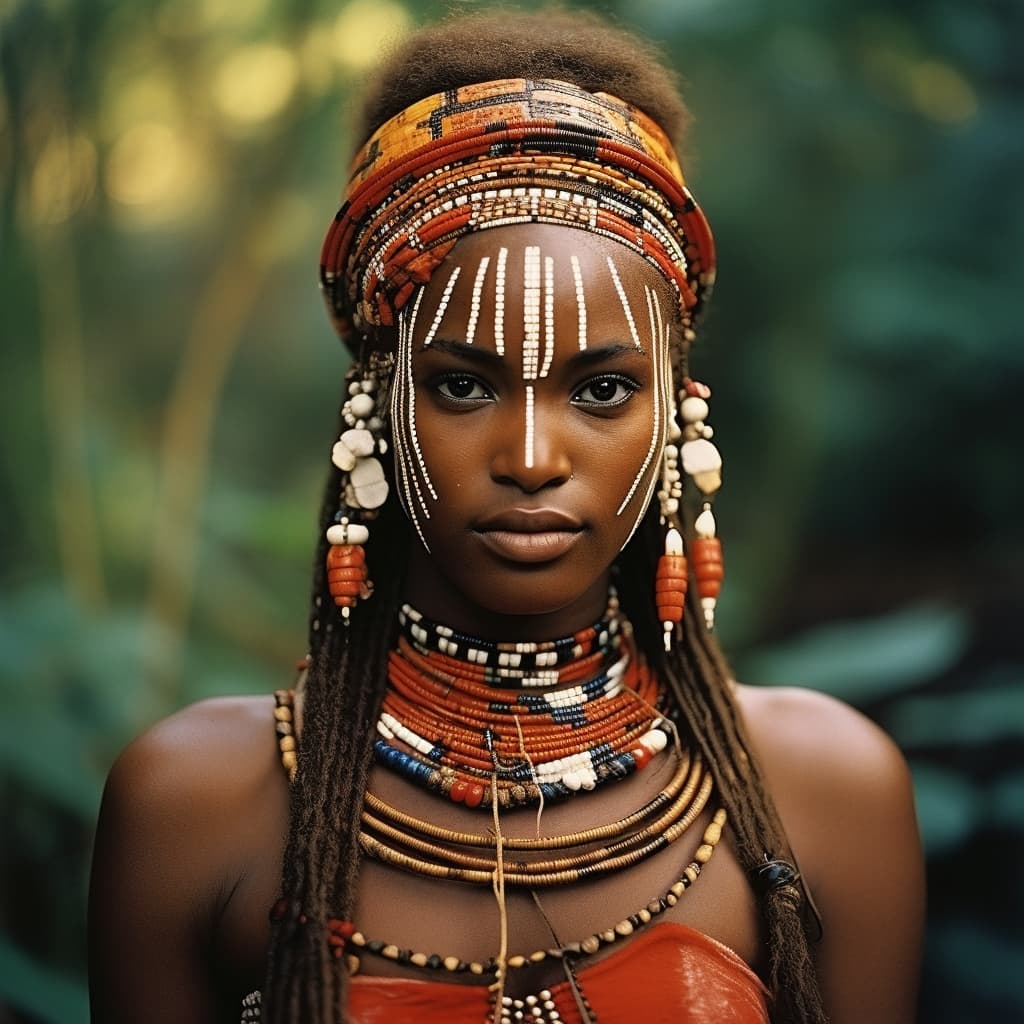
Konjo Erotic
Rwenzori Mountains (Democratic Republic of the Congo, Uganda)
Niger–Congo / Bantu / Konjo
Christianity
Nande
Central Africa
About Konjo People
The Konjo are a Bantu-speaking people of the Rwenzori massif — the snow-capped range that straddles the border between western Uganda and the eastern Democratic Republic of the Congo. They live mostly on the slopes themselves, in the cold, steep, banana-and-millet country between roughly 1,500 and 2,200 metres, where the cloud sits on the ridges for weeks at a time. The mountains are not backdrop here; they are the organising fact of Konjo life, dictating where villages sit, what crops grow, and which neighbours one trades or fights with. To the Ugandan side they are usually called Bakonzo; the much larger Nande population on the Congolese side speaks the same language and shares the same origin stories, and the two are best understood as branches of one people separated by a colonial border drawn in 1885.
Their language, Lhukonzo (Nande on the Congo side), is a Great Lakes Bantu tongue but a comparatively isolated one, ringed by Lugandan, Lutooro and Lugbara speakers from whom the Konjo have kept a distinct identity for centuries. That distinctness has had political consequences. In the kingdom-heavy region of western Uganda, the Konjo were long subjects of the Batoro lowland kings, and the resentment of mountain people made to pay tribute to a plains aristocracy fed the Rwenzururu movement — a separatist insurgency that smouldered from the early 1960s into the 1980s and produced, eventually, a recognised Rwenzururu kingdom of their own in 2009. Echoes of that struggle still flare; the 2016 clashes in Kasese left scars that have not healed.
Most Konjo are Christian today, predominantly Anglican on the Ugandan side and Catholic in much of North Kivu, though older practices around the mountain itself have not been displaced so much as folded in. Nyamuhanga, the high god, is associated with the upper peaks, and the spirits of ancestors and of specific places — rivers, certain crags, particular forest groves — remain part of how illness, misfortune and good harvests are explained, even in churchgoing households. Twin births carry their own ritual weight, as they do across much of the Bantu world, with named ceremonies and obligations that fall on the parents for years afterwards. The Konjo are also serious beekeepers and brewers; mountain honey and a millet beer called kasiksi show up at almost every social occasion that matters.
Typical Konjo Phenotypes
Reference for AI generation — hair, eyes, skin, facial structure, build
The Konjo (and their closely related Nande cousins across the Ugandan border) are mountain Bantu, and their phenotype reflects the long isolation of populations spread across the Rwenzori foothills rather than the lowland Bantu pattern more familiar from Central Africa. Skin tone sits in the Fitzpatrick V–VI range, predominantly deep brown with cool, slightly reddish undertones rather than the blue-black common further west in the Congo basin — the higher-altitude Rwenzori sun gives many older men and women a weathered, matte finish on the face and forearms while the torso stays more even.
Hair is almost uniformly Type 4 (4B–4C), tightly coiled with low visible sheen, worn close-cropped on men and frequently braided, twisted, or wrapped on women. Eyes are dark brown to near-black; epicanthic folds are absent, eye shape is wide and almond, and the brow ridge is moderate rather than heavy. The nose is the most distinctive feature — Konjo and Nande tend toward a relatively narrow nasal bridge for a Bantu group, with moderate alar width, sometimes producing a more sculpted profile than the broader, flatter nose typical of Equatorial lowlanders. Lips are full but not extremely everted; the philtrum is typically well-defined.
Facial structure runs to high cheekbones and a tapered jaw, giving a somewhat angular, oval face rather than a round one. Build is where the Rwenzori environment shows most clearly: Konjo and Nande are generally shorter and more compactly built than their Hutu, Tutsi, or Luhya neighbors — men commonly 5'5"–5'8", women 5'1"–5'4" — with dense musculature in the legs and shoulders from generations of farming on steep terrain. Body fat distribution leans low; hips and thighs on women are muscular rather than soft.
Phenotype differences between the Congolese Konjo and Ugandan Nande are minor — the Nande side shows slightly more admixture with neighboring Ugandan Bantu groups, occasionally producing a marginally taller stature and a wider nose, but the two read as one population.
Data depth
0/100Coverage of image-grounded phenotype observations · drives AI generation diversity
- Sample size
- 0/40· 0 images
- Image quality
- 0/30· 0% high
- Confidence
- 0/20
- Source diversity
- 0/10
- ·No image observations yet
Explore phenotype categories
Structured taxonomy with peer-reviewed scales · 22 anatomical categories





Generate Konjo AI Content
Use this ethnicity's phenotype data to create AI-generated content with accurate physical traits and cultural context.
Open Creator Studio