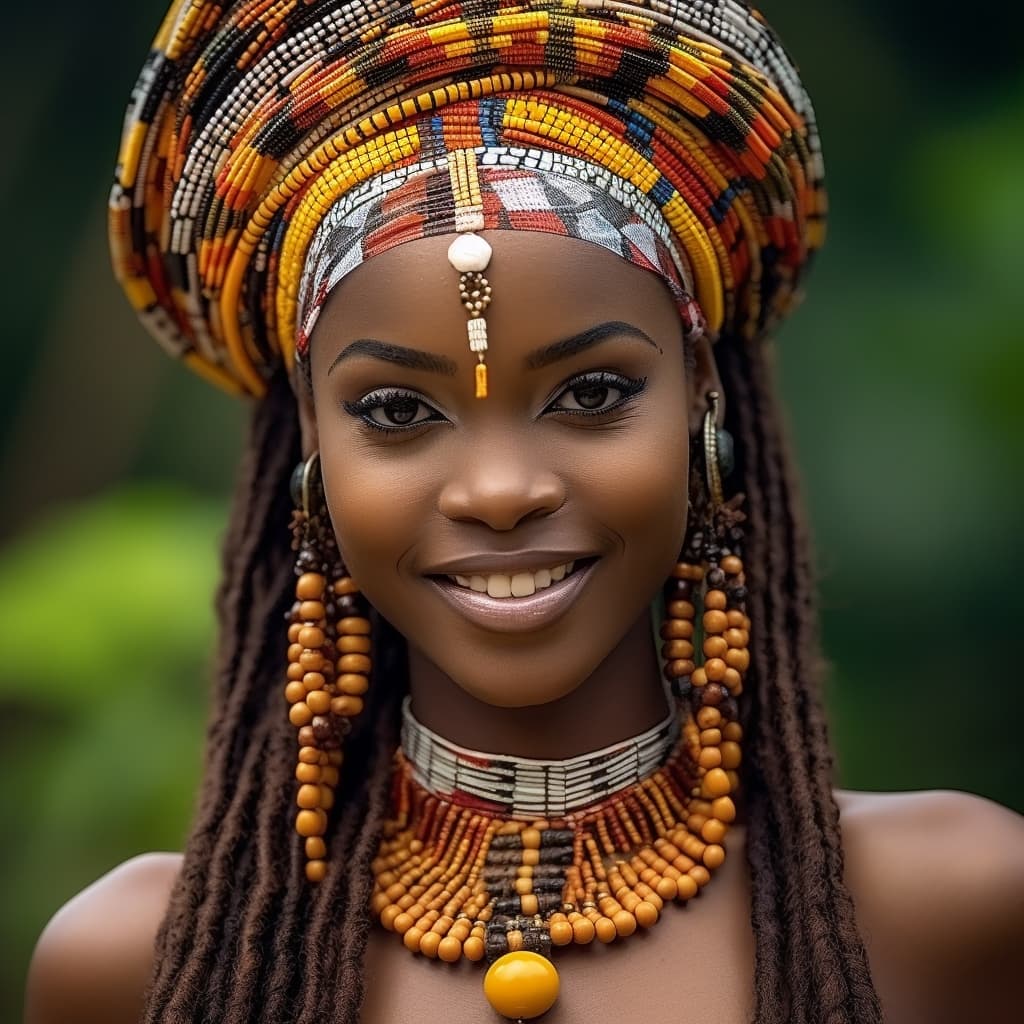
Kongo Erotic
Kongoland (Democratic Republic of the Congo, Republic of the Congo, Angola)
Niger–Congo / Bantu / Kongo
Christianity
Lari, Vili, Yombe, Suundi, Dondo, Hangala, Kugni, Manyanga, Beembe
Central Africa
About Kongo People
The Kongo are a Bantu people whose homeland straddles the lower reaches of the Congo River and the Atlantic coast where it meets the ocean — a stretch of forest, savanna, and tidal estuary now divided between three modern states (the DRC, the Republic of the Congo, and northern Angola) but historically a single political and cultural sphere. They are one of the larger Bantu populations on the continent, and their internal diversity is real: the Lari around Brazzaville, the Vili of the coast, the Yombe of the Mayombe forest, and the Beembe, Suundi, Dondo, Hangala, Kugni, and Manyanga each carry distinct accents, ritual specialties, and sub-regional identities under the wider Kongo umbrella. Their language, Kikongo, sits firmly within the western Bantu branch of Niger–Congo and was important enough in the colonial period that a simplified trade form, Kituba, became a regional lingua franca still spoken by millions who are not ethnically Kongo at all.
The defining historical fact for the Kongo is the Kingdom of Kongo, which from the late fourteenth century until its slow disintegration in the nineteenth was one of the most consequential states in Atlantic Africa. Its 1491 conversion to Christianity under Mvemba a Nzinga (Afonso I) was not a missionary imposition but a royal political project, and it produced something genuinely unusual: a centuries-long Kongolese Catholicism that absorbed crucifixes, saints, and sacraments into an existing cosmology of ancestors and territorial spirits rather than displacing it. That fusion still shapes religious life. Most Kongo today are Christian — Catholic in the older heartland, increasingly Pentecostal or independent-church elsewhere — but the prophetic movement begun by Simon Kimbangu in 1921, now the Kimbanguist Church, remains a major Kongo institution and an unmistakably Kongo reading of Christianity.
Other things worth knowing: the nkisi tradition, the carved and bound power-figures that anchor much of what the world sees as "Kongo art," is a ritual technology, not decoration — the famous nail-studded nkisi nkondi were activated objects bound to oaths and grievances. Funerary practice carries unusual weight; the dead are participants, not departed. And politically, the Kongo have been at the center of nearly every modern upheaval in the region, from the anti-colonial revolts of the 1950s to the long shadow of the Angolan war, which scattered substantial Kongo populations across the diaspora.
Typical Kongo Phenotypes
Reference for AI generation — hair, eyes, skin, facial structure, build
The Kongo phenotype sits squarely within Central African Bantu morphology, with skin tones clustering in the deeper end of Fitzpatrick V through VI — rich brown to near-black, with warm reddish or olive undertones rather than the cooler blue-black sometimes seen further east in the Nilotic belt. Sun exposure across the equatorial Congo Basin reinforces this depth uniformly; you don't see the wide tonal spread found in groups straddling Sahel transitions.
Hair is almost universally Type 4 — tightly coiled, dense, with the small-diameter curl pattern characteristic of Bantu populations. Natural color is true black; reddish or auburn cast appears occasionally in children and fades with age. Hairlines tend to be defined, with relatively low temple recession in younger adults.
Eyes are dark brown to near-black, almond-shaped, set under moderately full upper lids without epicanthic folds. Brow ridges are gently pronounced rather than heavy. Nose form is one of the more distinctive Kongo features: typically a low to moderate bridge with broad alar wings and rounded tip — broader on average than East African or Horn populations. Lips are full top and bottom with well-defined vermillion borders. Cheekbones sit forward and wide; jaws are square in men and softly rounded in women, with prognathism that's present but generally subtle.
Build runs medium-tall by Central African standards — men commonly 170–178 cm, women 158–165 cm — with lean muscular frames, narrow hips relative to shoulders in men, and the gluteofemoral fat distribution typical of West-Central African women. Limb-to-torso ratios tend toward longer legs.
Sub-group variation is real but subtle. Yombe and Vili populations from the coastal and Mayombe forest zones often show slightly lighter complexions and finer features, a pattern visible in the celebrated Yombe sculptural tradition. Lari and Beembe from the Pool and Niari plateaus trend taller and more angular, while Suundi and Manyanga sit closer to the broader Kongo central type.
Data depth
0/100Coverage of image-grounded phenotype observations · drives AI generation diversity
- Sample size
- 0/40· 0 images
- Image quality
- 0/30· 0% high
- Confidence
- 0/20
- Source diversity
- 0/10
- ·No image observations yet
Explore phenotype categories
Structured taxonomy with peer-reviewed scales · 22 anatomical categories
Generate Kongo AI Content
Use this ethnicity's phenotype data to create AI-generated content with accurate physical traits and cultural context.
Open Creator Studio