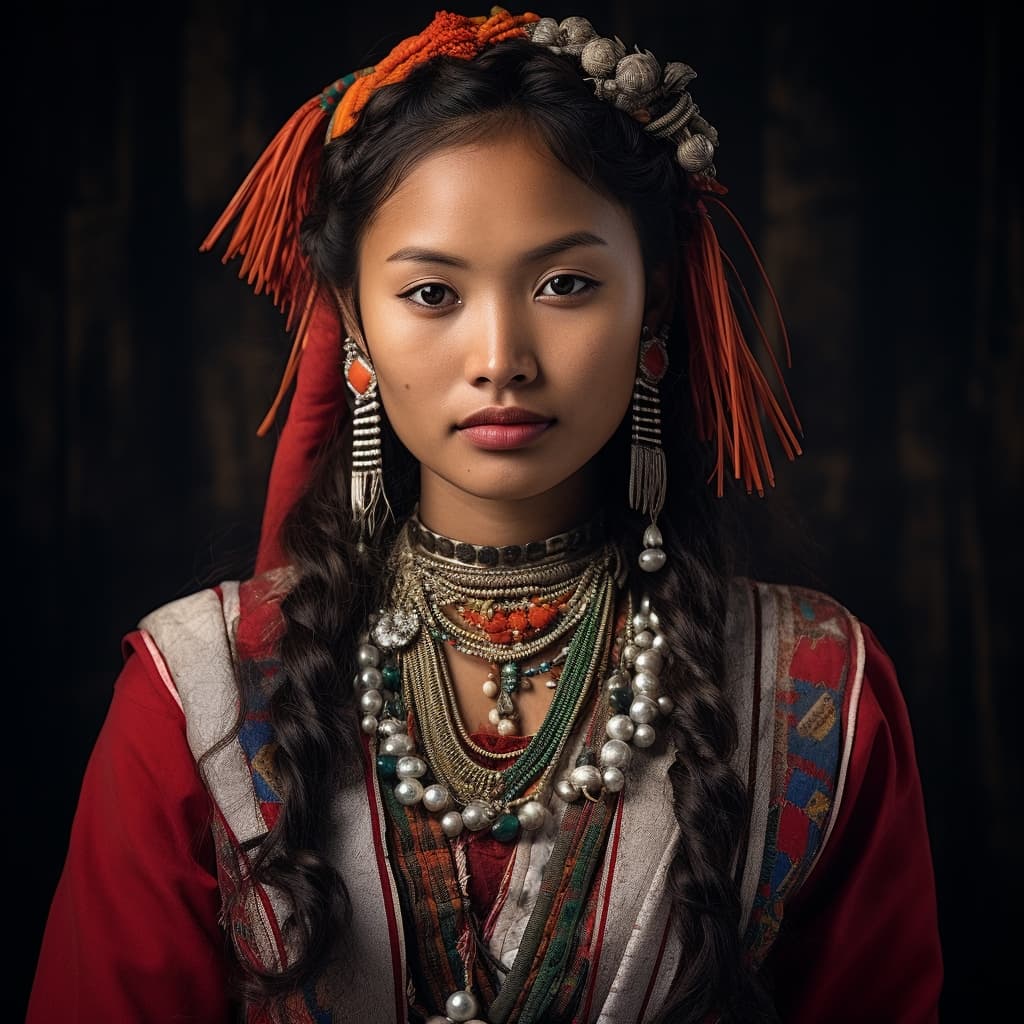
Kirantis Erotic
Eastern Region (Nepal)
Sino-Tibetan / Kiranti
Kirat Mundhum
Limbu, Sunuwar, Yakkha (including Athpare), Rai (including Kulung, Bantawa, and Bahing)
Southern Asia
About Kirantis People
The Kirantis are the indigenous peoples of the eastern Himalayan foothills, holding the country's most rugged terrain — the spurs and river gorges between the Sun Kosi and the Mechi, climbing toward Kanchenjunga. They are not a single tribe but a confederation of related peoples — Limbu, Rai, Sunuwar, Yakkha — who share an older Tibeto-Burman substrate that predates the Hindu kingdoms to the west. The Rai alone are an umbrella covering dozens of sub-communities, each with its own tongue: Kulung, Bantawa, Bahing, Chamling, Thulung. A Bantawa speaker and a Kulung speaker, though both called Rai, often cannot understand each other and switch to Nepali to talk.
Their faith, Kirat Mundhum, is an oral scripture rather than a book — a body of recited verse held by ritual specialists called phedangma, yeba, yema, or mangpa depending on the community. The Mundhum traces clan ancestries back through the rivers and ridges of the homeland, names the spirits of household and forest, and prescribes the rites for birth, marriage, and the long sequence of death observances. It coexists with Hindu and Buddhist neighbors without dissolving into them; a Limbu wedding looks nothing like a high-caste Nepali one. The dead are remembered by clan, and the lineage of names matters — knowing one's ancestors three or four generations back is not antiquarian but liturgical.
Historically the Kiranti country was the last frontier of the Gorkhali expansion in the late eighteenth century. The Limbu negotiated a land-tenure arrangement called kipat — communal title held by the lineage rather than the individual — which survived into the twentieth century and shaped how the eastern hills resisted absorption. Kipat is gone now, dismantled by land reform, but its memory undergirds a strong sense that the soil itself belongs to the clan. Out-migration has hollowed many villages: men go to Gulf labor camps, the British Gurkha regiments still recruit heavily from Rai and Limbu households, and Sikkim and Darjeeling hold large diaspora populations that have kept their languages alive in tea-garden settlements.
What strikes a visitor first is often the assertiveness — the Kirantis are not a deferential people. The drinking culture around tongba, fermented millet served hot in a wooden tankard with a bamboo straw, is a small piece of that confidence: a drink that belongs to them, served on their terms, in homes built into hillsides their grandfathers cleared.
Typical Kirantis Phenotypes
Reference for AI generation — hair, eyes, skin, facial structure, build
The Kirantis are eastern-Himalayan hill peoples whose phenotype sits firmly in the Tibeto-Burman cluster, distinct from the Indo-Aryan populations of Nepal's plains. Hair is uniformly black to very dark brown, straight or with a faint wave, coarse to medium in texture, and slow to gray. Beard and body hair growth is typically light — many Kirat men carry only sparse moustache and chin hair into middle age, a Northeast-Asian-leaning trait that visibly separates them from Brahmin-Chhetri neighbors.
Eyes run dark brown to near-black. The epicanthic fold is present in the clear majority — fuller and more pronounced among Limbu and northern Rai groups closer to the Tibetan frontier, lighter or partial among southern Rai and Sunuwar communities sitting further into the middle hills. Palpebral fissures tend to be narrow and slightly upslanted; the brow ridge is low and the orbits set shallow.
Skin spans Fitzpatrick III to IV, with warm yellow-to-olive undertones rather than the red-brown undertone common in Pahari Hindus. Higher-altitude Limbu and Yakkha communities often read paler with rosier cheek flush from cold exposure; Bantawa and Kulung Rai from lower mid-hills tan deeper from sustained field work.
Facial structure is the clearest marker: flat midface, broad and relatively low nasal bridge, modest alar width, and prominent malar (cheekbone) projection. Jaws are square but not heavy, chins moderate, lips medium in fullness with a defined vermilion border. Foreheads are typically broad and slightly sloped.
Build is compact and wiry. Men average roughly 158–164 cm, women 148–154 cm — short by global standards but with notably high lean-mass ratios, thick-walled chests, and strong calves and forearms. This is the anthropometric profile that produces Gurkha soldiers, drawn heavily from Rai and Limbu lines. Sunuwar tend toward the slightest frames; Limbu toward the most robustly built. Neoteny is pronounced — adult faces often retain a youthful roundness well past forty.
Data depth
0/100Coverage of image-grounded phenotype observations · drives AI generation diversity
- Sample size
- 0/40· 0 images
- Image quality
- 0/30· 0% high
- Confidence
- 0/20
- Source diversity
- 0/10
- ·No image observations yet
Explore phenotype categories
Structured taxonomy with peer-reviewed scales · 22 anatomical categories





Generate Kirantis AI Content
Use this ethnicity's phenotype data to create AI-generated content with accurate physical traits and cultural context.
Open Creator Studio