Khas Erotic
Nepal, India(Uttarakhand, Sikkim, Assam, West Bengal)
Indo-European / Indo-Aryan / Nepali
Hinduism
Brahmin, Chhetri, Thakuri, Rana, Vaisya, Kami, Damai, Sarki, Sunar, Gandarbha
Southern Asia
About Khas People
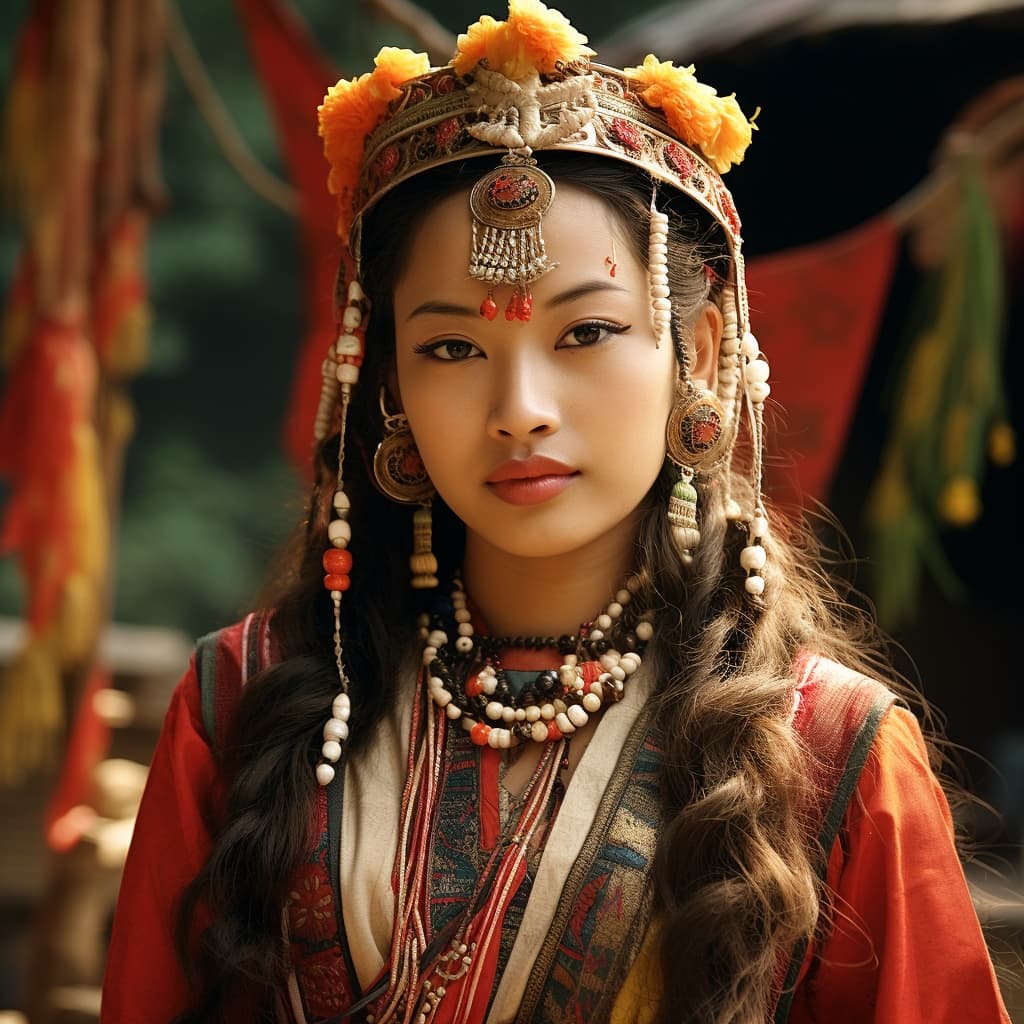
The Khas are the Indo-Aryan population that gives Nepal its dominant language and much of its political shape — the people whose dialect, carried down from the central hills, became Nepali. They are concentrated through the middle ranges of Nepal and spill across the western Indian Himalaya into Uttarakhand, Sikkim, Assam, and the hill districts of West Bengal. Their homeland is not the high snow country of postcards but the temperate, terraced country below it: ridge villages, river valleys, oak and rhododendron forest, fields cut into slopes by generations of patient labor. The name Khas is older than Nepal itself; it appears in early Sanskrit sources and survived as the self-designation of the medieval Khasa kingdom in the far west, whose courtly speech is the direct ancestor of modern Nepali.
What complicates any short account of the Khas is that the term works at two scales at once. In its broadest sense it refers to all the Indo-Aryan hill people who carry that linguistic and historical inheritance. In daily Nepali usage it overlaps heavily with the caste system imposed under the Shah and Rana states: Bahun (Brahmin) and Chhetri at the top, the Thakuri ruling lineages above them, and the Dalit occupational castes — Kami the blacksmiths, Damai the tailors and wedding musicians, Sarki the leatherworkers, Sunar the goldsmiths, Gandarbha the itinerant singers — historically excluded from the same ritual space. Rana refers more narrowly to the noble clan that ruled Nepal as hereditary prime ministers from 1846 until 1951, an era whose architecture and grievances are still legible in Kathmandu.
Religion is Hindu, but a hill Hinduism — practical, household-centered, full of local deities and lineage gods alongside the pan-Indian pantheon. Dashain and Tihar mark the autumn calendar more decisively than anything else; lineage priests handle the life-cycle rituals; the kul devta of a clan often outranks any textual orthodoxy in actual practice. Caste rules around food and marriage have loosened in cities and among the diaspora and remain stubborn in many villages.
The Khas have been mobile for two centuries. Gurkha military service drew men into the British and Indian armies and seeded communities across the eastern Himalaya; later waves carried laborers, students, and remittance economies to the Gulf, Malaysia, the UK, and North America. The result is a people whose center of gravity is still the Nepali hills but whose households, increasingly, are not.
Typical Khas Phenotypes
Reference for AI generation — hair, eyes, skin, facial structure, build
The Khas are an Indo-Aryan population of the Nepali mid-hills whose phenotype sits at a genuine crossroads — predominantly South Asian features overlaid with measurable Tibeto-Burman admixture from centuries of contact across the Himalayan foothills. The result reads as South Asian with a softer, slightly attenuated facial geometry compared to plains-Indian populations, and it varies more by elevation and caste sub-group than by region.
Hair is almost uniformly black to very dark brown, straight to gently wavy, with fine to medium thickness and high density. Premature greying is common from the late thirties onward. True curls are rare. Eyes range from dark brown to near-black; light eyes are essentially absent. Eye shape is where the Tibeto-Burman influence shows most clearly — a partial or vestigial epicanthic fold appears in a sizable minority, particularly among hill-dwelling Chhetri and Thakuri lineages, while Brahmin lines tend toward fully open, almond-shaped eyes with no fold.
Skin tones cluster across Fitzpatrick III to V, with warm olive to medium brown undertones — typically lighter than Gangetic-plains populations and darker than Tibetan ones. Higher-elevation Brahmin and Thakuri families often present at the lighter end (III–IV), while occupational caste groups historically tied to outdoor labor — Kami, Damai, Sarki — average somewhat deeper (IV–V), though intra-family variation is wide.
Noses are typically straight and medium-bridged with moderate alar width, neither the high narrow bridge of Kashmiri populations nor the broader form common further east. Lips are medium-full, cheekbones moderately high, and jaws slightly tapered, giving a generally oval to softly diamond face. Build is compact and wiry: men average roughly 162–168 cm, women 150–156 cm, with lean musculature and low body fat — a phenotype shaped by generations of mid-hill agriculture and walking terrain. The Gurkha military build — short, dense, broad-chested, exceptionally durable — draws heavily from Khas Chhetri stock and is the most documented anthropometric signature of the group.
Data depth
29/100Coverage of image-grounded phenotype observations · drives AI generation diversity
- Sample size
- 11/40· 4 images
- Image quality
- 13/30· 25% high
- Confidence
- 5/20· mean 0.41
- Source diversity
- 0/10· wikipedia
- ·Small sample (n<10)
- ·Low overall confidence
- ·Mostly low-quality source images
- ·Wikipedia-only source — not population-representative
Observed Distribution — Image Sample
Empirical observations from analyzed photographs · supplementary signal, not population truth
Sample: 4 images analyzed (4 wikipedia). Quality: 1 high, 3 medium, 0 low, 0 very_low. Avg analyzer confidence: 0.40.
Skin tone (Fitzpatrick): II (25%), III (25%), IV (25%), unclear (25%)
Hair color: gray/white (50%), black (25%), unclear (25%)
Hair texture: straight (50%), wavy (25%), unclear (25%)
Eye color: brown (25%), dark brown (25%), unclear (50%)
Epicanthic fold: 25% present, 25% absent, 50% unclear
Caveats: Sample size 4 is small — observed distribution should be treated as suggestive, not definitive. Quality skews toward older or low-resolution photos; phenotype detail may be lossy. Low average analyzer confidence — many photos partially obscured or historical. Sample is 100% Wikipedia notable people — skews toward male, public-life, and modern figures, not population-representative.
Last aggregated: May 7, 2026
Explore phenotype categories
Structured taxonomy with peer-reviewed scales · 22 anatomical categories
Notable Khas People
4 reference figures — sourced from Wikipedia
- Shivaram Singh Basnyat — Badabir senapanti)
- Dor Bahadur Bista — 1991). Fatalism and Development: Nepal's Struggle for Modernization. Orient B…
- Grierson, George Abraham — 1916). Linguistic Survey of India, Volume 9, Part 4. Vol. 9. Office of the su…
- doi — Richard Burghart (1984). "The Formation of the Concept of Nation-State in Nep…



Generate Khas AI Content
Use this ethnicity's phenotype data to create AI-generated content with accurate physical traits and cultural context.
Open Creator Studio