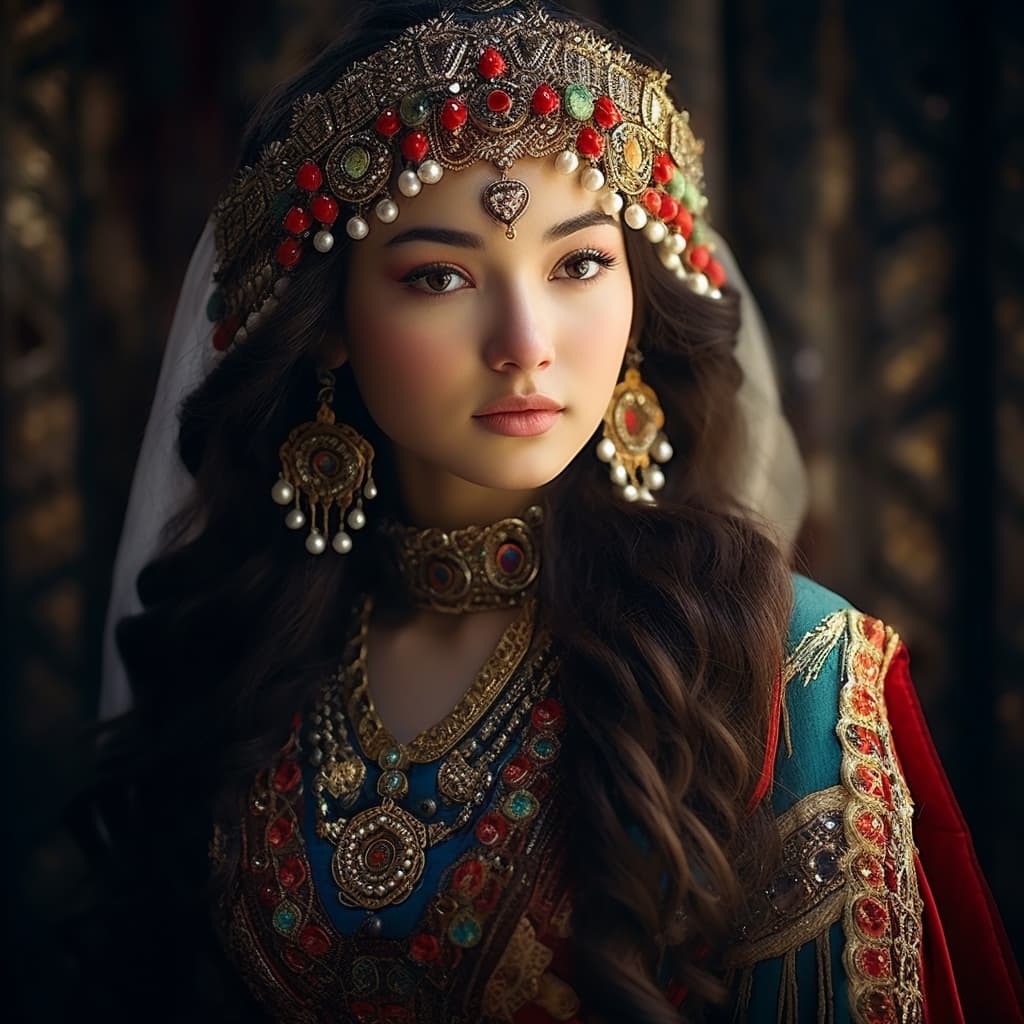
Kazakhs Erotic
Kazakhstan
Turkic / Kipchak / Kazakh
Islam / Sunni Islam
Significant populations in China, and Russia
Southern Asia
About Kazakhs People
The Kazakhs are a steppe people whose identity was forged less by a single homeland than by the rhythm of moving across one. For centuries, the defining unit was not the village but the aul — the mobile household cluster that wintered in sheltered valleys and pushed out across the open grass each spring with horses, sheep, and camels. Even now, generations into urban settlement, the cultural reflexes of pastoralism are everywhere: an emphasis on hospitality so codified it functions almost as law, a cuisine built around horsemeat and fermented mare's milk (kumis), and a deep memorization of lineage that lets most Kazakhs trace their ancestry back through a named line of forefathers and place themselves within one of the three historical hordes — the Great, Middle, and Little jüz.
Kazakh sits in the Kipchak branch of the Turkic family, close enough to Kyrgyz and Karakalpak that speakers can muddle through a conversation, distinct enough from Uzbek or Turkish that the kinship is structural rather than mutual. The language has been written in Arabic, then Latin, then Cyrillic under the Soviets, and is now in the middle of a state-led return to a Latin script — a quiet but real act of repositioning away from the Russian sphere. Sunni Islam, mostly of the Hanafi school, arrived gradually from the south and layered onto an older Tengrist substrate rather than erasing it; the result is a religious sensibility that tends toward the practical and tolerant, with shamanic and ancestor-honoring threads still visible at weddings, funerals, and the spring festival of Nauryz.
The twentieth century cut hard into this world. Forced collectivization in the early 1930s destroyed the herds and triggered a famine that killed roughly a quarter of the Kazakh population and pushed many across the border into Xinjiang and Mongolia, which is why substantial Kazakh communities still live in China and, in smaller numbers, Russia. The Soviet decades also brought Russian settlement on a scale that left Kazakhs a minority in their own republic until well after independence in 1991. Reclaiming demographic majority, language, and historical memory has been the slow background project of the country ever since. The eagle hunters of the Altai, the dombra players, the wrestlers and horseback games like kokpar are not folkloric set pieces — they are the parts of an older life that the culture has deliberately chosen to keep close.
Typical Kazakhs Phenotypes
Reference for AI generation — hair, eyes, skin, facial structure, build
Kazakhs sit at a visible crossroads — a Turkic-Mongol population whose phenotype carries clear East Asian admixture overlaid on a Central Asian Turkic base, with Russian and Slavic influence in the north and stronger Mongolic features moving east toward the Altai. The result is a face that often reads as "in-between" to outsiders accustomed to either purely East Asian or European categories.
Hair is overwhelmingly dark — black to very dark brown — straight to slightly wavy, typically thick and coarse with a heavy density. Greying tends to come late. Light hair is uncommon outside Russified northern populations. Eyes run dark brown through medium brown, occasionally hazel; lighter eyes appear but are not typical. The epicanthic fold is present in most Kazakhs, though usually less pronounced than in Mongols or Han Chinese — it's often a partial or upper fold rather than the complete monolid, and many have a visible, though narrow, double eyelid crease. Eye shape tends almond and slightly upturned.
Skin tone clusters around Fitzpatrick II–IV, typically a warm wheat or light olive with yellow undertones. Steppe sun exposure tans this readily to a deeper bronze. Rural and southern Kazakhs often present darker than urban Almaty or northern populations.
The facial structure is the strongest tell: broad, high, prominent cheekbones with a relatively flat midface, a moderately wide nose with a low-to-medium bridge and rounded tip, and lips of medium fullness. Jaws are typically square to oval rather than narrow, and the face overall is wider than it is long. Models like Ruslana Korshunova showed the more European-leaning end of this range; the broader Kazakh population reads more visibly Central Asian.
Build is medium — men typically 170–178 cm, women 160–168 cm — with a sturdy, compact frame, shorter limbs relative to torso, and a tendency toward muscular density rather than length. Northern Kazakhs trend slightly taller and lighter-featured; Chinese and southeastern Kazakhs lean more Mongolic.
Data depth
70/100Coverage of image-grounded phenotype observations · drives AI generation diversity
- Sample size
- 26/40· 19 images
- Image quality
- 29/30· 58% high
- Confidence
- 15/20· mean 0.79
- Source diversity
- 0/10· wikipedia
- ·Modest sample (n<25)
- ·Wikipedia-only source — not population-representative
Observed Distribution — Image Sample
Empirical observations from analyzed photographs · supplementary signal, not population truth
Sample: 19 images analyzed (19 wikipedia). Quality: 11 high, 7 medium, 1 low, 0 very_low. Avg analyzer confidence: 0.78.
Skin tone (Fitzpatrick): I (5%), II (11%), III (42%), IV (42%)
Hair color: black (53%), gray/white (37%), other (5%), red/auburn (5%)
Hair texture: straight (68%), wavy (5%), bald (11%), shaved (5%), covered (11%)
Eye color: dark brown (79%), hazel (5%), blue (5%), unclear (11%)
Epicanthic fold: 68% present, 21% absent, 11% unclear
Caveats: Sample size 19 is modest — secondary patterns may not be reliable. Sample is 100% Wikipedia notable people — skews toward male, public-life, and modern figures, not population-representative.
Last aggregated: May 7, 2026
Explore phenotype categories
Structured taxonomy with peer-reviewed scales · 22 anatomical categories
Notable Kazakhs People
100 reference figures — sourced from Wikipedia
- Farhat Abdraimov — 1966–2021), actor
- Shaken Aimanov — 1914–1970), film director, actor
- Berik Aitjanov — born 1979), actor, film producer
- Dinmukhamet Akhimov — born 1948), actor
- Damir Amangeldin — born 2002), actor
- Emir Baigazin — born 1984), actor, film director
- Timur Bekmambetov — born 1961), film director
- Khadisha Bukeyeva — 1917–2011), theater and film actress
- C.C.TAY — born 2000), singer and actress
- Eva Dedova — born 1992), actress
- Ruslana Korshunova — 1987–2008), international fashion model
- Sergei Lukyanenko — born 1968), author, screenwriter
- Sabira Maykanova — 1914–1994), actress
- Rashid Nugmanov — born 1954), film director
- Linda Nigmatulina — born 1983), actress
- Venera Nigmatulina — born 1962), actress
- Gulshat Omarova — born 1968), writer, film director and actress
- Darezhan Omirbaev — born 1958), film director, screenwriter
- Kuman Tastanbekov — 1945–2017), actor
- Vladimir Tolokonnikov — 1943–2017), actor
- Gulnara Sarsenova — born 1961), film producer
- Alyona Subbotina — born 1990), international fashion model
- Bayan Yessentayeva — born 1974), producer, television presenter, actress
- Samal Yeslyamova — born 1984), actress
- Altynai Asylmuratova — born 1961), ballerina
- Dilka Bear — born 1977), painter
- Agimsaly Duzelkhanov — born 1951), artist
- Aigana Gali — born Ayganim Sadykova, 1981), multimedia artist
- Aisha Galimbaeva — 1917–2008), painter and educator
- Gulfairus Mansurovna Ismailova — 1929–2013), artist, actress
- Lazzate Maralbayeva — born 1951), painter and architect
- Sergey Kalmykov — 1891–1967), painter, draughtsman and writer
- Abilkhan Kasteev — 1904–1973), painter
- Zhenis Kakenuly Nurlybayev — born 1965), painter
- Rustam Khalfin — 1949–2008), painter
- Leyla Mahat — born 1970), artist, curator, gallery director, associate professor
- Almagul Menlibayeva — born 1969), artist
- Shaken Niyazbekov — 1938–2014), artist, designer of the flag of Kazakhstan
- Edige Niyazov — 1940–2009), photographer
- Malik Oskenbay — born 1966), artist, sculptor
- Yesken Sergebayev — born 1940), sculptor
- Chezhina Svetlana — born 1985), comic book artist
- Ural Tansykbayev — 1904–1974)
- Ola Volo — Canadian muralist of Kazakh descent
- Karina Abdullina — born 1976) – poet and singer
- Daniyar Adilbekov — born 1989) - journalist
- Ibrahim Altynsarin — 1841–1889) – pedagogue, writer
- Mukhtar Auezov — 1897–1961) – writer, public figure
- Ahmed Baitursynuli — 1873–1937) – poet, writer, pedagogue and politician
- Alikhan Bukeikhanov — 1866–1937) – writer, political activist and environmental scientist
- Mir Yakub Dulatuli — 1885–1935) – poet, writer and a leader of Alash Orda government
- Bukhar-zhirau Kalmakanov — 1693–1789) – poet
- Aigul Kemelbayeva — born 1965) – prose writer and literary critic
- Baqytjan Kanapyanov — born 1951) – poet and lyricist
- Mukaghali Makatayev — 1931–1976) – akyn, poet
- Bakhyt Kenjeev — Russian poet and writer
- Bauyrjan Momyshuly — 1910–1982) – writer, hero of the Soviet Union during World War II
- Sabid Mukanov — 1900–1973) – poet and writer
- Gabit Musirepov — 1902–1985) – writer, playwright
- Seitzhan Omarov — 1907–1985) – writer
- Ibrahim Qunanbaiuly — 1845–1904) – poet, composer and philosopher
- Saken Seifullin — 1894–1939) – poet and writer, national activist
- Mukhtar Shakhanov — born 1942) – writer, lawmaker, ambassador
- Oljas Suleimenov — born 1936) – poet, politician, and anti-nuclear activist
- Aigerim Tazhi — born 1981) – poet
- Sultanmahmud Toraygirov — 1893–1920) – poet and writer
- Tauman Torekhanov — born 1931) – writer, journalist and executive editor
- Muhammed Shoqan Qanafiya Shynghysuly Walikhanov — 1835–1865) – scholar, ethnographer and historian
- Ahmad Yasawi — 1106–1166) – poet and Sufi (Muslim mystic)
- Zhambyl Zhabayuly — 1846–1945) – akyn, student of Suinbay
- Muhammedjan Jumabayev — 1893–1938) – writer, publicist, founder of modern Kazakh literature
- Qabdesh Zhumadilov — 1936–2021) – writer
- Mukhtar Ablyazov — born 1963), BTA Bank
- Bulat Abilov — born 1957), Sun & Wind Electric Stations
- Vladimir Kim — born 1960), KAZ Minerals
- Vyacheslav Kim — born 1969), Kaspi.kz
- Timur Kulibayev — born 1966), Halyk Bank, son-in-law of Nursultan Nazarbayev
- Oleg Novachuk — born 1971), Kazakhmys
- Dzhambulat Sarsenov — born 1961), Kazenergy
- Margulan Seisembayev — born 1966), Seimar
- Dilnaz Akhmadieva — born 1980), pop singer
- Jania Aubakirova — born 1987), pianist
- Roza Baglanova — 1922–2011), opera singer
- Kulyash Baiseitova — 1912–1957), opera singer
- Marat Bisengaliev — born 1962), violinist and director of orchestras
- Alan Buribayev — born 1979), conductor
- Dos Mukasan — formed 1967), rock and pop music group
- Zhanar Dugalova — born 1987), singer
- Nagima Eskalieva — born 1954), singer
- Imanbek — born 2000), DJ and record producer
- Makpal Isabekova — born 1984), singer
- Darkhan Juzz — 1990–2023), indie pop singer, songwriter, sound producer and musician
- Shamshi Kaldayakov — 1930–1992), composer
- Nurzhan Kermenbayev — born 1989), singer
- Stanislav Khegai — born 1985), pianist
- Almas Kishkenbayev — born 1985), singer
- Kristian Kostov — born 2000), Bulgarian-Russian singer of Kazakh descent
- Erzhan Kulibaev — born 1986), Spanish violinist of Kazakh descent
- Erik Kurmangaliev — 1959–2008), opera singer
- Maria Mudryak — born 1994), operatic soprano
Generate Kazakhs AI Content
Use this ethnicity's phenotype data to create AI-generated content with accurate physical traits and cultural context.
Open Creator Studio