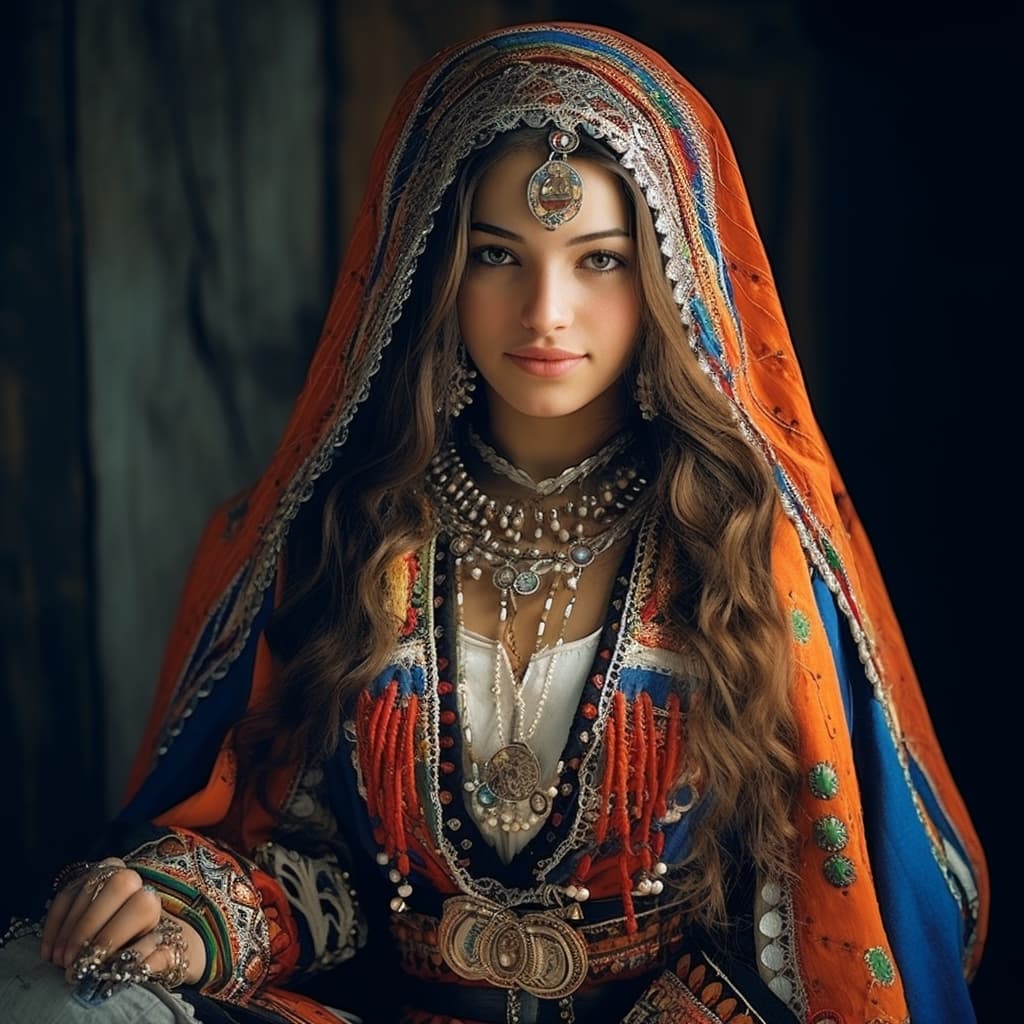
Karachays Erotic
Karachay-Cherkessia (Russia)
Turkic / Kipchak / Karachay
Islam / Sunni Islam
Southern Asia
About Karachays People
The Karachays live in the high valleys of the western Caucasus, on the northern flanks of Mount Elbrus — Europe's tallest peak rises directly out of their pastureland. Their republic, Karachay-Cherkessia, pairs them administratively with the Circassian Cherkess, but the two peoples are unrelated: the Karachays are Turkic, Kipchak-branch, and their nearest linguistic kin are the Balkars across the ridge in Kabardino-Balkaria. The two languages are close enough that linguists often treat them as a single Karachay-Balkar tongue split by Soviet borders rather than by speech.
How a Turkic-speaking people ended up in mountains otherwise dominated by Caucasian-language groups is the central puzzle of their history. The standard account ties them to the medieval Kipchak-Cuman world of the steppe, with Alanic and local Caucasian admixture layered in over centuries; the Karachays themselves often emphasize the Alanic thread. Islam arrived comparatively late — eighteenth century, mostly via Kabardian and Crimean Tatar influence — and settled into a Sunni Hanafi practice that runs alongside an older code of mountain customary law called tau adet, governing hospitality, blood feud, marriage payments, and the obligations between kin.
The defining trauma of the modern Karachay experience is the deportation of November 1943. Stalin accused the entire nation of collaboration with the German occupation and shipped them, in days, to Kazakhstan and Central Asia. Roughly a third did not survive the exile. They were rehabilitated in 1957 and allowed to return, finding their villages renamed and resettled; the slow work of reclaiming homes and graveyards continued into the 1990s. Memorial day on the second of November is observed seriously.
Daily life still carries the imprint of pastoral highland economy. Karachay sheep — a hardy local breed — and the famous Karachay horse, bred for narrow mountain trails, remain points of cultural pride rather than mere agriculture. Cuisine leans on lamb, smoked meats, ayran, and khychin, a thin stuffed flatbread that turns up at every guest table. Respect for elders is structural, not sentimental: seating order, speaking order, and the choreography of a wedding or funeral are all worked out by age and lineage. Polyphonic men's singing, once tied to herding and warfare, survives in performance and at family gatherings, and it sounds nothing like the Russian music of the lowlands an hour's drive away.
Typical Karachays Phenotypes
Reference for AI generation — hair, eyes, skin, facial structure, build
The Karachays are a Turkic-speaking people of the northwest Caucasus, and their phenotype reflects that crossroads — overwhelmingly European in cast, with the lean, high-bridged features common across the Caucasus rather than the broader Central Asian morphology their language family might suggest. Centuries of endogamy in the high valleys around Mount Elbrus have kept the look relatively cohesive compared to neighboring lowland groups.
Hair runs from medium brown to near-black, with chestnut and dark-ash browns common; true blondness is rare but light brown with reddish undertones turns up, particularly in children before darkening with age. Texture is typically straight to gently wavy, fine to medium in density, and male pattern baldness presents on the later side. Beards grow in full and tend toward darker than scalp hair.
Eyes skew brown — mid to dark brown predominates — but a meaningful minority carry hazel, green, or grey-blue, a Caucasian highland pattern shared with Circassians and Balkars. The eye shape is almond, set deep, with a defined upper lid crease and no epicanthic fold; brows are strong and often close-set above the bridge.
Skin is generally Fitzpatrick II–III: pale to light olive with cool or neutral undertones, tanning to a warm wheat color with sun rather than reddening severely. Year-round high-altitude exposure gives many adults a weathered, ruddy finish across the cheekbones.
The face is long and angular more often than round. Noses are a defining feature — high, narrow bridges, often with a slight convex profile or distinct dorsal hump, and relatively narrow alar bases. Lips run thin to medium; the lower lip is typically the fuller of the two. Cheekbones sit high but read more sculpted than wide, and the jawline is firm with a tapered chin.
Build trends tall and lean-muscled — Karachay men commonly clear 178–182 cm — with broad shoulders, narrow hips, and strong hands. Women are slender through the torso with defined waists and long limbs, and aging tends toward sharpening rather than softening of the features.
Data depth
0/100Coverage of image-grounded phenotype observations · drives AI generation diversity
- Sample size
- 0/40· 0 images
- Image quality
- 0/30· 0% high
- Confidence
- 0/20
- Source diversity
- 0/10
- ·No image observations yet
Explore phenotype categories
Structured taxonomy with peer-reviewed scales · 22 anatomical categories






Generate Karachays AI Content
Use this ethnicity's phenotype data to create AI-generated content with accurate physical traits and cultural context.
Open Creator Studio