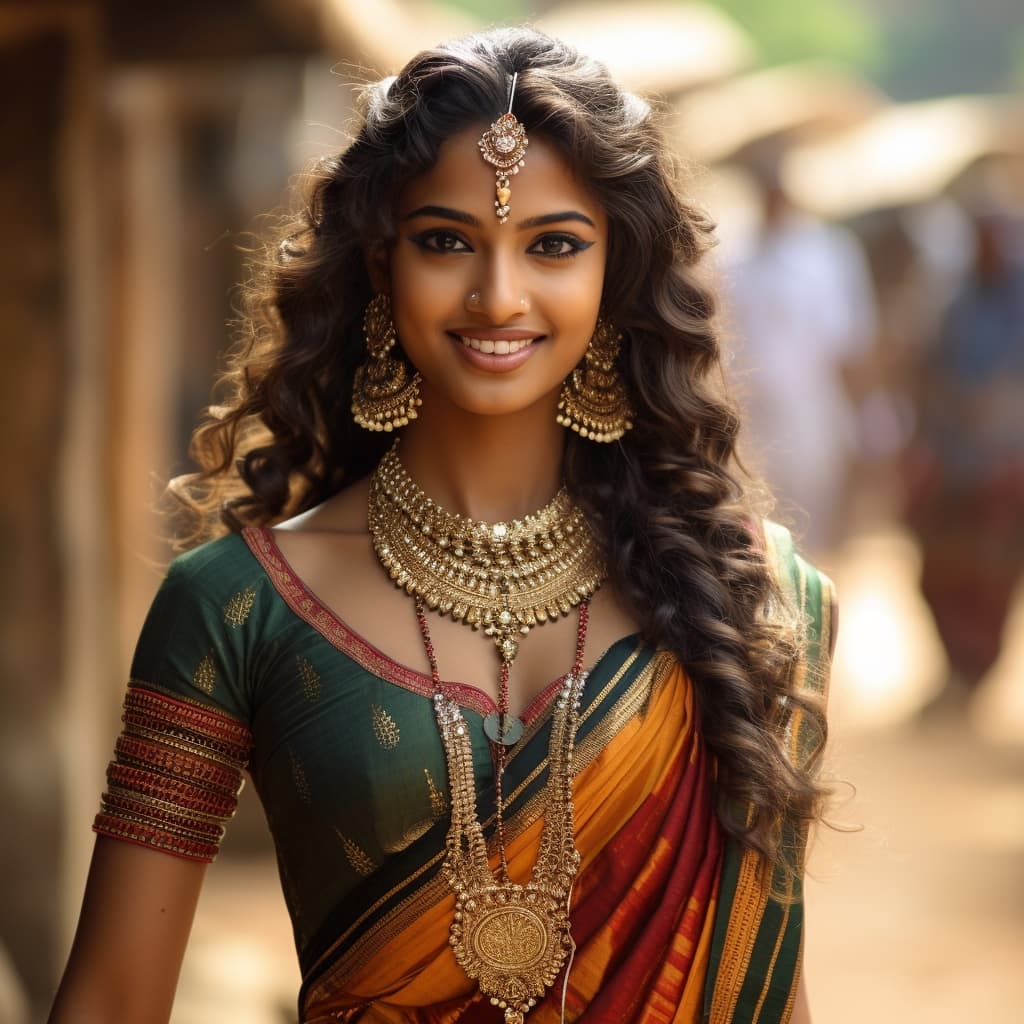
Kannadigas Erotic
Karnataka (India)
Dravidian / Kannada
Hinduism
Vokkaliga
Southern Asia
About Kannadigas People
Kannadigas are the speakers of Kannada, the Dravidian language that anchors the Indian state of Karnataka — roughly the Deccan plateau between the Western Ghats and the dry interior, sliding down to a short Arabian Sea coastline at Mangalore and Karwar. The language itself is one of the older literary tongues in India: Kannada inscriptions run continuously from around the fifth century, and the Kavirajamarga, a ninth-century treatise on poetics, already treats Kannada as a settled literary medium with its own conventions. That long shelf of writing is part of how Kannadigas locate themselves — not as a regional offshoot of a larger Indian story, but as a literary culture with its own canon, its own grammarians, and a script that branched off, alongside Telugu, from a shared Kadamba ancestor.
Geography splits the group into recognizable belts. The coastal strip and the Western Ghats produce one register of culture — rice, fish, areca, the matrilineal traditions that linger in parts of Tulu and Kodava country adjacent to Kannada-speaking areas, and the temple towns of Udupi and Sringeri that exported a particular strand of Vaishnava and Advaita thought. The interior plateau is drier, sorghum-and-ragi country, historically the seat of dynasties — the Chalukyas of Badami, the Hoysalas at Belur and Halebidu, and the Vijayanagara empire whose ruined capital at Hampi still sets the visual vocabulary of South Indian temple architecture. Among the cultivating communities of the southern plateau, the Vokkaligas are the largest single bloc, traditionally landholders around Mysore and the old Mysore princely state, and a defining presence in the politics and agrarian economy of the region.
Religion is overwhelmingly Hindu, but with internal sectarian seams that matter. Karnataka is the heartland of Lingayatism — the twelfth-century reform movement around the poet-saint Basavanna, which rejected caste hierarchy, temple intermediaries, and Sanskrit ritual in favor of personal devotion to Shiva carried in a small linga worn on the body. Lingayats remain a major community alongside the Vokkaligas, and the two form the axis around which much of modern Karnataka politics turns. Layered onto this are sizable Jain, Muslim, and Christian populations — Jainism in particular has deep regional roots, visible in the monolithic Bahubali at Shravanabelagola. Day to day, Kannadiga life tends to read as quietly cosmopolitan: Bengaluru pulls in migrants from across India, but the older cultural centers — Mysore, Dharwad, Mangaluru — keep their own dialects, cuisines, and musical traditions intact, and Kannadigas are generally insistent that their language not be flattened into a generic "South Indian" category.
Typical Kannadigas Phenotypes
Reference for AI generation — hair, eyes, skin, facial structure, build
Kannadigas occupy the Dravidian phenotype band of peninsular India, with a structural signature shaped by long isolation from the Indo-Aryan north and steady gene flow along the western coast. Hair is almost uniformly black to blue-black, with brown highlights surfacing under sun rather than as a base color. Texture runs straight to loose-wavy across most of the population, with tighter curl patterns appearing more often in coastal Karnataka and in older agricultural lineages of the Deccan interior; coarse, dense growth is the norm and premature graying is uncommon before middle age.
Eyes are dark brown to near-black, occasionally a warmer honey-brown in lighter-skinned Vokkaliga and Lingayat lines. The lid is open and almond-shaped — no epicanthic fold — with thick lashes and well-defined brow ridges that read strongly even on softer faces. Skin spans a wide band, roughly Fitzpatrick III through V, with warm olive-to-brown undertones rather than the yellow cast of further-east populations. Coastal Karnataka skews darker and more reddish-brown from sun and humidity; the Deccan plateau and old Mysore region carry lighter wheat-to-tan tones, sometimes noticeably fair in Brahmin and Vokkaliga households.
Facial structure tends toward medium-length oval faces with straight or slightly convex nasal bridges, moderate alar width, and lips of medium fullness — fuller in southern and coastal districts, thinner toward the northern Deccan border with Maharashtra. Cheekbones are present but not high-set; jaws are softer and rounder than in north Indian phenotypes, giving a less angular profile overall. Build is generally compact: average male stature sits around 165–168 cm, female around 152–155 cm, with lean-to-medium frames, narrow shoulders, and a tendency toward central adiposity with age rather than overall mass.
Within the listed Vokkaliga branch, expect the lighter, taller end of this range — historically a landowning agricultural community of the southern Karnataka plateau, with fairer skin and stronger features than the regional average, as seen in figures like M. Visvesvaraya.
Data depth
61/100Coverage of image-grounded phenotype observations · drives AI generation diversity
- Sample size
- 26/40· 20 images
- Image quality
- 20/30· 40% high
- Confidence
- 15/20· mean 0.79
- Source diversity
- 0/10· wikipedia
- ·Modest sample (n<25)
- ·Wikipedia-only source — not population-representative
Observed Distribution — Image Sample
Empirical observations from analyzed photographs · supplementary signal, not population truth
Sample: 20 images analyzed (20 wikipedia). Quality: 8 high, 12 medium, 0 low, 0 very_low. Avg analyzer confidence: 0.79.
Skin tone (Fitzpatrick): IV (35%), V (65%)
Hair color: gray/white (75%), black (10%), other (5%), unclear (10%)
Hair texture: straight (65%), wavy (5%), coily (5%), bald (10%), covered (15%)
Eye color: dark brown (95%), unclear (5%)
Epicanthic fold: 5% present, 95% absent, 0% unclear
Caveats: Sample size 20 is modest — secondary patterns may not be reliable. Sample is 100% Wikipedia notable people — skews toward male, public-life, and modern figures, not population-representative.
Last aggregated: May 7, 2026
Explore phenotype categories
Structured taxonomy with peer-reviewed scales · 22 anatomical categories
Notable Kannadigas People
20 reference figures — sourced from Wikipedia
- Shivakumara Swami — Siddaganga Matha, Tumkur, Karnataka
- Balagangadharanatha Swamiji — Sri Adichunchanagiri Maha Samsthana Math
- Kadidal Manjappa — former chief minister of Karnataka
- B D Jatti — former president and vice president of India
- Mailara Mahadevappa — only person from Karnataka to accompany Gandhiji in Dandi salt sathyagraha/march
- N. K. Naik — Professor Emeritus at IIT Bombay.
- Raja Ramanna — Indian nuclear scientist and father of the Indian nuclear bomb.
- Dr. M.C. Modi — Ophthalmologist and humanist.
- C. N. R. Rao — Notable Solid-state scientist and chairman of Science Advisory Council of GOI…
- K. N. Shankara — Indian space scientist and master in satellite payload technology.
- Shakuntala Devi — Mathematics.
- Vivek Murthy — American physician serves as the 19th Surgeon General of the United States.
- Narayan Hosmane — Biochemistry and Cancer research.
- S. K. Shivkumar — Scientist, ISRO telemetry (ISRO), associated with Chandrayaan-1 lunar probe.
- Shrinivas Kulkarni — Professor of astrophysics and planetary science at Caltech, United States of …
- S. Shankar Sastry — Dean of the College of Engineering at the University of California, Berkeley.
- L. S. Shashidhara — Developmental biologist, geneticist and a professor and chair of Biology at I…
- M. Visvesvaraya — Indian scholar and engineer, who also served as the Diwan of Mysore
- Ullas Karanth — tiger research biologists/zoologist)
- Poornachandra Tejaswi — ornithologist / littérateur)
Generate Kannadigas AI Content
Use this ethnicity's phenotype data to create AI-generated content with accurate physical traits and cultural context.
Open Creator Studio