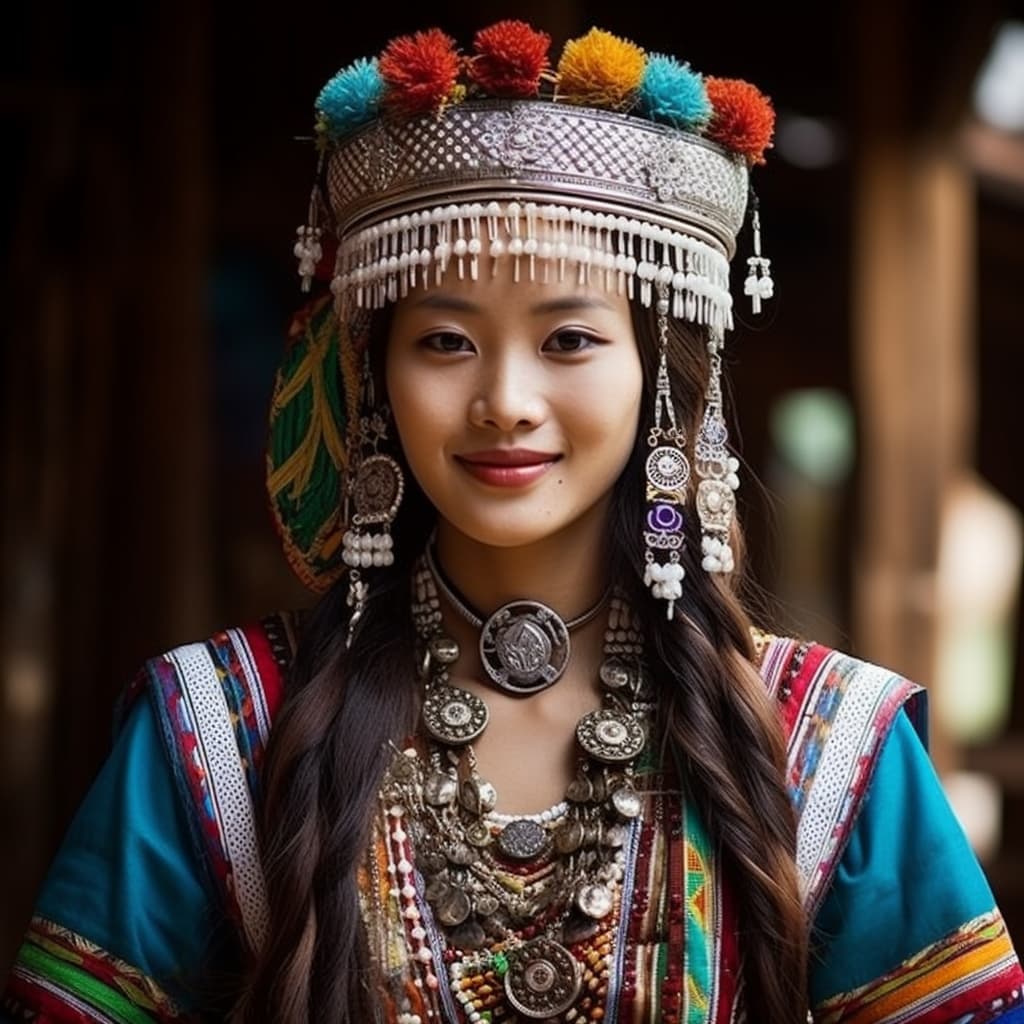
Jingpo Erotic
Kachin State (Myanmar), Yunnan (China) North-East India
Sino-Tibetan / Sal / Jingpho
Animism
Southern Asia
About Jingpo People
The Jingpo are a hill people of the upper Irrawaddy basin, spread across the ridges where Myanmar's Kachin State meets Yunnan and the easternmost slivers of Arunachal Pradesh. In Myanmar they are usually counted as the dominant branch of the broader Kachin grouping — a label that lumps together several related peoples (Lisu, Rawang, Lhaovo, Lacid, Zaiwa) who share territory and political history but not always a mother tongue. The Jingpho language itself sits inside the Sal branch of Sino-Tibetan, more closely related to the Bodo-Garo languages of Assam than to Burmese, which gives some sense of how far these communities have moved and how long their presence in the eastern Himalayas runs.
Jingpo society is built around patrilineal clans, and the older system of gumsa and gumlao — roughly, a chiefly-aristocratic order versus a more egalitarian one — is the case study that made the British anthropologist Edmund Leach famous. His point was that the same villages oscillated between the two over generations, which is a useful corrective to the idea that hill peoples are static. Marriage in the traditional system runs along strict lines between wife-giving and wife-taking lineages, an arrangement that ties villages together as much as it differentiates them.
Animism remains the underlying religious grammar — propitiation of nat spirits attached to households, fields, rivers, and ancestors — though American Baptist missionaries arriving from the late nineteenth century onward converted a large share of the Kachin population, and Christianity is now the public-facing religion of many Jingpo communities in Myanmar. The two layers coexist more than they compete; nat offerings persist around births, illness, and harvest even where Sunday services have replaced the older ceremonial calendar.
The signature public event is the Manau, a multi-day festival originally tied to victory, peace, or major communal transitions, organized around tall painted posts and circling line dances led by a feathered nau shawng. On the Chinese side of the border the Jingpo are one of the recognized minority nationalities of Yunnan, where the festival has been folded into state cultural programming; in Kachin State it remains closer to its older meaning, sharpened by decades of armed conflict between the Kachin Independence Organization and the Myanmar military, which has shaped Jingpo life — displacement, diaspora, a politicized sense of identity — as much as any older tradition.
Typical Jingpo Phenotypes
Reference for AI generation — hair, eyes, skin, facial structure, build
The Jingpo (Kachin) sit at the Tibeto-Burman crossroads of upland Myanmar, Yunnan and Arunachal Pradesh, and their phenotype reads as a hill-country Southeast Asian profile rather than a lowland Burman or Han one. Hair is uniformly black, occasionally with a very dark brown cast in sunlight, and almost always straight to gently wavy with a heavy, coarse strand — the loose curls common further south in island Southeast Asia are essentially absent. Greying tends to come late.
Eyes are dark brown to near-black. The epicanthic fold is near-universal but typically softer and shallower than in Han Chinese populations — many Jingpo faces show a partial or "half" fold rather than the deep monolid, and double eyelids occur at a meaningful rate, especially among Kachin sub-groups closer to the Indian frontier. The palpebral fissure is moderately almond-shaped, set fairly horizontal.
Skin spans Fitzpatrick III through V with warm olive and golden-brown undertones; the upland farming and outdoor life of Kachin State pushes much of the population toward the deeper end, while urban Myitkyina and diaspora communities skew lighter. A genuine yellow-ivory fairness, of the kind associated with northern Han phenotypes, is uncommon.
Facial structure is the giveaway. Cheekbones are high and broad-set, but the midface is less flat than in Mongolic-influenced groups — noses are straight or very slightly convex with a defined bridge and a moderate, not wide, alar base. Lips run medium-full, the lower lip often noticeably fuller than the upper. Jaws are squared in men and softly tapered in women, with a relatively short chin.
Builds are compact and wiry. Men typically fall in the 165–172 cm range, women 152–158 cm, with low body-fat tendencies, narrow hips and dense, well-defined musculature — the MMA fighter Aung La Nsang is an unusually tall but otherwise textbook Jingpo somatotype. Sub-group variation is real: Maru and Lashi branches lean a touch darker and more angular, while Rawang and Lisu-adjacent Jingpo trend lighter-skinned with finer features.
Data depth
57/100Coverage of image-grounded phenotype observations · drives AI generation diversity
- Sample size
- 17/40· 8 images
- Image quality
- 25/30· 50% high
- Confidence
- 15/20· mean 0.82
- Source diversity
- 0/10· wikipedia
- ·Small sample (n<10)
- ·Wikipedia-only source — not population-representative
Observed Distribution — Image Sample
Empirical observations from analyzed photographs · supplementary signal, not population truth
Sample: 8 images analyzed (8 wikipedia). Quality: 4 high, 3 medium, 1 low, 0 very_low. Avg analyzer confidence: 0.83.
Skin tone (Fitzpatrick): II (13%), IV (88%)
Hair color: black (50%), gray/white (50%)
Hair texture: straight (88%), wavy (13%)
Eye color: dark brown (100%)
Epicanthic fold: 100% present, 0% absent, 0% unclear
Caveats: Sample size 8 is small — observed distribution should be treated as suggestive, not definitive. Sample is 100% Wikipedia notable people — skews toward male, public-life, and modern figures, not population-representative.
Last aggregated: May 7, 2026
Explore phenotype categories
Structured taxonomy with peer-reviewed scales · 22 anatomical categories
Notable Jingpo People
13 reference figures — sourced from Wikipedia
- Duwa Lashi La — Acting President of National Unity Government NUG
- Hsu Eaint San — Burmese actress
- Bawmwang La Raw — founder of Kachin National Organisation
- Naung Na Jatan — Burmese politician
- La John Ngan Hsai — businessman and politician
- N'Ban La — Kachin military leader
- Maran Brang Seng — Kachin military leader and politician
- Sumlut Gun Maw — Kachin military leader
- Khet Aung — Kachin politician
- Htang Gam Shawng — Kachin military leader
- Sibo Kai — Indian politician and Member of Legislative Assembly from Arunachal Pradesh
- Aung La Nsang — Burmese and American martial artist
- Sut Ring Pan — Burmese journalist
Generate Jingpo AI Content
Use this ethnicity's phenotype data to create AI-generated content with accurate physical traits and cultural context.
Open Creator Studio