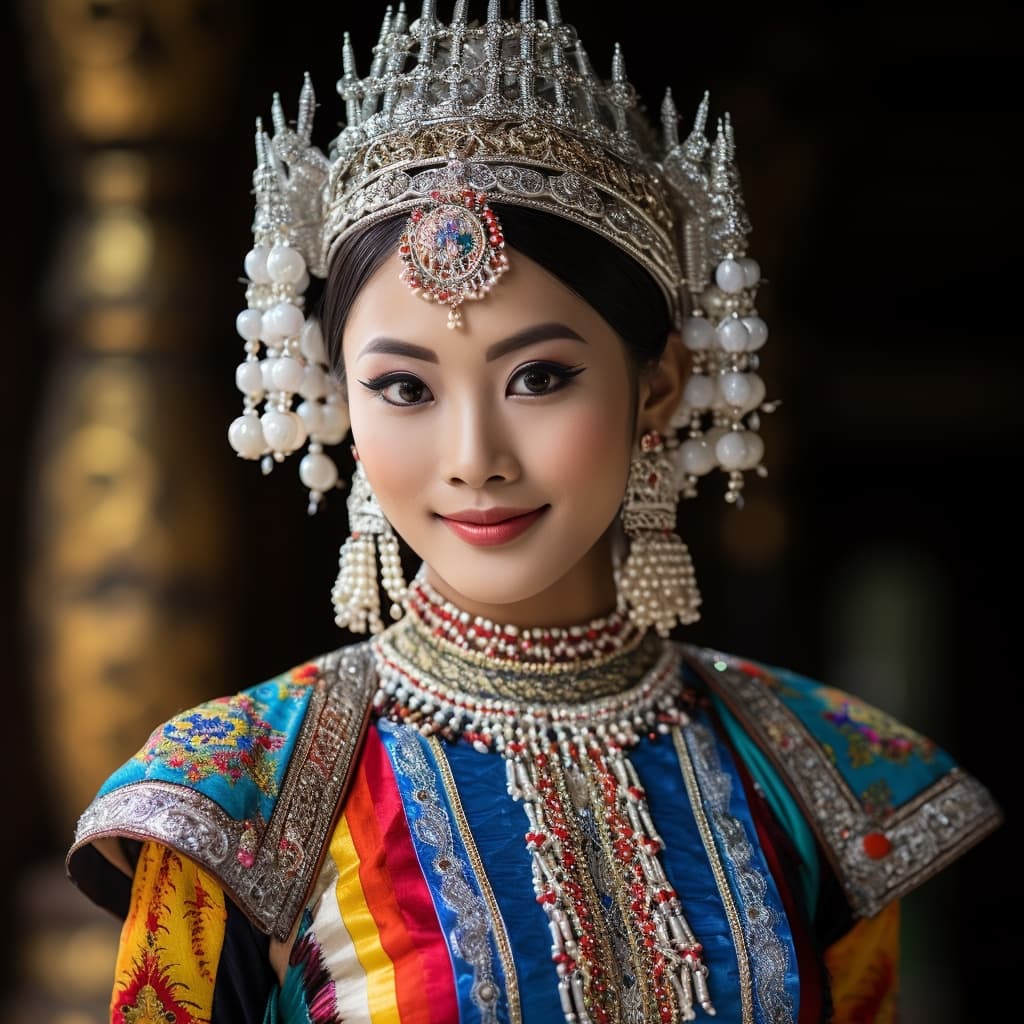
Isan Erotic
Isan (Thailand)
Kra–Dai / Tai / Lao / Isan
Buddhism / Theravada Buddhism
Southeast Asia
About Isan People
The Isan are the people of Thailand's northeastern plateau — roughly a third of the country's population, and the single largest regional bloc inside the Thai state. They are ethnically and linguistically Lao, separated from Laos proper by the Mekong rather than by any deep cultural break. The river is a border on maps; in daily life it is closer to a seam. Families, dialects, recipes, and Buddhist lineages run across it, and the Isan often describe themselves with a doubled identity — Thai citizens, Lao kin.
The plateau itself shapes much of what follows. The Khorat is dry, sandy, and prone to drought; the soil is thin and the rainy season decisive. Wet-rice farming dominates where it can, but Isan agriculture has historically leaned on glutinous (sticky) rice rather than the jasmine rice of the central plains, and on the foraged and fermented edges of the food system — wild greens, freshwater fish, salted and pickled preparations, the chili-and-lime sharpness that has made som tam and laap recognizable far outside the region. Food here is a clearer ethnic marker than dress.
Their language, usually called Isan or Lao Isan, sits inside the Tai branch of Kra–Dai and is mutually intelligible with the Lao spoken across the river. It is written, when written, in the Thai script rather than the Lao one — a consequence of twentieth-century centralization policies that pushed standard Thai through schools, broadcasting, and the civil service. Most Isan today are functionally bilingual, code-switching between Isan at home and Central Thai in formal settings, with a steady undertow of self-consciousness about which register belongs where.
Religion is Theravada Buddhist, but inflected. The village wat is the social center, and the monastic calendar still organizes much of rural life, yet older animist and Brahmanic layers remain visible — spirit houses, phi beliefs, the bun bang fai rocket festivals that fire homemade missiles at the sky to coax rain from the heavens before planting. The annual bun merit-making cycle is observed seriously.
Modern Isan identity is also a labor-migration identity. Decades of seasonal and permanent movement to Bangkok and abroad have made the region both economically peripheral and culturally assertive — mor lam and luk thung music, once dismissed by the capital, now define a recognizable Thai pop idiom. The political weight of the northeast, demographically unavoidable, has made Isan a reliable fault line in national elections.
Typical Isan Phenotypes
Reference for AI generation — hair, eyes, skin, facial structure, build
The Isan are ethnic Lao living on Thailand's northeastern Khorat Plateau, and their phenotype reflects deep Tai-Kadai roots with measurable Khmer and Mon-Khmer admixture from centuries of plateau settlement. Compared to Central Thais, Isan people tend to read slightly darker-skinned and more angular, a pattern often noted within Thailand itself.
Hair is uniformly black to very dark brown, coarse to medium in shaft thickness, and predominantly straight — light waves appear but tight curls are rare. Greying tends to come late. Eyes are dark brown to near-black; the epicanthic fold is near-universal, though it sits less heavily than in northern East Asian populations, producing a more open almond shape rather than a fully hooded lid. Double eyelids occur but are a minority trait, and lashes are typically straight rather than curled.
Skin ranges across Fitzpatrick III to V, with the working rural majority sitting at IV–V and a noticeably warm golden-olive to light-brown undertone. Sun exposure from rice agriculture deepens this considerably; urban and younger Isan trend a shade or two lighter. Compared to Bangkok Central Thais, the Isan baseline skews browner, and this is a widely commented-on marker within Thai society.
Facial structure tends toward broad, somewhat flat midfaces with prominent malar bones and a relatively short, low-bridged nose with moderate alar flare — narrower than Khmer averages but wider than northern Thai or Lanna profiles. Lips are medium-full, well-defined, with a clear vermillion border. Jaws are often square in men and softly tapered in women; chins are usually short.
Build is small to medium-framed. Adult male stature averages roughly 165–168 cm, female 153–156 cm — shorter than the global mean and slightly under Central Thai averages. Body composition is lean and wiry through young adulthood, with a tendency toward central adiposity later in life. Limbs are proportionally short relative to torso, and shoulders are narrow; women carry weight in hips and thighs more than bust.
Data depth
0/100Coverage of image-grounded phenotype observations · drives AI generation diversity
- Sample size
- 0/40· 0 images
- Image quality
- 0/30· 0% high
- Confidence
- 0/20
- Source diversity
- 0/10
- ·No image observations yet
Explore phenotype categories
Structured taxonomy with peer-reviewed scales · 22 anatomical categories






Generate Isan AI Content
Use this ethnicity's phenotype data to create AI-generated content with accurate physical traits and cultural context.
Open Creator Studio