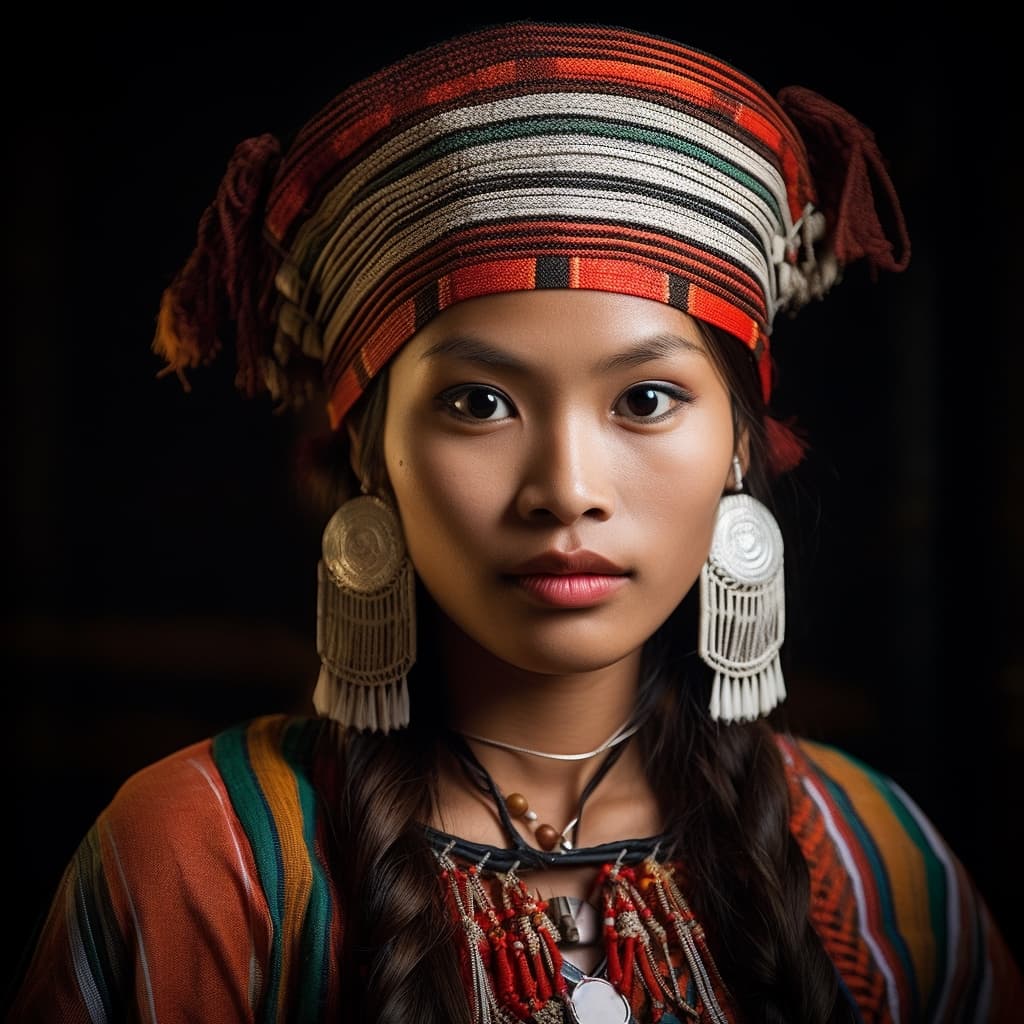
Igorot Erotic
Cordillera Administrative Region (Philippines)
Austronesian / Philippine / Cordilleran
Anitism
Balangao, Bontoc, Ibaloi, Ifugao (including Kalanguya), Isnag, Kalinga, Kankanaey
Southeast Asia
About Igorot People
"Igorot" is an umbrella term, not a single people. It covers at least seven distinct mountain societies of northern Luzon — Bontoc, Ibaloi, Ifugao, Isnag, Kalinga, Kankanaey, Balangao — each with its own language, territory, and political tradition, bound together mostly by a shared geography and a shared history of refusing to be governed from below. The Cordillera is a high, broken country of pine ridges and rice-terraced valleys, and for nearly four centuries it functioned as the single largest piece of the Philippines that Spain never effectively conquered. That fact shapes almost everything else.
The languages belong to the Cordilleran branch of the Philippine subgroup of Austronesian, related to lowland Tagalog and Ilocano but mutually unintelligible with them and often with each other. A Kankanaey speaker from Mountain Province and an Ibaloi speaker from Benguet, two valleys apart, will switch to Ilocano or English to do business. The terraces themselves — the Ifugao stonework at Banaue and Batad is the famous example, but Kalinga and Bontoc built their own — are not monuments. They are working agriculture, two thousand years old in places, maintained by households who still plant tinawon rice on them.
Religion in the older sense is anitist: a layered cosmology of ancestral spirits (anito), nature deities, and ritual specialists who mediate between them through chant, animal sacrifice, and rice-wine offerings. Most Igorot today are nominally Christian — Catholic in the south, Anglican and evangelical in the north, a legacy of the American colonial period rather than the Spanish — but the older practices persist alongside the new ones, especially around death, harvest, and illness. A funeral in an Ifugao village can run for days and involve both a priest and a mumbaki.
The political inheritance is distinctive. Bontoc and Kalinga villages historically governed themselves through the ato or dap-ay, a council of male elders meeting at a stone platform; peace between villages was managed through bilateral treaties called bodong, individually negotiated and individually enforced. Headhunting, which is the thing outsiders always want to talk about, was real until the early twentieth century and was woven into this same political logic — a controlled instrument of intervillage relations, not random violence. Modern Igorot identity carries the weight of all of it: the terraces, the treaties, the long refusal, and a continuing fight over mining concessions, dam projects, and land rights in their own mountains.
Typical Igorot Phenotypes
Reference for AI generation — hair, eyes, skin, facial structure, build
The Igorot phenotype is shaped by long isolation in the Cordillera highlands of northern Luzon, producing one of the more distinctive Austronesian populations in the Philippines. Compared with lowland Filipinos, Igorots tend toward a more compact, muscular build and a slightly more angular facial structure, reflecting both genetic continuity with early Austronesian settlers and centuries of life in steep terraced terrain.
Hair is almost uniformly black, thick, and coarse, usually straight or with a loose wave; tight curls are uncommon. Premature graying is relatively rare, and brown-tinted hair generally appears only with sun bleaching. Eyes are dark brown to near-black, with a present but often moderate epicanthic fold — typically less pronounced than in northern East Asian groups, and the palpebral fissure tends to be slightly wider and more level than the upturned shape common further north. Eyelashes are short and straight.
Skin tones cluster in the Fitzpatrick III–IV range, with warm golden to coppery-brown undertones. Working populations in the rice terraces and uplands often weather to a deeper IV–V from sustained sun exposure, while younger and indoor individuals stay noticeably lighter. The face is broad through the cheekbones with a relatively short midface; the nose is small to medium with a low-to-moderate bridge and a rounded, moderately wide alar base — flatter than mestizo Filipino noses but more defined than typical Negrito profiles. Lips are medium in fullness, jaws are squared rather than tapered, and the chin is modest.
Stature is on the shorter end of the Philippine range — adult men commonly 1.55–1.65 m, women 1.45–1.55 m — paired with dense, well-developed musculature in the legs and shoulders. Subgroup variation is real but subtle: Ifugao and Bontoc tend toward the most compact, muscular build; Kalinga are often taller and leaner with sharper cheekbones; Ibaloi and Kankanaey of the southern Cordillera lean slightly lighter-skinned and rounder-featured; Isnag of the northern frontier sometimes show marginally darker skin and broader noses.
Data depth
0/100Coverage of image-grounded phenotype observations · drives AI generation diversity
- Sample size
- 0/40· 0 images
- Image quality
- 0/30· 0% high
- Confidence
- 0/20
- Source diversity
- 0/10
- ·No image observations yet
Explore phenotype categories
Structured taxonomy with peer-reviewed scales · 22 anatomical categories






Generate Igorot AI Content
Use this ethnicity's phenotype data to create AI-generated content with accurate physical traits and cultural context.
Open Creator Studio