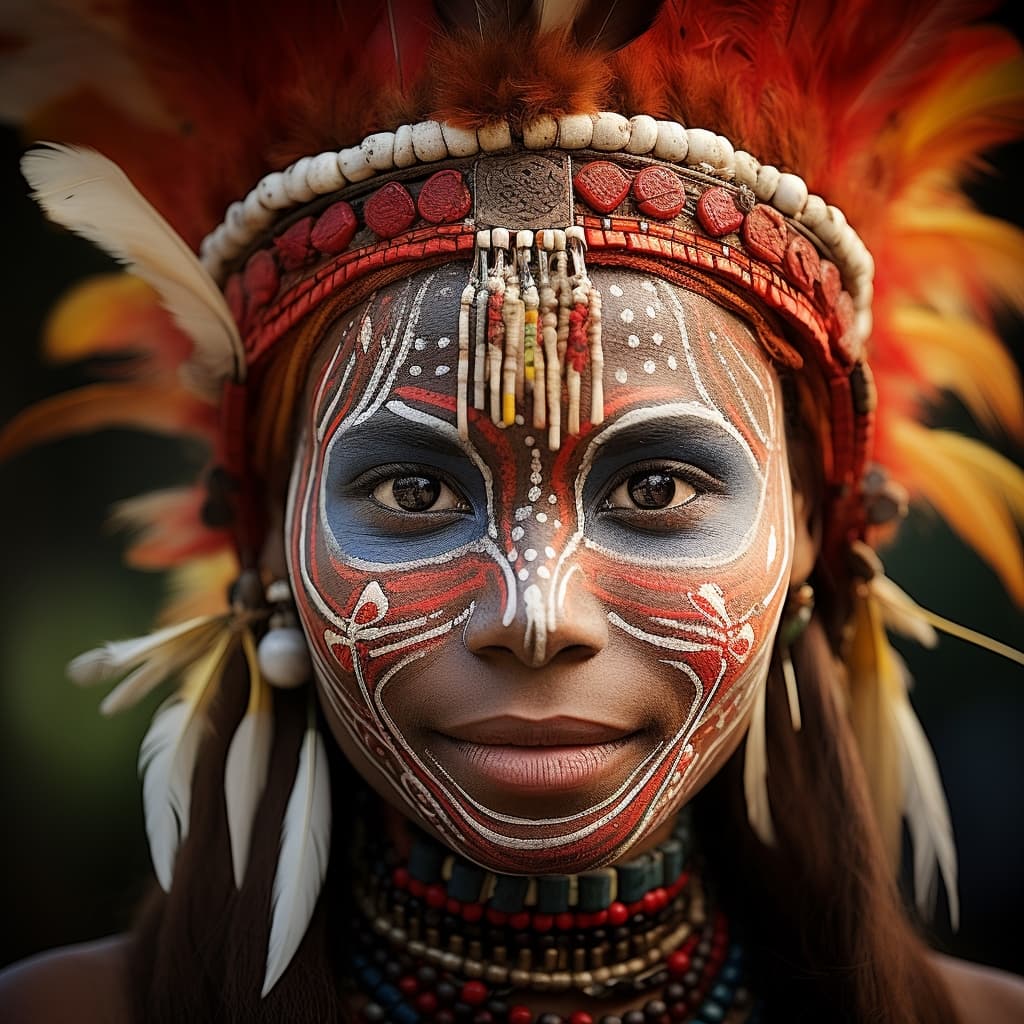
Huli Erotic
Southern Highlands Province (Papua New Guinea)
Trans–New Guinea / Engan / Huli
Christianity
Southern Asia
About Huli People
The Huli live in the high valleys around Tari in Papua New Guinea's Southern Highlands, at elevations where the air is cool and the soil, worked into long parallel ditches, has supported sweet potato cultivation for centuries. They are one of the largest highland populations in the country — several hundred thousand people — and their visibility outside PNG owes a great deal to the men's tradition of growing human-hair wigs shaped over a cane frame and decorated with everlasting daisies, parrot feathers, and the iridescent breast plumage of the Superb Bird-of-Paradise. The wigs are not costume. They are made during a period of seclusion in a wig school, under the guidance of a specialist, and the hair must be grown by the wearer himself under strict ritual rules about diet, contact with women, and exposure to certain plants. A man may produce several wigs in a lifetime; some are ceremonial, some everyday.
Huli belongs to the Engan branch of the Trans–New Guinea family, and sits in a dense neighborhood of related but mutually unintelligible highland tongues — Enga, Ipili, Mendi — the legacy of populations that have lived in adjacent valleys long enough for languages to drift apart while staying recognizably kin. Traditional Huli social organization rests on patrilineal clans tied to specific land, and on a sharp separation between the worlds of men and women: until quite recently, married couples did not share a house, and boys left their mothers around age seven or eight to live in men's quarters. Christianity, mostly through Lutheran, Catholic, and various evangelical missions that arrived after first contact in the late 1930s, is now the dominant religious affiliation, but it overlays rather than replaces older ideas about ancestral spirits, sacred ground, and the ritual responsibilities of clan leaders.
The arrival of the Porgera and Hides resource projects, and the wider footprint of the PNG LNG pipeline, has reshaped Huli life in a single generation: cash, rifles, court cases over land royalties, and renewed clan warfare have all followed. So has a complicated visibility — the wigman in feathers has become one of the standard images used to represent Papua New Guinea abroad, often without much sense of the ritual discipline behind the costume, or of the fact that the people wearing it are negotiating mining contracts and provincial elections in the same week.
Typical Huli Phenotypes
Reference for AI generation — hair, eyes, skin, facial structure, build
The Huli of Papua New Guinea's Southern Highlands present one of the most phenotypically distinct populations in Melanesia, shaped by tens of thousands of years of isolation in highland valleys above 1,500 meters. The hallmark trait is hair: tightly coiled, dense, and famously voluminous — Huli men cultivate it for years to weave the ceremonial wigs that give the group its tourist label, "Wigmen." Natural color is uniformly black-brown, though the ochre clay (ambua) painted across face and hair in ceremony reads visually as orange-red and is often mistaken for pigmentation in photographs.
Eye color sits in the dark brown to near-black range, with no blue or green variants documented. The eye shape is wide-set and deeply socketed under heavy supraorbital ridging — a brow structure more pronounced than in most Asian or African populations and one of the defining Highland Melanesian features. Epicanthic folds are absent. Skin tone runs Fitzpatrick V to VI, with warm red-brown undertones rather than the cooler blue-black undertones common in West African populations; sun exposure at altitude deepens this further on exposed skin while torso and inner-arm tones remain noticeably lighter.
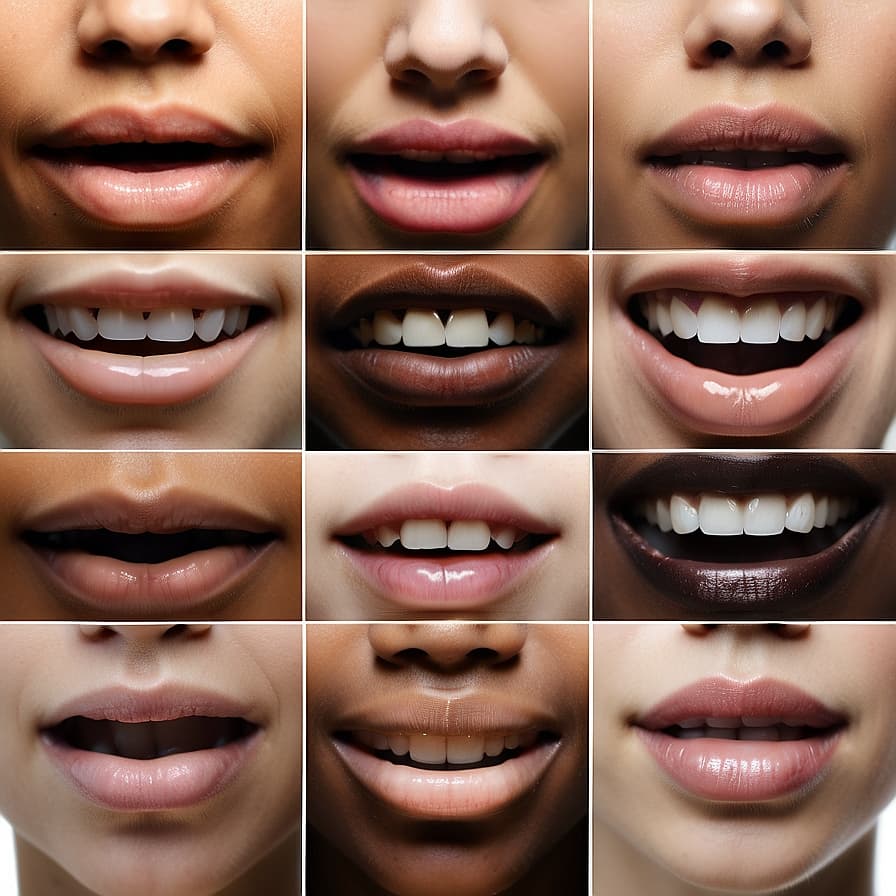
Facial structure is broad and powerful — wide alar bases, low-bridged but fleshy noses, full lips with strong eversion, and square jaws set under high zygomatic arches. Beard growth is heavy, often worn long. Build is compact and densely muscled rather than tall: average male stature lands around 160–165 cm, short by global standards but with exceptional upper-body and leg musculature developed by mountain agriculture and walking. Body fat distribution is low; shoulder-to-hip ratios are pronounced in men.
Genetically, Highland Papuans including the Huli carry the highest proportion of Denisovan ancestry of any living population — roughly 4–6% — and this archaic inheritance is part of what makes their craniofacial profile read so differently from neighboring Austronesian groups along the coast.
Data depth
0/100Coverage of image-grounded phenotype observations · drives AI generation diversity
- Sample size
- 0/40· 0 images
- Image quality
- 0/30· 0% high
- Confidence
- 0/20
- Source diversity
- 0/10
- ·No image observations yet
Explore phenotype categories
Structured taxonomy with peer-reviewed scales · 22 anatomical categories


Generate Huli AI Content
Use this ethnicity's phenotype data to create AI-generated content with accurate physical traits and cultural context.
Open Creator Studio