Gurungs Erotic
Nepal, Sikkim (India), West Bengal (India)
Sino-Tibetan / Gurung
Hinduism, Buddhism
Ghale, Gurung
Southern Asia
About Gurungs People
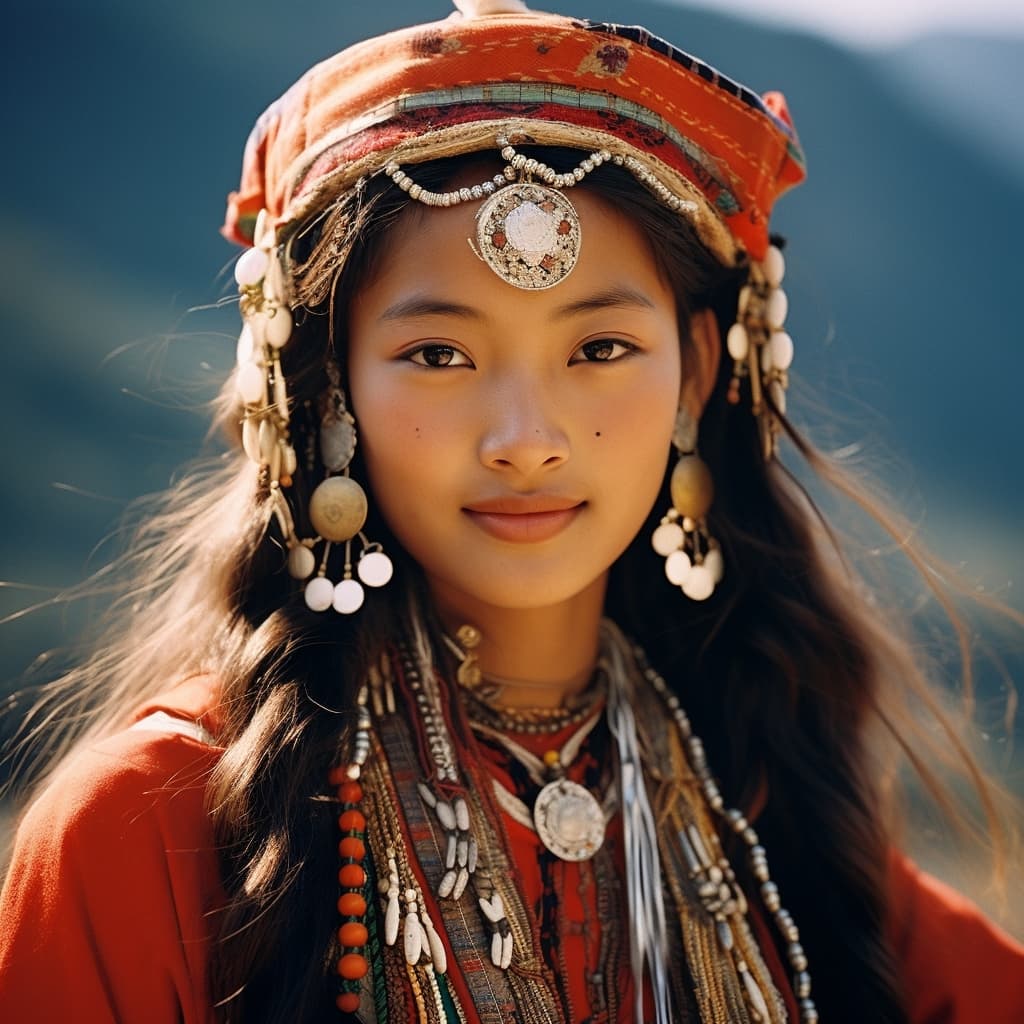
The Gurungs — who call themselves Tamu — live mostly on the middle slopes of the Annapurna and Lamjung massifs in central Nepal, with smaller communities scattered across Sikkim, Darjeeling, and Bhutan. Their villages sit in that particular altitude band where rice gives way to millet and barley, and where the air thins enough that terraced fields are cut into hillsides rather than valleys. The geography matters: Gurung identity has been shaped by what grows at six to eight thousand feet and by the herding routes that climb higher still each summer.
The language, also called Tamu Kyi, belongs to the Tibeto-Burman branch of Sino-Tibetan and is closer to Tamang and Thakali than to the Indo-Aryan Nepali that surrounds it. It carries a tonal system unusual in the region and a body of oral literature — particularly the funeral chants of the pae rite — that has only recently begun to be written down. Two broad lineage groupings, sometimes glossed as Char Jat and Sora Jat (four-clan and sixteen-clan), structure marriage and kinship; the Ghale, named here as a sub-group, are often counted among the higher Char Jat lineages, though the boundaries blur depending on whom you ask in which valley.
Religion among the Gurungs is genuinely layered rather than nominally so. Tibetan Buddhism arrived from the north and Hindu practice from the south, but underneath both sits an older shamanic tradition with two distinct ritual specialists — the pachyu and the klepri — who handle death rites, healing, and the long recitations that escort souls across the mountains. A given household may light butter lamps for a lama, observe Dasain with Hindu neighbors, and still call a pachyu when someone falls ill. None of this is treated as contradiction.
The historical inflection point most outsiders know is the Gurkha recruitment that began in the early nineteenth century, after the Anglo-Nepalese War; Gurungs, alongside Magars, Rais, and Limbus, became central to that institution, and remittance from British and Indian army service has reshaped village economies for two centuries. Less remarked on is the older Gurung practice of the rodi, a village house where unmarried young people gathered in the evenings to sing, weave, and negotiate the courtships that would eventually produce marriages — a social institution that has thinned with migration but has not entirely disappeared.
Typical Gurungs Phenotypes
Reference for AI generation — hair, eyes, skin, facial structure, build
The Gurung phenotype sits clearly within the broader Tibeto-Burman cluster of the central Himalayan midhills, and at first read most outsiders register the face as "Nepali hill-Mongoloid" before the finer regional cues come through. Hair is almost uniformly black or very dark brown, coarse to medium in diameter, and predominantly straight — a loose wave appears in a minority, but tight curl is essentially absent. Greying tends to come late and stays jet-black well into the forties for many.
Eyes are dark brown to near-black, with a clearly present epicanthic fold in the great majority and a moderately low, often single eyelid crease. The palpebral aperture is typically narrower and more horizontally set than in Indo-Aryan Nepali neighbours from the Tarai — this is one of the fastest visual tells distinguishing a Gurung face from a Bahun or Chhetri face on the same trail. Skin runs Fitzpatrick III to IV, with warm yellow-olive undertones rather than the red-brown undertones common further south; high-altitude pasture life adds weathered cheek flush and deeper tanning on exposed skin while the torso stays noticeably lighter.
Facial structure is the signature: relatively flat midface, broad and prominent malar (cheek) bones, a low and fairly wide nasal bridge with rounded, moderately fleshy alae, and lips of medium fullness — neither thin nor everted. Jaws are squared but not heavy, chins modest. Stature is short by global standards, with men commonly 5'2"–5'5" and women 4'9"–5'1", but build is famously compact and densely muscled through the legs and back — the anthropometric profile that historically made Gurungs prized Gurkha recruits.
Between the two listed branches, Ghale lineages tend to read slightly more classically Tibetan — taller-set cheekbones, paler winter skin, occasional lighter brown hair in children — while Gurung-proper lineages from lower Lamjung and Kaski elevations show a touch more midhill blending, with marginally higher bridges and a hair more facial hair in men.
Data depth
0/100Coverage of image-grounded phenotype observations · drives AI generation diversity
- Sample size
- 0/40· 0 images
- Image quality
- 0/30· 0% high
- Confidence
- 0/20
- Source diversity
- 0/10
- ·No image observations yet
Explore phenotype categories
Structured taxonomy with peer-reviewed scales · 22 anatomical categories

Generate Gurungs AI Content
Use this ethnicity's phenotype data to create AI-generated content with accurate physical traits and cultural context.
Open Creator Studio