Gujarati Erotic
Gujarat (India)
Indo-European / Indo-Aryan / Gujarati
Hinduism, Islam
Koli, Bharwad, Khoja, Patidar, Sunni Bohra, Lohana, Vagri, Kharva, Charan, Baria, Momna, Ghanchi, Shenva, Bhambi Khalpa, Zarabes, Bhoi, Luso-Indians, Gujarati Americans
Southern Asia
About Gujarati People
Gujaratis are the people of India's western coast — the long, hand-shaped state of Gujarat that juts into the Arabian Sea, all salt flats, port cities, and dry interior plains. More than any other Indian community, they are defined by mercantile reach. Gujarati traders were running dhows between Surat, Aden, Mombasa, and Muscat centuries before the Portuguese turned up, and that orientation outward is still legible everywhere: in the diaspora that runs corner shops in Leicester and motels in New Jersey, in Jain merchant lineages whose ledgers go back generations, in the Khoja and Bohra communities whose religious identity was shaped by Indian Ocean commerce as much as by doctrine.
The language belongs to the Indo-Aryan family, a sister to Hindi and Marathi, written in its own script and carrying a strong literary tradition — Narsinh Mehta in the fifteenth century, Govardhanram Tripathi in the nineteenth, a poetic and devotional vocabulary shaped by the Bhakti movement. Religiously the picture is layered. The Hindu majority leans heavily Vaishnav, with Krishna at Dwarka anchoring a particular emotional register, and Jainism — though small in population — carries weight far beyond its numbers, having shaped Gujarati attitudes toward vegetarianism, non-violence, and business ethics. Sunni and Shia Muslim communities, including the distinctive Khojas and Bohras, are not minorities at the edge of the culture; they are part of how it works, especially in trading towns.
The internal map is dense. Patidars came up through agriculture and now dominate professional and political life. Kolis are a large pastoral and fishing population scattered across the coast and interior. Bharwads herd sheep across the Saurashtra grasslands. Charans are a bardic caste with a long tradition of court poetry and oral genealogy. Lohanas and Bhatias are old trading communities. The Kharva and Bhoi work the water. Each carries its own customs, its own marriage rules, its own set of household deities, and treating "Gujarati" as a single texture flattens what is actually a federation.
Two modern inflections shape how the community sees itself. Gandhi was Gujarati, born in Porbandar, and the moral self-image of the state still runs partly through him. And the 2001 earthquake and the communal violence of the following year remain, twenty-odd years on, raw points in living memory — the kind of recent history that quietly informs how people talk about home.
Typical Gujarati Phenotypes
Reference for AI generation — hair, eyes, skin, facial structure, build
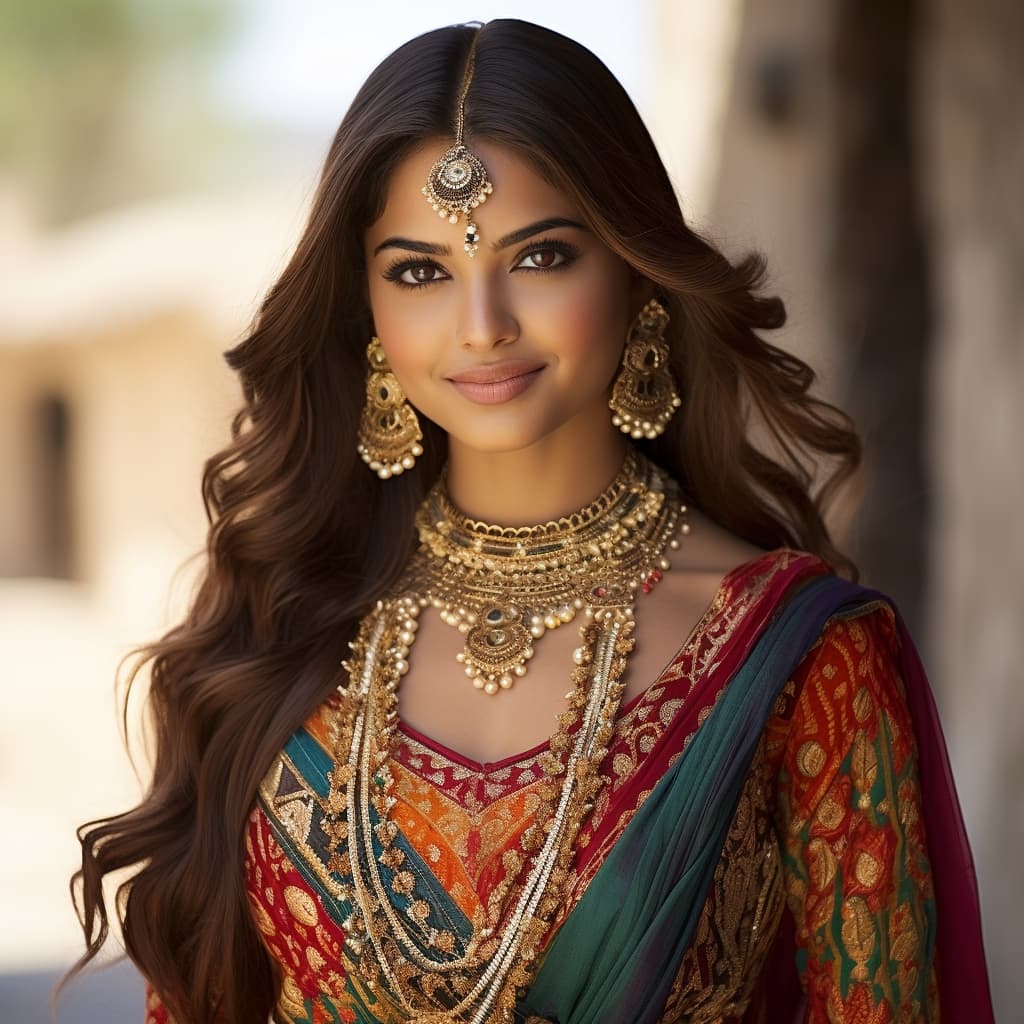
Gujaratis sit on the western edge of the South Asian phenotype range, and the dominant structural note is mid-tone skin paired with sharply defined Indo-Aryan features — a narrower, higher-bridged nose than you'll see further east in India, and a face that tends to be oval to long rather than broad. Hair is almost universally black or very dark brown, thick, and ranges from straight to loosely wavy; tight curls are uncommon. Greying patterns skew early in some lineages — salt-and-pepper from the late thirties is unremarkable. Body hair on men is typically moderate to heavy, with full beard growth.
Eye color is overwhelmingly dark brown to near-black, with occasional lighter hazel or honey-brown showing up in Patidar, Lohana, and some Bohra and Khoja lines that carry older Persian or Central Asian admixture. Eyes are almond-shaped, set under defined brows; no epicanthic fold. Skin spans Fitzpatrick III through V — wheatish (a term Gujaratis themselves use) is the modal tone, with warm yellow-olive undertones rather than the cooler red-brown undertones common in eastern India. Coastal and pastoralist sub-groups like the Kharva, Koli, and Bharwad tend darker, often Fitzpatrick V, weathered by sun exposure. Urban Patidar and merchant-caste Lohana populations often sit at III–IV.
Facial structure is the giveaway: medium-to-narrow alar base, a bridge that's straight or slightly aquiline, lips of moderate fullness (fuller than North Indian Punjabi norms but less so than Dravidian South Indian), and a defined jaw. Cheekbones are present but not high-set. Build runs lean to medium-frame, with documented short-to-medium stature — Gujarati men average around 5'5"–5'7", women 5'0"–5'2" — and a known tendency toward central adiposity and elevated cardiometabolic risk even at lower BMIs, the so-called thin-fat phenotype. Bharwad and Rabari pastoralists are the visible outliers: taller, more angular, darker, with the weather-cut features of a herding life, distinct from the softer urban Patidar look most outsiders picture as Gujarati.
Data depth
0/100Coverage of image-grounded phenotype observations · drives AI generation diversity
- Sample size
- 0/40· 0 images
- Image quality
- 0/30· 0% high
- Confidence
- 0/20
- Source diversity
- 0/10
- ·No image observations yet
Explore phenotype categories
Structured taxonomy with peer-reviewed scales · 22 anatomical categories






Generate Gujarati AI Content
Use this ethnicity's phenotype data to create AI-generated content with accurate physical traits and cultural context.
Open Creator Studio