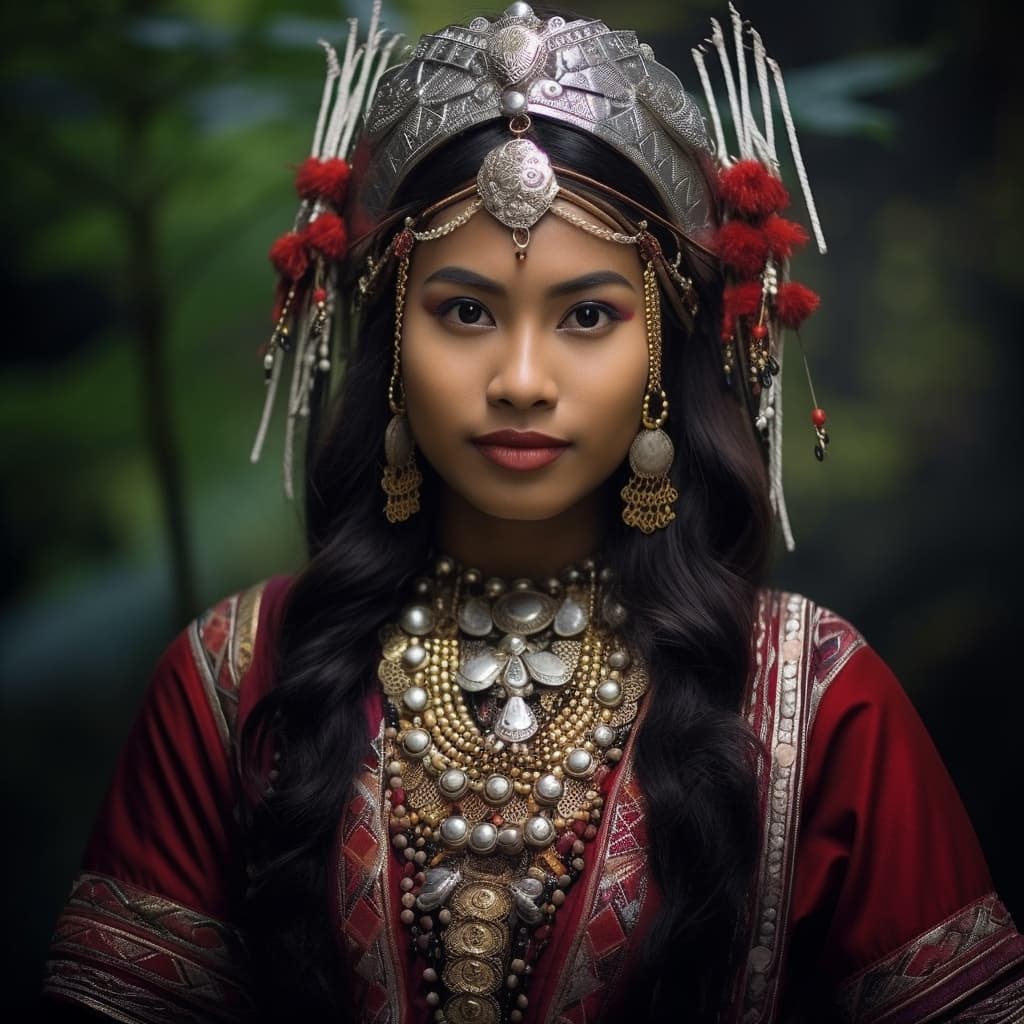
Gorontaloans Erotic
Gorontalo (Indonesia)
Austronesian / Philippine / Gorontaloan
Islam / Sunni Islam
Southeast Asia
About Gorontaloans People
The Gorontaloans occupy the narrow neck of northern Sulawesi, where the island bends east toward the Sangihe chain. Their homeland is mountainous and coastal at once — a strip of lowland rice country pressed between the Tomini and Sulawesi seas, with volcanic ridges rising sharply behind the towns. Around a million and a half people speak Gorontalo, and the province that bears their name was carved out of North Sulawesi only in 2000, a recent administrative recognition of an identity that has been distinct for centuries.
Linguistically they sit in an interesting place. Gorontalo belongs to the Philippine branch of Austronesian — closer in deep structure to Tagalog or Cebuano than to Javanese or Malay — making the Gorontaloans, along with their Mongondow and Sangir neighbors, the southern outliers of a language family whose center of gravity lies several hundred kilometers north. The language has its own internal divisions, with dialects shading into one another between the old kingdom-towns of Limboto, Suwawa, Atinggola, and Gorontalo proper.
Islam arrived here in the sixteenth and seventeenth centuries, principally through the conversion of Sultan Amai of Gorontalo around 1525, and it took root deeply enough that Gorontalo is sometimes called the Serambi Madinah — the Veranda of Medina — of eastern Indonesia. Sunni practice is woven through ordinary life rather than performed at a remove from it: Friday observance, Ramadan fasting, and the rhythms of the mosque set the public calendar. What is striking, though, is how thoroughly pre-Islamic adat has survived inside that frame. The classical confederation of Pohala'a — the five linked kingdoms of Gorontalo, Limboto, Suwawa, Bolango, and Atinggola — still organizes ceremonial life, and its protocols govern weddings, royal investitures, and funerals with a precision that the modern province defers to.
The wedding rites are the clearest window onto this layering. A Gorontaloan marriage is formally Islamic but procedurally elaborate: the bride's baruwa headdress, the gilded bili'u regalia, the slow processional dances and the recitation of dialogue between the families' representatives all belong to a courtly tradition older than the conversion. Rice agriculture, freshwater fishing on Lake Limboto, and small-boat trade across the Tomini Gulf still anchor the economy, even as Gorontalo City has grown into a regional university hub. The result is a people who read as recognizably Sulawesian and recognizably Muslim, but on terms — linguistic, ceremonial, political — that are entirely their own.
Typical Gorontaloans Phenotypes
Reference for AI generation — hair, eyes, skin, facial structure, build
Gorontaloans occupy a phenotypic middle ground between the Philippine-affiliated Austronesian populations to the north and the broader Sulawesi cluster, with a strong but not absolute Southern Mongoloid signature softened by long contact with Bugis, Makassarese, and Arab-descended traders along the Tomini coast. The look skews compact, fine-boned, and warm-toned rather than the more robust morphology seen further east toward Maluku.
Hair is overwhelmingly straight to gently wavy, jet black to very dark brown, and thick-shafted — coarse curl is uncommon and usually traces to Papuan or African admixture. Premature graying in the 40s is widely observed. Eye color sits firmly in dark brown to near-black; a moderate epicanthic fold is the norm but rarely as pronounced as in northern East Asian populations, and a meaningful minority — particularly in coastal lineages — shows only a faint inner fold or none at all. Eye shape tends almond, set on a relatively flat orbital plane.
Skin tone covers Fitzpatrick III through V, clustering at IV: a warm golden-brown to medium tan with yellow-olive undertones rather than the redder undertones common in nearby Minahasan or Sangirese populations. Inland highland Gorontaloans run lighter; coastal fishing communities along Tomini Bay sit notably darker from sun exposure layered over the same base.
Facial structure is the clearest tell. Noses are short with a low-to-medium bridge and moderately wide alae — neither the narrow profile of insular Southeast Asians further west nor the broad form of eastern Indonesian groups. Lips run medium-full, often with a defined cupid's bow. Cheekbones are present but rounded, jaws tapered, faces broadly oval to heart-shaped. The combination of a softly rounded face, golden-olive skin, and a short low-bridged nose is the most consistent regional marker.
Build is small-to-medium: men typically 162–168 cm, women 150–157 cm, with slim-to-mesomorphic frames, narrow shoulders relative to hip width in women, and a tendency toward soft midsection weight gain after early adulthood rather than muscular bulk.
Data depth
0/100Coverage of image-grounded phenotype observations · drives AI generation diversity
- Sample size
- 0/40· 0 images
- Image quality
- 0/30· 0% high
- Confidence
- 0/20
- Source diversity
- 0/10
- ·No image observations yet
Explore phenotype categories
Structured taxonomy with peer-reviewed scales · 22 anatomical categories






Generate Gorontaloans AI Content
Use this ethnicity's phenotype data to create AI-generated content with accurate physical traits and cultural context.
Open Creator Studio