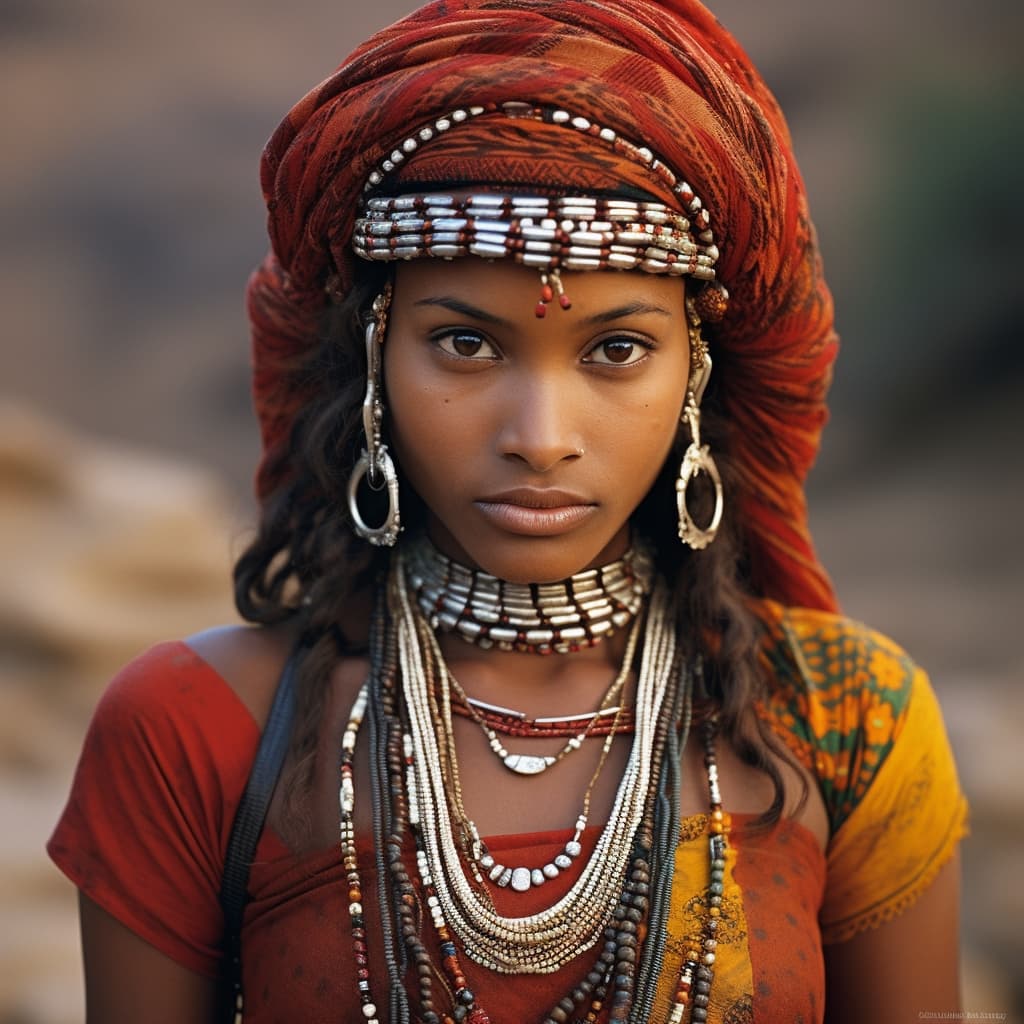
Gonds Erotic
Gondwana (India)
Dravidian / Gondi
Hinduism
Godha, Madia Gonds, Muria, Koya
Southern Asia
About Gonds People
The Gonds are one of the largest tribal populations in India, numbering in the millions and concentrated across the forested plateau country of central India — Madhya Pradesh, Chhattisgarh, Maharashtra, Telangana, Andhra Pradesh, and Odisha. The name Gondwana belongs to them: a belt of hills, sal forests, and river valleys that geologists later borrowed to name the ancient southern supercontinent. Despite the size of the population and the territory, Gonds have historically lived as a constellation of branches rather than a single political body — Raj Gonds, Madia, Muria, Koya, Dorla, and others, each with its own dialect register and ritual repertoire.
Their language, Gondi, belongs to the Dravidian family — the same family as Tamil and Telugu — which makes the Gonds a linguistic island in a sea of Indo-Aryan speakers in central India. The mismatch tells a longer story: Dravidian-speaking populations once extended much further north before Indo-Aryan languages displaced them, and the Gonds are part of what survived in the hills. Not every Gond speaks Gondi today; in much of the Hindi belt, daily life has shifted toward Hindi or Chhattisgarhi, while Koya speakers in the south sit closer to the Telugu sphere.
Religion is layered. Most Gonds are counted as Hindu in the census, and the Gond pantheon has long absorbed and been absorbed by surrounding Hindu practice — the clan deity Persa Pen sits alongside village goddesses, ancestor spirits, and figures from the broader Hindu fold. But underneath that surface is an older clan-based system organised around saga divisions (four-, five-, six-, and seven-god clans), each with its own ritual obligations and totems. The Pardhans, a bardic group historically attached to the Gonds, kept the genealogies and sang the deeds of clan ancestors; that oral tradition is the backbone of what's now called Gond mythology.
The Muria of Bastar are best known outside the community for the ghotul, a youth dormitory institution where adolescents lived communally and learned the work, music, and social codes of adult life — an arrangement anthropologists wrote a great deal about in the twentieth century, and one that has thinned considerably under modern schooling and outside scrutiny. Gond visual art — the dotted, line-built paintings associated with the Pardhan-Gond school out of Patangarh — moved from house walls onto canvas in the late twentieth century and now circulates internationally, though the tradition behind it is older than the gallery version suggests.
Typical Gonds Phenotypes
Reference for AI generation — hair, eyes, skin, facial structure, build
The Gonds are one of the largest Adivasi (tribal) populations of central India, and their phenotype reflects a deep South Asian Dravidian-Australoid substrate that predates the Indo-Aryan layer over much of the subcontinent. Skin tone clusters firmly in the Fitzpatrick IV–VI band, with warm brown to deep umber the modal range; Madia and Muria communities of the Bastar forests trend darker, while northern Rajgond lineages from the Satpura and Maikal hills carry slightly lighter olive-brown tones. Undertones run warm — bronze and red-bronze rather than yellow.
Hair is near-universally black to blue-black, thick-shafted, and ranges from pin-straight to loosely wavy; tight curls are uncommon. Greying tends to come late. Eyes are uniformly dark brown to near-black, set under a low, often heavy brow with a horizontal almond shape; the epicanthic fold is generally absent, though a faint medial fold appears in eastern Koya groups bordering tribal Andhra and Odisha.
Facial structure is the most distinctive register. Noses are typically broad-based with a low to medium bridge and wider alar wings than mainstream North Indian populations — the Australoid signature is clearest here. Lips are full, often with a pronounced philtrum and a slightly everted lower lip. Cheekbones sit high and wide, jaws are squared rather than tapered, and the overall face reads as broad and horizontally oriented. Komaram Bheem's portraits capture the type well: heavy brow, broad nose, strong jaw.
Build is compact and wiry. Men average roughly 162–166 cm, women 150–154 cm — shorter than the Indian national mean — with low body fat, lean musculature from forest and agricultural labour, and narrow hips. The Madia and Muria of the Bastar interior are visibly the most phenotypically distinct branch, retaining the broadest noses, darkest skin, and shortest stature; Rajgond and Koya populations, with longer histories of admixture along the Telugu and Hindi-belt margins, show somewhat softened features and a wider tonal range.
Data depth
22/100Coverage of image-grounded phenotype observations · drives AI generation diversity
- Sample size
- 14/40· 6 images
- Image quality
- 8/30· 17% high
- Confidence
- 0/20· mean 0.27
- Source diversity
- 0/10· wikipedia
- ·Small sample (n<10)
- ·Low overall confidence
- ·Mostly low-quality source images
- ·Wikipedia-only source — not population-representative
Observed Distribution — Image Sample
Empirical observations from analyzed photographs · supplementary signal, not population truth
Sample: 6 images analyzed (6 wikipedia). Quality: 1 high, 2 medium, 2 low, 1 very_low. Avg analyzer confidence: 0.27.
Skin tone (Fitzpatrick): IV (33%), V (17%), unclear (50%)
Hair color: black (33%), unclear (67%)
Hair texture: covered (100%)
Eye color: dark brown (50%), unclear (50%)
Epicanthic fold: 0% present, 50% absent, 50% unclear
Caveats: Sample size 6 is small — observed distribution should be treated as suggestive, not definitive. Quality skews toward older or low-resolution photos; phenotype detail may be lossy. Low average analyzer confidence — many photos partially obscured or historical. Sample is 100% Wikipedia notable people — skews toward male, public-life, and modern figures, not population-representative.
Last aggregated: May 7, 2026
Explore phenotype categories
Structured taxonomy with peer-reviewed scales · 22 anatomical categories
Notable Gonds People
18 reference figures — sourced from Wikipedia
- Komaram Bheem — freedom fighter
- Gunda Dhur — tribal leader
- Ramji Gond — tribal chief
- Asha Gond — skateboarder
- Hridayshah — king of Garha
- Ajanbahu Jatbasha — founder of the Gonds of Deogarh dynasty
- Motiravan Kangali — linguist and author
- Kanaka Raju — gusadi dancer
- Bakht Buland Shah — Rajgond ruler
- Dalpat Shah — 49th ruler of the Garha Kingdom.
- Raghunath Shah — freedom fighter
- Sangram Shah — king of Garha
- Shankar Shah — freedom fighter
- Baburao Shedmake — tribal freedom fighter
- Chakradhar Singh — raja of Raigarh State
- Karunkar Singh — freedom fighter
- Nareshchandra Singh — first Scheduled Tribe Chief Minister of Madhya Pradesh
- Veer Narayan Singh — activist






Generate Gonds AI Content
Use this ethnicity's phenotype data to create AI-generated content with accurate physical traits and cultural context.
Open Creator Studio