Garos Erotic
Garo Hills (India)
Sino-Tibetan / Sal / Garo
Christianity
Southern Asia
About Garos People
The Garos call themselves A·chik — "hill people" — and the name fits the geography exactly. Their homeland is a compact tangle of low forested ranges in what is now Meghalaya, in India's far northeast, with a smaller population spilling across the border into Bangladesh's Mymensingh plains. The hills are wet, deeply green, and cut by countless small rivers; the soil is poor enough that until recently most Garo cultivation was jhum, the rotating slash-and-burn system that shaped both the landscape and the rhythm of village life.
Linguistically the Garos sit inside the Sal branch of Sino-Tibetan, alongside the Bodo and Kachin/Jinghpaw further east — a quiet reminder that the deep linguistic ties of Northeast India run not toward the subcontinent but toward upland Burma and southwest China. Garo itself is a cluster of mutually intelligible varieties; A·we, Chisak, Matchi, Dual and others trace older clan and territorial divisions. The language was first written down by American Baptist missionaries in the nineteenth century, and that encounter is the second great fact of Garo identity: today the overwhelming majority are Christian, mostly Baptist or Catholic, and the church functions as both spiritual home and social spine. The older religion, Songsarek — an ancestor- and spirit-centered practice with its own priesthood and harvest cycle — survives in pockets and, more diffusely, in the vocabulary of festivals like Wangala, the post-harvest drumming festival now celebrated by Christians and Songsarek alike.
What sets the Garos apart from almost every neighboring group, Hindu or tribal, is that they are matrilineal. Property and clan name pass from mother to youngest daughter, the nokna, who inherits the house and the obligation to care for aging parents. Husbands move into their wives' households. This is not a ceremonial inversion — it is the actual structure of land tenure and family authority, and it has held up remarkably well against a century and a half of Christian, colonial, and Indian-national pressure to standardize family law. Politically the Garos are organized through the Garo Hills Autonomous District Council, a constitutional carve-out that protects customary law and clan land. Outsiders often note the music — Garo choirs are unusually accomplished, a Baptist inheritance turned local — and the food, which leans on dried fish, bamboo shoot, and a fiery chili paste called nakham bitchi that no visiting palate forgets.
Typical Garos Phenotypes
Reference for AI generation — hair, eyes, skin, facial structure, build
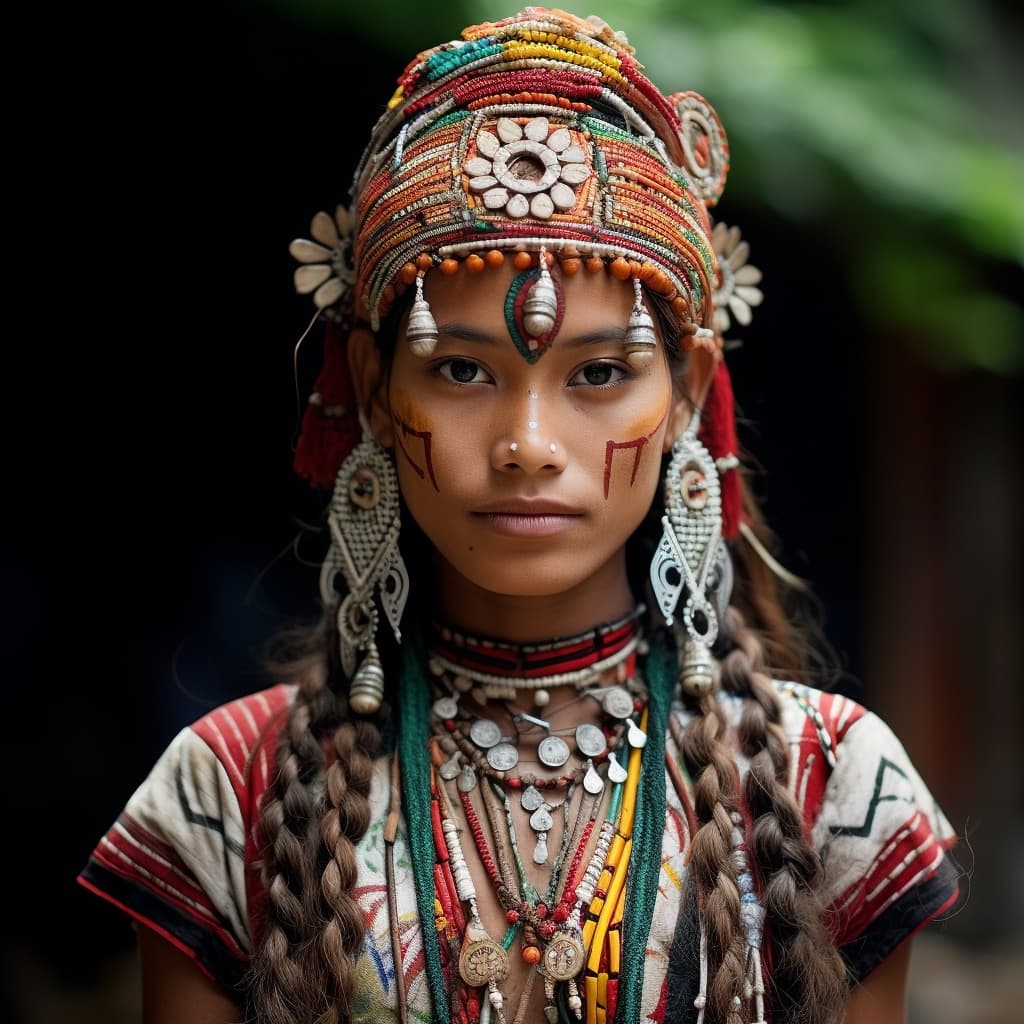
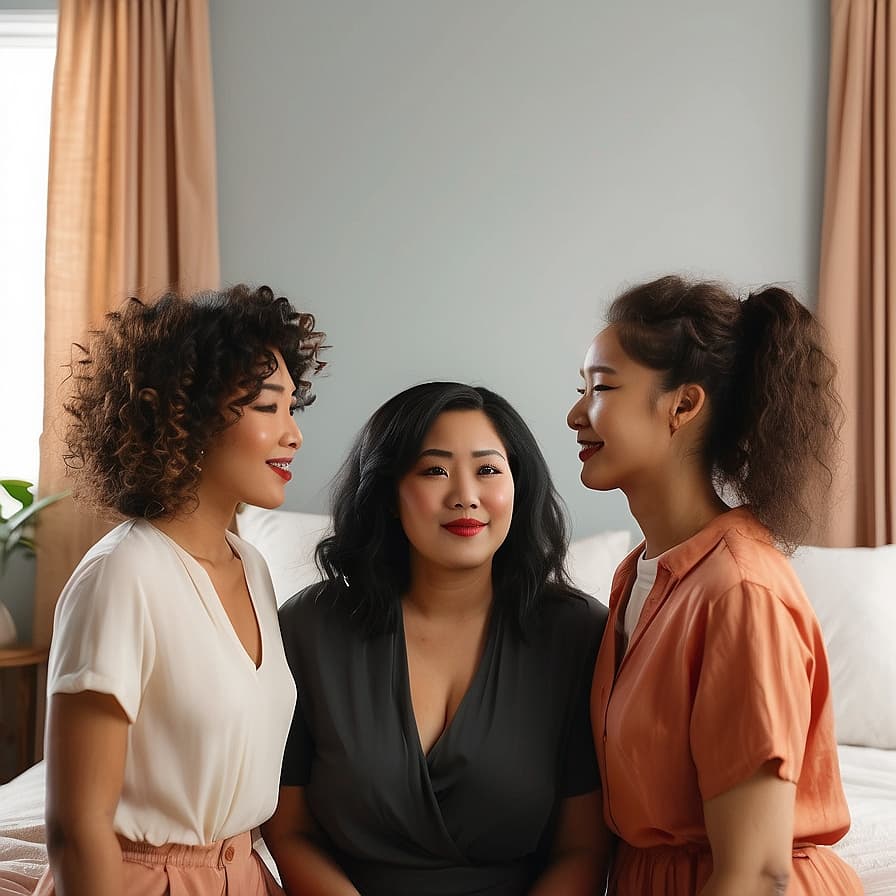
The Garo phenotype reads as East Asian first, South Asian second — a Sino-Tibetan-speaking population in the Meghalaya hills whose appearance sits closer to upland Southeast Asia and southern China than to the Indo-Aryan plains around them. Hair is uniformly straight to gently wavy, coarse in texture, and almost always blue-black; natural brown shades are rare, and the silvering pattern with age tends toward salt-and-pepper rather than uniform graying. Most adults wear it heavy and sleek; it holds shape rather than frizzing in the region's humidity.
Eyes are dark brown, occasionally near-black, and the epicanthic fold is present in the great majority — full mongoloid fold in many, partial in others, especially among those with mixed Bengali ancestry along the southern foothills. Eye shape skews almond and slightly upturned, with relatively low orbital projection. Skin tones cluster in the Fitzpatrick III–IV band: a warm, golden-tan to light-brown range with yellow rather than red undertones. Highland Garos who work indoors run noticeably lighter than plains-adjacent communities, and sun exposure deepens the tone toward an even bronze rather than burning.
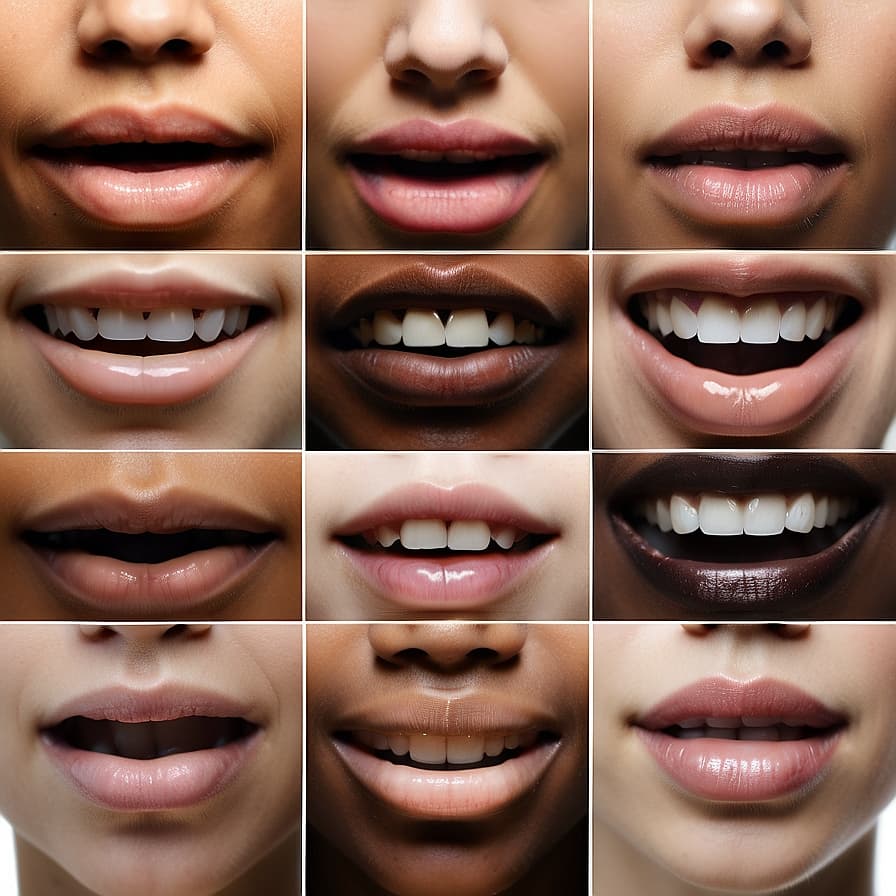
Facial structure carries the clearest signature. Cheekbones are wide and high, the malar region prominent, with relatively flat midfaces and modest brow ridges. Noses are short with a low to medium bridge and a moderately wide alar base — rarely the high, narrow Indo-Aryan nose of neighboring populations. Lips are medium in fullness, mouths typically wide. Jaws are squared in men, softer and more tapered in women, with rounded chins.
Builds run on the shorter, compact end: men commonly 5'3"–5'6", women 4'10"–5'2", with sturdy frames, short limbs relative to torso, and a tendency toward lean muscularity rather than tallness — visible in athletes like Gilbertson Sangma. The dominant Sangma, Marak, Momin, Areng, and Shira clans show no strong phenotypic split; variation tracks geography more than lineage.
Data depth
0/100Coverage of image-grounded phenotype observations · drives AI generation diversity
- Sample size
- 0/40· 0 images
- Image quality
- 0/30· 0% high
- Confidence
- 0/20
- Source diversity
- 0/10
- ·No image observations yet
Explore phenotype categories
Structured taxonomy with peer-reviewed scales · 22 anatomical categories
Notable Garos People
26 reference figures — sourced from Wikipedia
- Zenith Sangma — politician
- Limison D. Sangma — politician
- Thomas A. Sangma — politician
- Rupa M. Marak — politician
- Mehtab Sangma — politician
- Gilbertson Sangma — India international footballer.
- Agatha Sangma — politician.
- Conrad K Sangma — politician.
- Numal Momin — Deputy Speaker of the Assam Legislative Assembly since 2021.
- James Pangsang K Sangma — politician.
- Martin Danggo Marak — politician.
- Mukul M. Sangma — politician.
- Purno A. Sangma — politician.
- Pa Togan Nengminja Sangma — freedom fighter.
- Ramke W. Momin — educationist and philosopher.
- S. C. Marak — politician.
- Sanford Marak — politician.
- Timothy D Shira — politician.
- Williamson A. Sangma — politician.
- Saleng A. Sangma — politician
- Jewel Areng — politician.
- Debinash Sangma — Pakistan international footballer.
- Maria Manda — Bangladesh women's international footballer.
- Promode Mankin — politician.
- Sheuli Azim — Bangladesh women's international footballer.
- doi — Ghosh, A.; Ganguly, P. (2026). "Articulating Culture Through Oral Narratives:…

Generate Garos AI Content
Use this ethnicity's phenotype data to create AI-generated content with accurate physical traits and cultural context.
Open Creator Studio