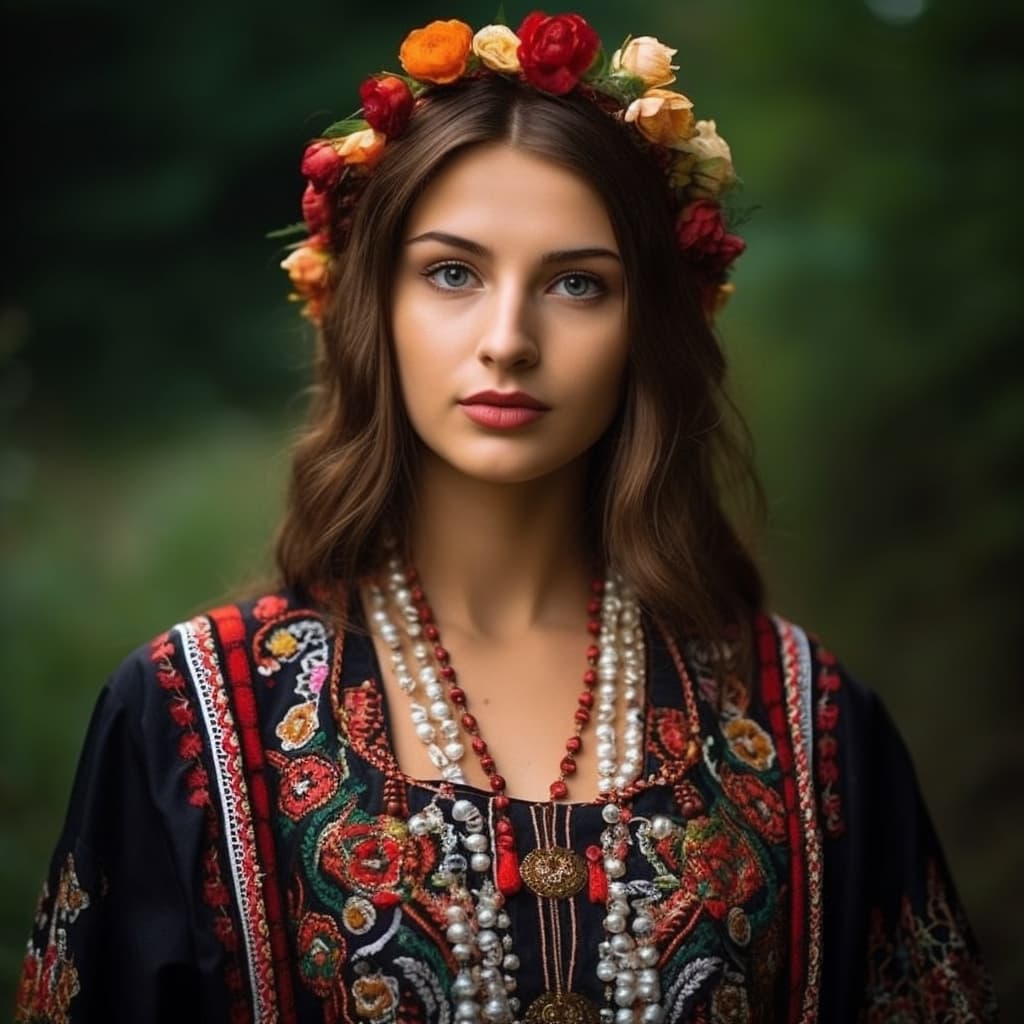
Gagauz Erotic
Gagauzia (Moldova), Budjak (Ukraine)
Turkic / Oghuz / Gagauz
Christianity / Eastern Orthodoxy
Southern Asia
About Gagauz People
The Gagauz are a Turkic-speaking, Orthodox Christian people — a combination unusual enough that it has shaped almost everything about how they're perceived and how they perceive themselves. Roughly 150,000 live in Gagauzia, an autonomous territorial unit in southern Moldova, with smaller communities scattered across the Budjak steppe of southwestern Ukraine and pockets in Bulgaria, Romania, and the southern Caucasus. Their language belongs to the Oghuz branch of Turkic, close kin to Turkish and Azerbaijani; a Gagauz speaker and an Istanbul Turk can generally make themselves understood after a few minutes of adjustment. But the cultural reference points — saints' days, baptisms, the rhythm of the Orthodox calendar — pull in the opposite direction.
Origins are genuinely unsettled. The leading theories trace them either to Turkic nomads (Pechenegs, Cumans, Oghuz) who migrated into the Balkans in the medieval period and adopted Orthodoxy from their Bulgarian and Byzantine neighbors, or to Balkan Christians who shifted to a Turkic language under Ottoman rule. The community itself tends to favor the first version. What's documented is the modern resettlement: in the late 18th and early 19th centuries, Gagauz villages moved north out of Ottoman Bulgaria into the then-Russian Budjak, fleeing wars and looking for tsarist land grants. The villages they founded — Comrat, Ceadîr-Lunga, Vulcănești — are still the demographic core today.
Daily life leans agrarian and unshowy: vineyards, sunflower fields, sheep, and a strong household wine tradition that produces something closer to a working drink than a connoisseur's bottle. Hospitality codes are firm — a guest is fed before being asked their business — and the family hierarchy is conservative in the older sense, with deference to elders that hasn't fully eroded under post-Soviet life. Folk practices preserve pre-Christian layers under the Orthodox surface: the Hederlez festival on May 6th, marking the start of the pastoral year, and a body of agricultural rites tied to St. George and St. Demetrius that look more shamanic the longer you watch them.
Politically, the Gagauz secured autonomy from Moldova in 1994 after a tense standoff that nearly produced a second breakaway region alongside Transnistria. The arrangement holds, but uneasily — Comrat tilts toward Moscow, Chișinău tilts toward Brussels, and the Gagauz find themselves negotiating a small people's leverage between much larger gravitational fields.
Typical Gagauz Phenotypes
Reference for AI generation — hair, eyes, skin, facial structure, build
The Gagauz are an Orthodox Christian, Turkic-speaking population concentrated in southern Moldova and the Budjak steppe of Ukraine, and the phenotype reflects exactly that intersection — Oghuz Turkic ancestry layered onto Balkan and Pontic-Steppe stock, with centuries of admixture from Bulgarians, Romanians, Ukrainians, and Russians. The result reads as broadly Southeastern European rather than Central Asian, with only intermittent traces of Inner-Asian morphology.
Hair runs predominantly dark — chestnut to near-black is the modal range, with mid-brown common and natural blonde uncommon but not rare in children, often darkening to ash or light brown in adulthood. Texture is typically straight to lightly wavy; tight curl is unusual. Eye color skews brown and hazel, but a meaningful minority carry green or grey-blue, particularly in the Budjak villages with heavier Slavic admixture. The eyelid is overwhelmingly European in shape; a soft, partial epicanthic fold appears in a minority and is one of the few visible cues to the Turkic substrate.
Skin is generally Fitzpatrick II–III, leaning III, with neutral to faintly olive undertones — paler than Anatolian Turks, warmer than ethnic Russians, and prone to a steady tan rather than burn under the long Bessarabian summers. Facial structure is moderate: a straight or slightly convex nasal bridge with a narrow-to-medium alar base, defined but not high cheekbones, and a jawline that tends to square in men and soften in women. Lips are average in fullness. The face is more often oval than round.
Build sits in the European mid-range — men commonly 173–178 cm, women 160–165 cm — with a tendency toward sturdy, slightly broad-shouldered frames in rural populations and leaner proportions in the urbanized younger cohort. Athletic builds in figures like the Radulov brothers and the cool, classically European look of Xenia Deli mark the visible ends of a phenotype that is, on balance, quietly Balkan with a Turkic undertone.
Data depth
48/100Coverage of image-grounded phenotype observations · drives AI generation diversity
- Sample size
- 20/40· 11 images
- Image quality
- 18/30· 36% high
- Confidence
- 10/20· mean 0.68
- Source diversity
- 0/10· wikipedia
- ·Modest sample (n<25)
- ·Wikipedia-only source — not population-representative
Observed Distribution — Image Sample
Empirical observations from analyzed photographs · supplementary signal, not population truth
Sample: 11 images analyzed (11 wikipedia). Quality: 4 high, 4 medium, 2 low, 1 very_low. Avg analyzer confidence: 0.68.
Skin tone (Fitzpatrick): II (45%), III (55%)
Hair color: gray/white (55%), black (36%), dark brown (9%)
Hair texture: straight (73%), wavy (18%), bald (9%)
Eye color: dark brown (45%), blue (9%), hazel (9%), unclear (36%)
Epicanthic fold: 0% present, 91% absent, 9% unclear
Caveats: Sample size 11 is modest — secondary patterns may not be reliable. Sample is 100% Wikipedia notable people — skews toward male, public-life, and modern figures, not population-representative.
Last aggregated: May 7, 2026
Explore phenotype categories
Structured taxonomy with peer-reviewed scales · 22 anatomical categories
Notable Gagauz People
13 reference figures — sourced from Wikipedia
- Alexandru Averescu — 1859-1938), Marshal of Romania and former Prime Minister of Romania, partial …
- Mihail Ciachir — 1861-1938), Orthodox priest and Gagauz educator, historian and ethnographist
- Gavril Zanetov — 1874-1934), Bulgarian lawyer, historian, publicist and literary critic
- Dumitru Topciu — 1888-1958), Romanian politician and agriculturalist
- Anton Novakov — ?-1938), industrialist and legislator of the short-lived Moldavian Democratic…
- Vladimir Cavarnali — 1910-1966), Romanian poet, journalist, editor, and political figure
- Stepan Topal — 1938-2018), Moldovan politician
- Zinovia Dushkova — born 1953), Russian author, poet, philosopher, and historian
- Alexandr Stoianoglo — born 1967), Moldovan former prosecutor and politician
- Igor Radulov — born 1982), Russian former professional ice hockey player
- Alexander Radulov — born 1986), Russian professional ice hockey player
- Xenia Deli — born 1989), Moldovan-American model
- Vladislav Baboglo — born 1998), Moldovan-Ukrainian footballer
Generate Gagauz AI Content
Use this ethnicity's phenotype data to create AI-generated content with accurate physical traits and cultural context.
Open Creator Studio