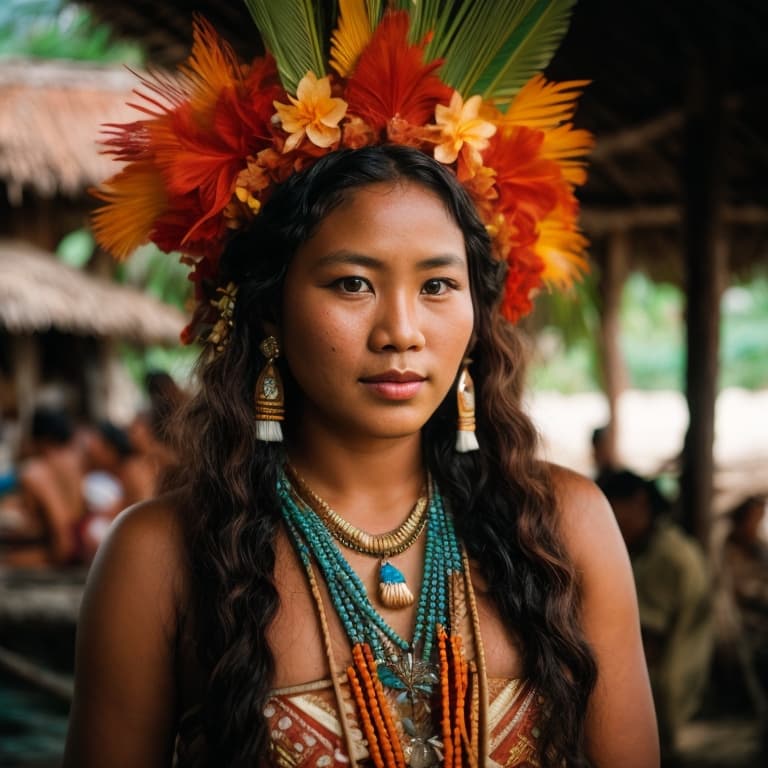
Chuukese Erotic
Chuuk Lagoon (Federated States of Micronesia)
Austronesian / Micronesian / Chuukese
Christianity / Catholicism
Southeast Asia
About Chuukese People
The Chuukese are the people of Chuuk Lagoon, a ring of volcanic high islands enclosed by a barrier reef in the central Caroline Islands of Micronesia. The lagoon itself shapes nearly everything: it is large enough that the inhabited islands inside it — Weno, Tonoas, Fefan, Uman, and others — feel like a small archipelago of their own, each with its own dialect lean and its own claims of seniority. Outside the reef, the Mortlocks to the southeast and the smaller atolls to the north and west fall under the same cultural and linguistic umbrella, though Chuukese themselves often distinguish sharply between lagoon people and outer-islanders.
Their language belongs to the Chuukic branch of Micronesian, itself a small twig of the enormous Austronesian family that runs from Madagascar to Easter Island. It sits in a dialect chain with Mortlockese, Puluwatese, and Satawalese — close enough that speakers can usually muddle through, distinct enough that no one mistakes one for another. English is the language of school and government; Chuukese is the language of the household, the funeral, and the argument.
Catholicism arrived in the late nineteenth century, Protestant missions slightly earlier, and the islands today are overwhelmingly Christian — but the older social architecture has not been displaced so much as layered under. Land and identity pass matrilineally; a person's clan, inherited from the mother, still determines who they can marry, where they can build, and whose funeral they are obliged to attend. Respect behavior between brothers and sisters, and between cross-cousins, remains strict enough that visitors who don't know the rules are quietly steered away from breaking them.
The twentieth century pressed hard on Chuuk. The Japanese Imperial Navy turned the lagoon into its central Pacific anchorage, and in February 1944 the American carrier strikes of Operation Hailstone sank dozens of warships and merchant vessels in two days. The wrecks are still down there, now a destination for divers; the memory is still up here, in family stories about hiding in the bush and eating taro corms through the war. After the Trust Territory years and the Compact of Free Association, Chuuk became the most populous state in the Federated States of Micronesia, and a steady current of migration now runs to Guam, Hawaii, and the U.S. mainland — where Chuukese communities keep the clan obligations, the funerals, and the language going at considerable distance from the reef.
Typical Chuukese Phenotypes
Reference for AI generation — hair, eyes, skin, facial structure, build
Chuukese phenotype sits at the Micronesian end of the Remote Oceanic spectrum — a distinct mix that reads as neither fully Polynesian nor Melanesian, with the lighter-brown skin and straighter facial features common to the FSM islands rather than the deeper pigmentation and tighter curl patterns of Papuan-influenced groups further south.
Hair is typically very dark brown to true black, with a strong tendency toward thick, coarse straight or loosely wavy texture; tight curls are uncommon and usually indicate mixed ancestry. Mid-life graying is often slow and dramatic against the dark base. Eyes run dark brown to near-black, with a soft, partial epicanthic fold present in many but not the pronounced fold seen in East Asian populations — the eye shape tends to be wide-set and almond, with relatively heavy upper lids.
Skin tone clusters around Fitzpatrick IV with warm copper-to-bronze undertones; coastal sun exposure pushes many adults toward a deeper tan, while children and indoor workers can read closer to a light golden brown. True olive or pinkish undertones are rare. Facial structure favors broad, rounded features: a moderately wide nose with a low-to-medium bridge and full alar base, naturally full lips with a defined philtrum, strong cheekbones, and a relatively short, rounded jawline. Foreheads are often broad and slightly sloped.
Build is one of the more distinctive features — Chuukese adults tend toward stocky, powerfully muscled frames with comparatively short stature (men commonly 5'4"–5'8", women 5'0"–5'4") and a tendency toward central weight gain in adulthood that's well documented in regional health surveys. Shoulders and chests are broad relative to height, hands and feet are wide, and calves are typically thick. The combined silhouette — short, dense, broad-shouldered, with dark straight hair and warm brown skin — is the most reliable visual marker. Variation across the lagoon's islands is real but subtle, mostly in stature and degree of facial breadth rather than coloring.
Data depth
0/100Coverage of image-grounded phenotype observations · drives AI generation diversity
- Sample size
- 0/40· 0 images
- Image quality
- 0/30· 0% high
- Confidence
- 0/20
- Source diversity
- 0/10
- ·No image observations yet
Explore phenotype categories
Structured taxonomy with peer-reviewed scales · 22 anatomical categories

Generate Chuukese AI Content
Use this ethnicity's phenotype data to create AI-generated content with accurate physical traits and cultural context.
Open Creator Studio