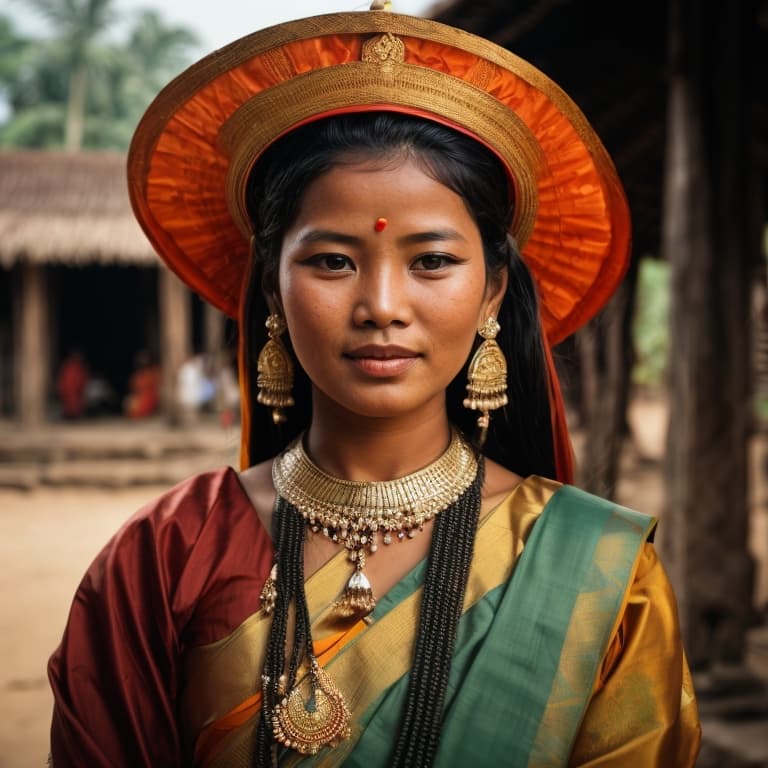
Chams Erotic
Champa (Cambodia, Vietnam)
Austronesian / Chamic / Cham
Islam / Sunni Islam
Southeast Asia
About Chams People
The Chams are the descendants of Champa, a string of Hindu and later Muslim kingdoms that ran along the central and southern coast of what is now Vietnam from roughly the second century until the Vietnamese conquest of Vijaya in 1471 and the final dismantling of the rump state in 1832. That long unraveling is the central fact of Cham history: a maritime, Indianized civilization with stone temple-towers, Sanskrit inscriptions, and a brisk trade in sandalwood and slaves was ground down over centuries by the southward push of the Việt and ultimately scattered. Today most Chams live as a minority in southern Vietnam and along the Mekong in Cambodia, with smaller communities in Malaysia and a refugee diaspora that left after the Khmer Rouge years, when Cambodia's Cham were targeted with particular ferocity for their religion and language.
Cham is an Austronesian language — a sea-faring family — which is the linguistic giveaway that these are not a Mainland Southeast Asian people in the usual sense. Their nearest relatives are the Jarai, Rhade, and other Chamic-speaking highlanders of the Vietnamese interior, and beyond them the languages of insular Southeast Asia. This is striking when you stand in a Cham village in the Mekong Delta and realize the speech around you belongs, distantly, to the same family as Malay and Tagalog rather than to Vietnamese or Khmer.
Religion among the Chams is split in a way that matters for understanding them. The majority — those in Cambodia and the Mekong — are Sunni Muslims with strong ties to the broader Malay world; many men have studied in Kelantan or the Gulf, and the community's mosques and madrasas have been rebuilding since the 1980s. In the old heartland around Phan Rang and Phan Rí in Vietnam, however, two older streams persist: the Bani, an indigenized Islam that absorbed pre-Islamic ritual and a localized clergy, and the Balamon or Cham Ahier, who preserve a Hindu-derived practice with their own brahmin caste, temple festivals, and matrilineal inheritance. These two communities historically intermarry and treat each other as halves of a single ritual whole — a configuration with no real parallel elsewhere in the Muslim world. The annual Kate festival at the surviving Po Klong Garai and Po Rome towers is the most visible expression of that older Cham identity, and it draws Bani and Balamon kin together each autumn.
Typical Chams Phenotypes
Reference for AI generation — hair, eyes, skin, facial structure, build
The Cham phenotype sits at an Austronesian-Mon-Khmer crossroads, and the most structurally distinctive thing about it is that mix: Chams generally read as Southeast Asian but with features pulled subtly toward island Southeast Asia rather than the Khmer or Kinh mainstream around them. Hair is near-universally black or very dark brown, predominantly straight to gently wavy, with a moderate but noticeable minority showing looser waves — a trace of the broader Austronesian range that distinguishes them from the uniformly straight-haired Vietnamese majority. Greying tends to come late and stays salt-and-pepper rather than uniform white.
Eyes are dark brown to near-black. The epicanthic fold is present in most but not universal — a meaningful share have a partial or absent fold, giving a more open, almond-rounded eye shape than typical Kinh or Khmer neighbors. Lashes are dense and straight. Skin spans Fitzpatrick III to V, most commonly a warm olive-brown with golden or tawny undertones; coastal and farming Chams tan deeply, while urbanized populations in Phnom Penh or Ho Chi Minh City often present lighter. The range is wider than in surrounding Khmer populations, with both notably fair and quite dark individuals well within type.
Facial structure tends toward soft, rounded contours: medium-width nose with a low-to-medium bridge and moderate alar flare, fuller lips than is typical for Vietnamese, and cheekbones that are present but not as architecturally prominent as in northern East Asian phenotypes. Jaws are usually rounded rather than square. Build is slight to medium — adult men commonly 162–170 cm, women 150–158 cm — with lean, wiry proportions and a tendency toward low body fat into middle age. Cambodian Chams (Sunni, Shafi'i) and Vietnamese Bani Chams of the central coast are phenotypically near-identical; what differences exist are dress and grooming — headscarves, beards — rather than underlying morphology. Singer Chế Linh is a recognizable anchor for the Vietnamese-Cham look.
Data depth
27/100Coverage of image-grounded phenotype observations · drives AI generation diversity
- Sample size
- 12/40· 5 images
- Image quality
- 10/30· 20% high
- Confidence
- 5/20· mean 0.46
- Source diversity
- 0/10· wikipedia
- ·Small sample (n<10)
- ·Low overall confidence
- ·Mostly low-quality source images
- ·Wikipedia-only source — not population-representative
Observed Distribution — Image Sample
Empirical observations from analyzed photographs · supplementary signal, not population truth
Sample: 5 images analyzed (5 wikipedia). Quality: 1 high, 2 medium, 1 low, 0 very_low. Avg analyzer confidence: 0.46.
Skin tone (Fitzpatrick): II (40%), IV (20%), unclear (40%)
Hair color: black (40%), gray/white (20%), unclear (40%)
Hair texture: straight (60%), unclear (40%)
Eye color: dark brown (20%), unclear (80%)
Epicanthic fold: 20% present, 20% absent, 60% unclear
Caveats: Sample size 5 is small — observed distribution should be treated as suggestive, not definitive. Quality skews toward older or low-resolution photos; phenotype detail may be lossy. Low average analyzer confidence — many photos partially obscured or historical. Sample is 100% Wikipedia notable people — skews toward male, public-life, and modern figures, not population-representative.
Last aggregated: May 7, 2026
Explore phenotype categories
Structured taxonomy with peer-reviewed scales · 22 anatomical categories
Notable Chams People
24 reference figures — sourced from Wikipedia
- Hinduism — The version of Islam practised by the Vietnamese Chams in Central Vietnam is …
- Shafi'i school — The version of Islam practised by Cambodian and Southern Vietnamese Chams bel…
- Po Tisuntiraidapuran — ruler of Champa from 1780 to 1793
- Les Kosem — Cambodian-Cham activist leader in FULRO (d. 1976)
- Po Dharma — Vietnamese-Cham activist leader of FULRO, he was also a Cham cultural historian
- Maha Sajan — king of Champa
- Amu Nhan — expert on Cham music
- Po Binasuor — the last strong king of Champa
- Chế Linh — Vietnamese-Cham singer
- Inrasara — [vi] (Phú Trạm), poet and Cham cultural scholar
- Amath Yashya — Amadh Yahya), Cambodian-Cham politician; ex-Member of Parliament, deputy in t…
- Samad Bounthong — Cham-American soccer player
- Yeu Muslim — Cambodian footballer
- Dụng Quang Nho — Vietnamese footballer
- Fatima Ahmed — Italian-Somali writer of distant Cham origin
- Aymonier, Étienne — 1891). Les Tchames et leurs religions. E. Leroux.
- Cabaton, Antoine — 1901). Nouvelles recherches sur les Chams. E. Leroux.
- Hourani, George — ; Carswell, John (1995). Arab Seafaring in the Indian Ocean in Ancient and Ea…
- Juergensmeyer, Mark — ; Roof, Wade Clark (2011). Encyclopedia of Global Religion. SAGE Publications…
- Kiernan, Ben — 1 October 2008). Blood and Soil. Yale University Press. ISBN 978-0-300-13793-4.
- ISBN — Lee, Jonathan H. X. (2014). Southeast Asian Diaspora in the United States: Me…
- doi — Mostiller, Marimas Hosan (2021). "The Nexus of Asian Indigeneity, Refugee Sta…
- Tạ, Văn Tài — 1988). The Vietnamese Tradition of Human Rights. Institute of East Asian Stud…
- Tarling, Nicholas — 1999). The Cambridge History of Southeast Asia. Cambridge University Press. I…






Generate Chams AI Content
Use this ethnicity's phenotype data to create AI-generated content with accurate physical traits and cultural context.
Open Creator Studio