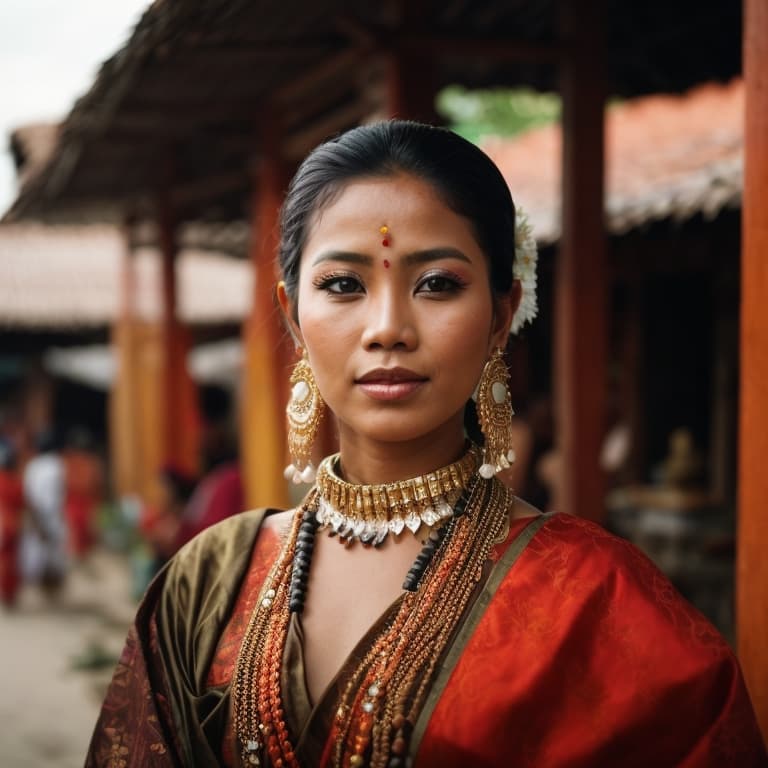
Butonese Erotic
Buton (Indonesia)
Austronesian / Celebic / Butonese
Islam
Southeast Asia
About Butonese People
The Butonese take their name from Buton, a long limestone island off the southeastern arm of Sulawesi, and from the sultanate that ruled it for nearly four centuries. Baubau, the old royal seat, still anchors the group's sense of itself: a hilltop fortress of coral-block walls — said to be among the largest fortifications in the world by enclosed area — looking down on a strait that has carried Butonese sailors, traders, and migrants across the eastern archipelago for generations. They are an island people in the working sense. Communities of Butonese descent are scattered through Maluku, the Banda Sea coasts, parts of Papua, and as far as the Tukangbesi and Wakatobi islands, where Butonese functions as the lingua franca of small-boat trade.
Their language belongs to the Celebic branch of Austronesian, a cluster largely confined to Sulawesi and its outliers. It is not one tongue but a small family: Wolio — the courtly speech of the old sultanate, written for centuries in a modified Arabic script known as buri Wolio — sits alongside Cia-Cia, Pancana, and several others, distinct enough that speakers from different parts of the island do not always understand each other without effort. Cia-Cia drew international curiosity in the late 2000s when a town on southern Buton adopted the Korean Hangul alphabet to write it, an experiment that has had a mixed afterlife but says something about the language's continuing search for a script of its own.
Islam arrived in the sixteenth century and was formalized when the local ruler converted and reorganized his polity as a sultanate in 1542. The faith took a particular shape on Buton: a Sufi-tinged Sunni Islam that wove itself into older adat law rather than displacing it, producing a layered system in which religious functionaries, customary chiefs, and the sultan's court each held defined roles. That framework — codified in the Martabat Tujuh, the sultanate's seven-rank constitution drafted in the seventeenth century — shaped local governance until the Indonesian republic absorbed the throne in 1960, and its vocabulary still surfaces in how Butonese communities organize weddings, inheritance, and village authority. Boatbuilding, seafaring, and a reputation as itinerant traders round out a self-image that is more maritime than agricultural, more diasporic than rooted.
Typical Butonese Phenotypes
Reference for AI generation — hair, eyes, skin, facial structure, build
The Butonese, indigenous to Buton Island and the surrounding Tukangbesi archipelago in Southeast Sulawesi, sit phenotypically within the broader Austronesian-speaking population of eastern Indonesia, with a measurable substrate that pulls toward Melanesian and Papuan influence the further east in the archipelago you go. Hair is near-uniformly black to very dark brown, predominantly straight to gently wavy, with a noticeable minority showing tighter waves or loose curls — the curly fraction increases in coastal and Tukangbesi sub-populations and reflects deeper eastern Indonesian admixture. Texture tends to be medium-fine; greying is typically late.
Eyes are dark brown to near-black. Epicanthic folds are present but inconsistent — visible in roughly half the population and often only as a partial or inner fold rather than the full monolid common further north in Asia. Eye shape leans almond, slightly upturned, with moderate palpebral aperture; double eyelids are common.
Skin spans Fitzpatrick III to V, clustering at IV — a warm light-to-medium brown with a clear olive-to-golden undertone. Coastal Butonese, historically seafarers and traders, run darker from sun exposure and from greater eastern admixture; inland highland communities trend lighter. Sunburn is uncommon; tanning is even.
Facial structure is moderate and balanced rather than sharply featured. Noses are short to medium with a low-to-moderate bridge and a somewhat broad alar base — broader on average than mainland Southeast Asian neighbors, narrower than Melanesian. Lips are medium-full, often with a defined cupid's bow. Cheekbones are softly prominent; jawlines are rounded rather than angular, and faces read as oval to slightly heart-shaped.
Build is compact. Men typically stand around 160–168 cm, women 150–158 cm, with lean to medium frames and relatively long torsos relative to limb length — a build shared with other maritime Austronesian populations. The Cia-Cia, Wolio, and Tukangbesi sub-groups are visually overlapping, but Tukangbesi islanders show a slightly higher incidence of curlier hair, darker skin, and broader nasal features consistent with their position on the Austronesian–Melanesian gradient.
Data depth
0/100Coverage of image-grounded phenotype observations · drives AI generation diversity
- Sample size
- 0/40· 0 images
- Image quality
- 0/30· 0% high
- Confidence
- 0/20
- Source diversity
- 0/10
- ·No image observations yet
Explore phenotype categories
Structured taxonomy with peer-reviewed scales · 22 anatomical categories



Generate Butonese AI Content
Use this ethnicity's phenotype data to create AI-generated content with accurate physical traits and cultural context.
Open Creator Studio