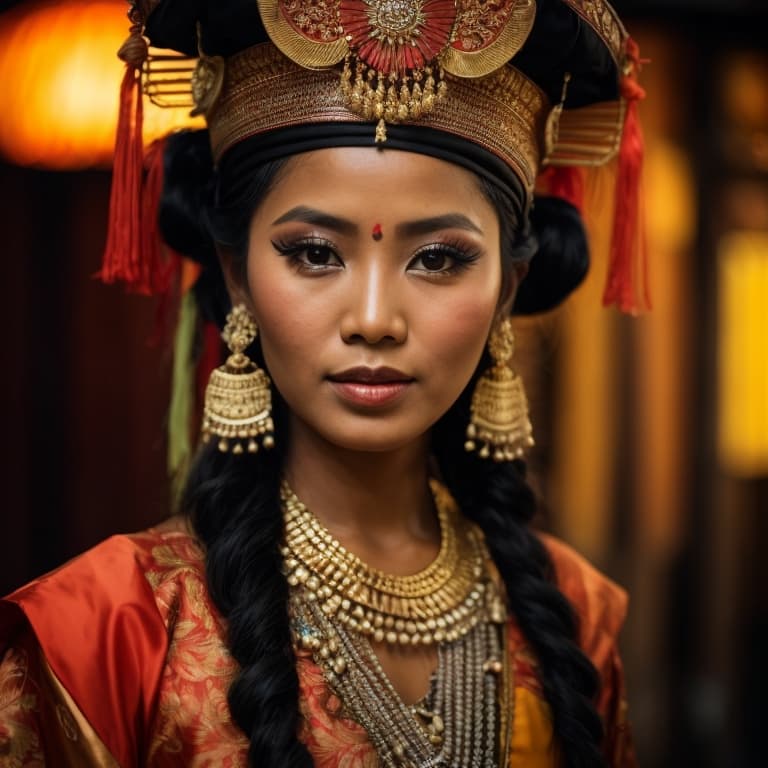
Buginese Erotic
South Sulawesi (Indonesia)
Austronesian / South Sulawesi / Buginese
Islam
Southeast Asia
About Buginese People
The Buginese are a seafaring people of South Sulawesi whose reputation has long preceded them across the Indonesian archipelago and beyond. For centuries their pinisi schooners carried Bugis traders, sailors, and sometimes raiders from the Makassar Strait to the coasts of Borneo, the Malay Peninsula, and northern Australia — far enough that the English word "bogeyman" is sometimes traced, half-seriously, to European fear of Bugis pirates. They remain one of the larger ethnic groups in eastern Indonesia, concentrated around the lowlands and river deltas near Bone, Wajo, Soppeng, and Sidenreng, with sizeable diaspora communities throughout maritime Southeast Asia.
Their language belongs to the South Sulawesi branch of Austronesian, sitting alongside Makassarese and Mandar rather than the Malayic languages most outsiders associate with Indonesia. Buginese is still written, when written traditionally, in Lontara — an Indic-derived script developed for the great epic La Galigo, a creation cycle longer than the Mahabharata and one of the largest literary works produced anywhere in the pre-modern world. The text was preserved largely by bissu, a class of ritual specialists who occupy a position outside the conventional male/female binary and who, in the older Bugis cosmology, mediated between humans and the upper world. Bissu traditions thinned considerably after Islamization and again under twentieth-century state pressure, but they persist in pockets, and the broader Bugis recognition of multiple gender roles — oroané, makkunrai, calalai, calabai, and bissu — is one of the more frequently cited features of the culture in anthropological writing.
Islam arrived in the early seventeenth century, when the rulers of Luwu, Gowa, and the Bugis kingdoms of Bone and Wajo converted in rapid succession. Sunni practice is now near-universal and shapes the rhythm of life, but it sits over older layers — adat law, ancestor reverence, and a strong ethic of siri', a concept of honor and shame so weighty it has historically justified anything from withdrawal of family ties to violence in defense of dignity. Bugis society is also unusually entrepreneurial by Indonesian standards; emigration for trade is treated as a normal life path rather than an exception, which explains the visibility of Bugis communities in Sabah, Johor, Singapore, and the eastern Indonesian outer islands. Among themselves, the four traditional Bugis kingdoms still inflect identity, and a person from Bone will quickly tell you they are not from Wajo.
Typical Buginese Phenotypes
Reference for AI generation — hair, eyes, skin, facial structure, build
The Buginese phenotype sits within the broader Austronesian Southeast Asian range but carries seafaring South Sulawesi distinctives — a lean, often wiry build paired with features that read as somewhat sharper and more angular than typical Javanese or Malay neighbors. Centuries as maritime traders across the archipelago left visible traces, with diaspora communities in Malaysia, Singapore, and eastern Indonesia showing slightly broader phenotype variation than the Sulawesi heartland.
Hair runs uniformly black to very dark brown, predominantly straight to gently wavy, with a smaller share of looser curl patterns appearing in coastal and southern subgroups. Texture tends to be medium to fine rather than coarse. Graying patterns favor late onset. Eye color is overwhelmingly dark brown, occasionally lifting to a warmer mid-brown in sunlight. The epicanthic fold is common but not universal — present in a clear majority but often subtler and less pronounced than in mainland East Asian populations, with many Buginese showing a partial fold or a softer monolid blending into a low double crease. Eye shape leans almond, set fairly level rather than upturned.
Skin tone spans Fitzpatrick III through V, centering on warm light-brown to medium-brown with golden or olive undertones; coastal and fishing-community Buginese trend darker through sun exposure, while inland highland subgroups (around Bone, Wajo, Soppeng) often sit a shade lighter. Reddish or sallow undertones are uncommon.
Facial structure is a notable feature: cheekbones tend to be high and defined, the jaw moderately tapered, and the nose more prominent than the regional average — a medium-to-high bridge with moderate alar width, occasionally aquiline, distinguishing many Buginese from the flatter-bridged Malay norm. Lips are medium-full, well-defined rather than heavy.
Stature is moderate — adult men commonly 162–170 cm, women 150–158 cm — with frames running lean and sinewy. Body composition favors low-to-moderate fat distribution and visible musculature, consistent with the group's historical maritime and agricultural livelihoods.
Data depth
21/100Coverage of image-grounded phenotype observations · drives AI generation diversity
- Sample size
- 11/40· 4 images
- Image quality
- 0/30· 0% high
- Confidence
- 10/20· mean 0.57
- Source diversity
- 0/10· wikipedia
- ·Small sample (n<10)
- ·Mostly low-quality source images
- ·Wikipedia-only source — not population-representative
Observed Distribution — Image Sample
Empirical observations from analyzed photographs · supplementary signal, not population truth
Sample: 4 images analyzed (4 wikipedia). Quality: 0 high, 3 medium, 1 low, 0 very_low. Avg analyzer confidence: 0.57.
Skin tone (Fitzpatrick): IV (25%), V (50%), unclear (25%)
Hair color: black (100%)
Hair texture: straight (50%), wavy (50%)
Eye color: dark brown (75%), unclear (25%)
Epicanthic fold: 50% present, 25% absent, 25% unclear
Caveats: Sample size 4 is small — observed distribution should be treated as suggestive, not definitive. Quality skews toward older or low-resolution photos; phenotype detail may be lossy. Sample is 100% Wikipedia notable people — skews toward male, public-life, and modern figures, not population-representative.
Last aggregated: May 7, 2026
Explore phenotype categories
Structured taxonomy with peer-reviewed scales · 22 anatomical categories
Notable Buginese People
8 reference figures — sourced from Wikipedia
- Endonym and exonym — The designation Bugis is classified as an exonym, referring to a term applied…
- Mythological associations — The origin of the term Bugis has been linked to La Sattumpugi, a central char…
- Portuguese — Colonial records: The term Bugis appears in colonial documentation as early a…
- Bugis in Malaysia — the Bugis diaspora in Malaysia
- Bugis in Singapore — the Bugis diaspora in Singapore
- Gender in Bugis society — the gender interpretation amongst the classical and pre-Islamic Bugis society
- List of Bugis people — a list of notable people of Bugis descent
- ISBN — Frawley, William J. (2003), International Encyclopedia of Linguistics, Oxford…




Generate Buginese AI Content
Use this ethnicity's phenotype data to create AI-generated content with accurate physical traits and cultural context.
Open Creator Studio