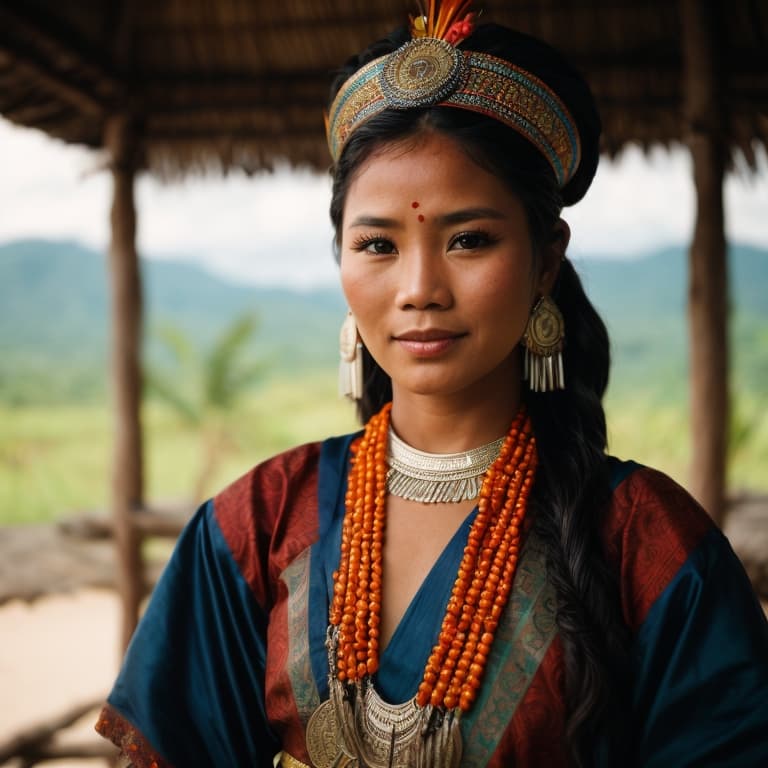
Blaan Erotic
Soccsksargen (Philippines)
Austronesian / Philippine / Blaan
Anitism
Southeast Asia
About Blaan People
The Blaan are highland people of southern Mindanao, scattered across the upland reaches of South Cotabato, Sarangani, Davao del Sur, and the slopes of Mount Matutum. The name they use for themselves splits across dialect lines — Blaan, B'laan, Bilaan — but the underlying word means roughly "opponent" or "rival people," a self-description carried over from a long history of distinguishing themselves from lowland and coastal neighbors. They were never absorbed into the Islamized sultanates that organized much of Mindanao before Spanish contact, and they were not Christianized along with the lowland Visayans. That double exemption is the single most important fact about how Blaan culture has held its shape.
Their language belongs to the South Mindanao branch of the Philippine subgroup of Austronesian, closely tied to Tboli and Tiruray and intelligible only at the edges with the languages of the lowlands around them. Anitism — the indigenous belief system organized around Dwata as a creator figure and a population of spirits inhabiting forest, river, and field — remains a working framework for many Blaan, even where Catholic or Protestant missions have taken hold. Ritual specialists called fulong or mabalian handle the negotiations between human settlements and the spirits of place, and an offense against a stream or a stand of old trees is still understood as something requiring repair rather than apology.
The Blaan are best known outside their own region for mabal tabih, an ikat weaving tradition in which abaca fibers are tie-dyed before they ever reach the loom. The patterns are not decorative in the ordinary sense — weavers traditionally receive designs through dreams from Furalo, a goddess associated with the craft, and a pattern that arrives unbidden in sleep belongs to the dreamer in a way that matters legally and ritually within the community. Brasswork, beadwork, and the heavy hilted fais blade round out the material culture, alongside a sung oral literature that carries genealogy and law through generations without writing.
The twentieth century pressed hard on Blaan land. Logging concessions, plantation expansion, and the arrival of large-scale mining in the Tampakan area have reshaped the uplands and produced a long, ongoing argument between the community, settler farmers, and corporate interests over ancestral domain. The Blaan are visible today in that argument — not as a vanishing people, but as one defending the terms on which they continue.
Typical Blaan Phenotypes
Reference for AI generation — hair, eyes, skin, facial structure, build
The Blaan are an indigenous Lumad people of southern Mindanao, concentrated in the highlands of South Cotabato, Sarangani, and Davao del Sur. Their phenotype sits within the broader Southern Philippine Negrito-admixed Austronesian range but trends toward features that distinguish them from the lowland Christianized Filipino majority. Hair is uniformly black, typically thick and coarse, predominantly straight to gently wavy — tighter waves and occasional loose curl appear in individuals with stronger Aeta/Negrito admixture from the Sarangani uplands, but the dominant texture is heavy straight hair worn long historically by both sexes. Premature graying is uncommon.
Eyes are dark brown to near-black. The epicanthic fold is present but generally lighter and less pronounced than in East Asian populations — many Blaan show a partial fold or an open inner canthus, with eye shape tending toward almond rather than the narrower aperture seen further north. Brows are dark and moderately full.
Skin tone runs noticeably darker than the Tagalog or Visayan average — Fitzpatrick IV to V is typical, with highland farmers and those with greater Negrito ancestry sitting solidly at V. Undertones are warm golden-brown to reddish-bronze. Generations of equatorial sun exposure deepen the range further.
Facial structure is compact and broad through the midface. Noses are short with low to medium bridges and moderate to wide alar bases — flatter and broader than Northern Luzon norms. Lips are medium-full, often with a defined cupid's bow. Cheekbones are high and laterally projecting; jaws are square but not heavy, giving a rounded-diamond face shape. Foreheads are typically modest in height.
Build is small-framed and short by global standards — adult men commonly 5'2"–5'5", women 4'9"–5'1" — with wiry musculature shaped by upland subsistence farming. Body fat distribution is even; torsos are short relative to limbs. The traditional tabih-weaving women of the highlands and the lowland Blaan of the coastal margins show the same core phenotype with only minor variation in stature and skin depth.
Data depth
0/100Coverage of image-grounded phenotype observations · drives AI generation diversity
- Sample size
- 0/40· 0 images
- Image quality
- 0/30· 0% high
- Confidence
- 0/20
- Source diversity
- 0/10
- ·No image observations yet
Explore phenotype categories
Structured taxonomy with peer-reviewed scales · 22 anatomical categories

Generate Blaan AI Content
Use this ethnicity's phenotype data to create AI-generated content with accurate physical traits and cultural context.
Open Creator Studio