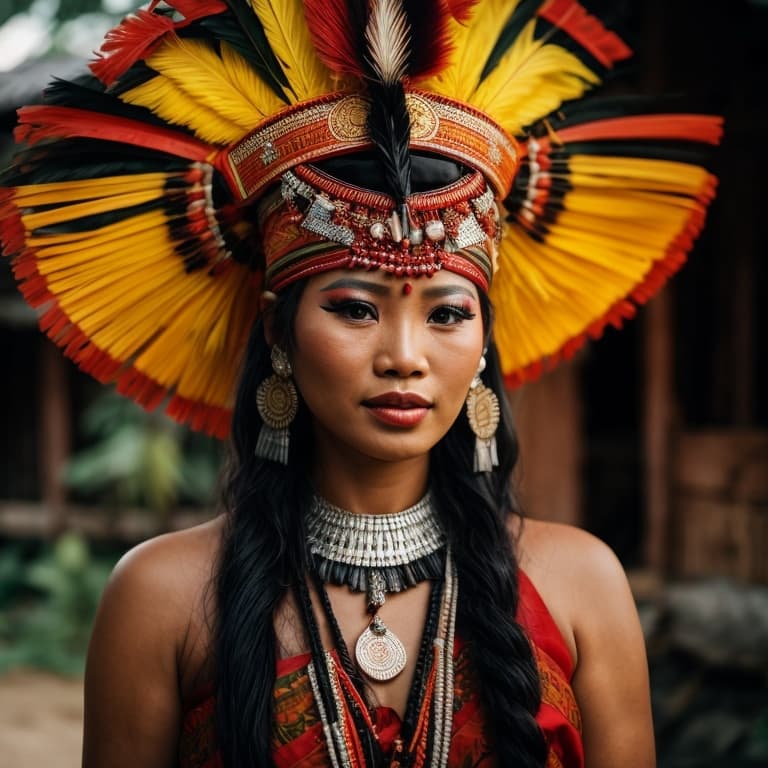
Bidayuh Erotic
Sarawak (Malaysia)
Austronesian / Malayo-Polynesian / Land Dayak
Christianity
Kendayan, Selako, Bakati', Sara Bakati', Laraʼ, Bukar Sadong, Biatah, Tringgus, Jagoi, Jangkang, Kembayan, Semandang, Ribun, Nyadu', Sanggau
Southeast Asia
About Bidayuh People
The Bidayuh are the hill people of southwestern Sarawak and the upland strip of West Kalimantan that runs alongside it — long called "Land Dayak" to distinguish them from the river-and-coast Iban who dominate the lowlands. The label covers a cluster of related communities rather than a single tribe, and Bidayuh from one valley often cannot understand Bidayuh from the next without switching to Malay or English. Bukar-Sadong, Biatah, Jagoi, Selako, Lara', Tringgus and a dozen others sit under the same umbrella largely by ethnological convention; on the ground, identity attaches to the village and the watershed before it attaches to the wider name.
Their languages belong to the Land Dayak branch of Malayo-Polynesian, a small and internally fractured group that does not slot neatly beside Iban or coastal Malay. The fragmentation is partly geography — the southwestern interior is a country of steep ridges, narrow river valleys and limestone outcrops, and until road-building in the late twentieth century most travel was by foot along ridge paths rather than by longboat. That topography also shaped settlement: the iconic Bidayuh structure is not the long communal longhouse of the Iban but the baruk or headhouse, a raised circular pavilion that historically held the skulls taken in the headhunting era and still functions in some villages as a ritual and meeting space.
Most Bidayuh today are Christian — Roman Catholic and Anglican mainly, with sizeable evangelical and SIB congregations — the legacy of Borneo Mission work that arrived in the mid-1800s and intensified after the Second World War. Conversion did not erase the older ritual layer so much as fold around it: gawai harvest festivals, ancestral observances and certain taboos around rice planting and house construction continue alongside the church calendar, and the village priest-figure (dayung borih in some dialects) is a recognised role even where the family attends Sunday mass. A smaller minority remain in the indigenous adat tradition, and a few have converted to Islam, usually through marriage.
Historically the Bidayuh were the first people the Brooke Rajahs of Sarawak set out to "pacify" in the 1840s, and their position — sandwiched between expanding Iban migration from the east and Malay sultanates on the coast — made them the smaller, quieter party in nineteenth-century Sarawak politics. That demographic position has not really changed. They number somewhere around two hundred thousand, concentrated in the Kuching, Bau, Serian and Padawan districts, with a steady drift of younger Bidayuh into the city for work while the bamboo-and-timber villages upriver hold the language and the headhouses.
Typical Bidayuh Phenotypes
Reference for AI generation — hair, eyes, skin, facial structure, build
The Bidayuh — the "Land Dayaks" of Sarawak's hill country — sit phenotypically between the Austronesian mainstream of island Southeast Asia and the older Proto-Malay substrate that predates the coastal Malay expansion. They read as visibly indigenous Bornean rather than peninsular Malay: shorter, more compact, with a slightly heavier brow and broader midface than the Javanese or coastal Malay average.
Hair is uniformly black or near-black, straight to gently wavy, coarse in shaft and thick on the scalp. Premature greying is uncommon. Body and facial hair is sparse — beard growth is light and patchy on most men, and chest hair is rare. Eyes are dark brown to almost black, with a soft, partial epicanthic fold rather than the strong, deep-set fold typical of Northeast Asians; the lid often shows a low or absent crease, giving a smoother, rounder eye opening. The palpebral fissure runs slightly upturned at the outer corner.
Skin tone clusters around Fitzpatrick III–IV — warm golden-brown to mid-brown with strong olive and red undertones, tanning deeply and rarely burning. Highland Bidayuh from the Penrissen and Padawan ranges tend to run a shade lighter than lowland Bukar-Sadong or Selako communities, where sustained sun exposure produces a more saturated copper-brown.
The face is typically broad and short relative to its width, with prominent malar bones, a moderately flat midface, and a rounded jaw that softens further with age. Noses are short with a low-to-medium bridge and a notably wide alar base — broader than the Malay norm. Lips are medium-full, often with a well-defined cupid's bow.
Build is small-framed and wiry. Men average around 162–166 cm, women 150–155 cm — shorter than peninsular Malays. Limbs are proportionally long for the torso, shoulders narrow, hips and waist slim; muscle tone reads as lean and fibrous rather than bulky, a build long shaped by hill agriculture and load-carrying. Across the fifteen named branches, the clearest visible split is between the lighter, finer-featured highland groups (Biatah, Jagoi, Tringgus) and the more sun-darkened, broader-featured lowland Bukar-Sadong and Selako.
Data depth
76/100Coverage of image-grounded phenotype observations · drives AI generation diversity
- Sample size
- 31/40· 28 images
- Image quality
- 30/30· 61% high
- Confidence
- 15/20· mean 0.82
- Source diversity
- 0/10· wikipedia
- ·Wikipedia-only source — not population-representative
Observed Distribution — Image Sample
Empirical observations from analyzed photographs · supplementary signal, not population truth
Sample: 28 images analyzed (28 wikipedia). Quality: 17 high, 9 medium, 2 low, 0 very_low. Avg analyzer confidence: 0.82.
Skin tone (Fitzpatrick): III (29%), IV (64%), V (7%)
Hair color: black (71%), light/medium brown (7%), gray/white (7%), dark brown (4%), unclear (11%)
Hair texture: straight (54%), wavy (32%), covered (14%)
Eye color: dark brown (96%), blue (4%)
Epicanthic fold: 89% present, 11% absent, 0% unclear
Caveats: Sample is 100% Wikipedia notable people — skews toward male, public-life, and modern figures, not population-representative.
Last aggregated: May 7, 2026
Explore phenotype categories
Structured taxonomy with peer-reviewed scales · 22 anatomical categories
Notable Bidayuh People
100 reference figures — sourced from Wikipedia
- Anwar Fazal — consumer, environmental activist, health advocate
- Amir Ahnaf — Malaysian actor
- Aaron Aziz — Singaporean actor
- Aedy Ashraf — Malaysian actor
- Alif Satar — Malaysian singer, TV host and actor, 1/2 Malay
- Aznil Nawawi — Malaysian TV host, singer and actor
- Cico Harahap — Malaysian actor, 1/2 Batak, 1/2 Malay
- Dini Schatzmann — Malaysian actor, 1/2 Malay 1/2 Switzerland Germans
- Iqram Dinzly — Malaysian actor
- Izzue Islam — Malaysian actor
- Pierre Andre — Malaysian actor
- Shaheizy Sam — Malaysian actor
- Syafiq Kyle — Malaysian actor
- Stephen Rahman-Hughes — Welsh actor, 1/2 Malay
- Zizan Razak — Malaysian actor and singer
- Asiah Aman — Singaporean actress and model, Singapore Hall of Fame 2022
- Artika Sari Devi — Indonesian actress and model
- Ayda Jebat — Malaysian singer and actress
- Fasha Sandha — Malaysian actress
- Heliza Helmi — Malaysian singer and activist
- Hazwani Helmi — Malaysian singer and activist
- Janna Nick — Malaysian actress, singer and producer, the most successful female singer in …
- Liyana Fizi — Malaysian actress, singer and famous songwriter
- Mathira — Pakistani and Zimbabwean actress, 1/2 Malay
- Mishqah Parthiepal — South African actress, 1/4 Malay
- Maisie Conceição — Singaporean actress and singer, 1/4 Malay
- Revalina S. Temat — Indonesian actress
- Uji Rashid — Bruneian-Malay actress and singer
- Zizi Kirana — famous Malaysian actress and singer from Sabah region
- Mazlan Othman — Malaysian astrophysicist who pioneered Malaysia's participation in Space expl…
- Sheikh Muszaphar Shukor — first Malaysian astronaut
- Nasimuddin Amin — founder, chairman and chief executive officer of the Naza Group of Malaysia.
- Syed Mokhtar Al-Bukhary — founder of the Albukhary Foundation
- Norman Musa — chef and restaurateur
- Rozman Jusoh — Malaysian convicted drug trafficker
- Ahmad Muin Yaacob — Malaysian convicted murderer
- Ahmad Najib Aris — Malaysian convicted murderer
- Mona Fandey — Malaysian convicted murderer
- Muid Latif — graphic designer, multimedia designer
- Nor Aini Shariff — fashion designer
- Ashley Isham — fashion designer
- P. Ramlee — Malaysian singer, actor and film director
- Jamil Sulong — Malaysian actor, film director and comic book artist
- M. Nasir — Singaporean poet, singer-songwriter, composer, producer, actor and film director
- Yasmin Ahmad — Malaysian film director, film writer, scriptwriter
- Aziz M. Osman — Malaysian film director
- Yusof Haslam — Malaysian actor and film director
- Syamsul Yusof — Malaysian actor and film director
- Syafiq Yusof — Malaysian actor and film director
- Nam Ron — Malaysian film director and producer
- Zainal Rashid Ahmad — Kedah famous author
- Tunku Abdul Rahman — 1st Prime Minister of Malaysia
- Abdul Razak Hussein — 2nd Prime Minister of Malaysia
- Mahathir Mohamad — 4th and 7th Prime Minister of Malaysia
- Abdullah Ahmad Badawi — 5th Prime Minister of Malaysia
- Najib Razak — 6th Prime Minister of Malaysia
- Muhyiddin Yassin — 8th Prime Minister of Malaysia
- Ismail Sabri Yaakob — 9th Prime Minister of Malaysia
- Anwar Ibrahim — 10th Prime Minister of Malaysia
- Ibrahim Mohammad Jaafar — 1st Brunei Chief Minister
- Marsal Maun — 2nd Brunei Chief Minister
- Pengiran Muhammad Yusuf — 3rd Brunei Chief Minister
- Pengiran Abdul Momin — 4th Brunei Chief Minister
- Abdul Aziz Umar — 5th Brunei Chief Minister
- Hassanal Bolkiah — 1st Brunei sovereign Prime Minister
- Hamzah Haz — 9th Vice President of Indonesia
- Raja Ali Haji — Johor Sultanate historian, poet and malay culture scholar, Malay royal family…
- Amir Hamzah — Indonesian national hero and poet
- A. Samad Said — father of Malaysian National Literature
- Salmi Manja — Singaporean female poet, wife of Samad Said
- Keris Mas — Asas 50's literature movement founder
- Faisal Tehrani — Malaysian writer of shia religion, Iranian maternal ancestry, Tehrani is his …
- Ishak Haji Muhammad — also known as Pak Sako, famous for his advocation of Maphilindo movement
- Shahnon Ahmad — famous writer from Kedah
- Tenas Effendy — Indonesian historian, renowned figure from Pelalawan Kingdom
- Taufik Ikram Jamil — Indonesian historian from Bengkalis, Riau
- Jamil Al-Sufri — Brunei historian, part of royal family
- Andrea Hirata — Indonesian novelist from Bangka Belitung
- Tere Liye — Indonesian best seller novelist from Lahat, Sumatra Selatan
- Hill Zaini — Bruneian singer and actor
- Evie Tamala — Indonesian dangdut singer and actress
- Shila Amzah — international Malaysian singer-songwriter
- Taliep Petersen — South African guitarist
- Yuna — Malaysian singer
- Aliff Aziz — Singaporean singer
- Meria Aires — known as Maria, a Bruneian singer
- Jamal Abdillah — Malaysian singer
- Sudirman Arshad — Malaysian singer
- Taufik Batisah — Singaporean singer
- Zul F — Bruneian actor and singer
- Elyana — Malaysian singer and actress
- Erwin Gutawa — Indonesian composer
- Eqah — Bruneian singer
- Erra Fazira — Malaysian actress and singer
- Sean Ghazi — Malaysian singer and actor
- Gita Gutawa — Indonesian singer 1/2 Malay
- Fauziah Latiff — Malaysian singer
- Sheila Majid — Malaysian singer
- Amy Mastura — Malaysian actress and singer
- Noorhaqmal Mohamed Noor — known as Aqmal. N, a Singaporean singer and songwriter
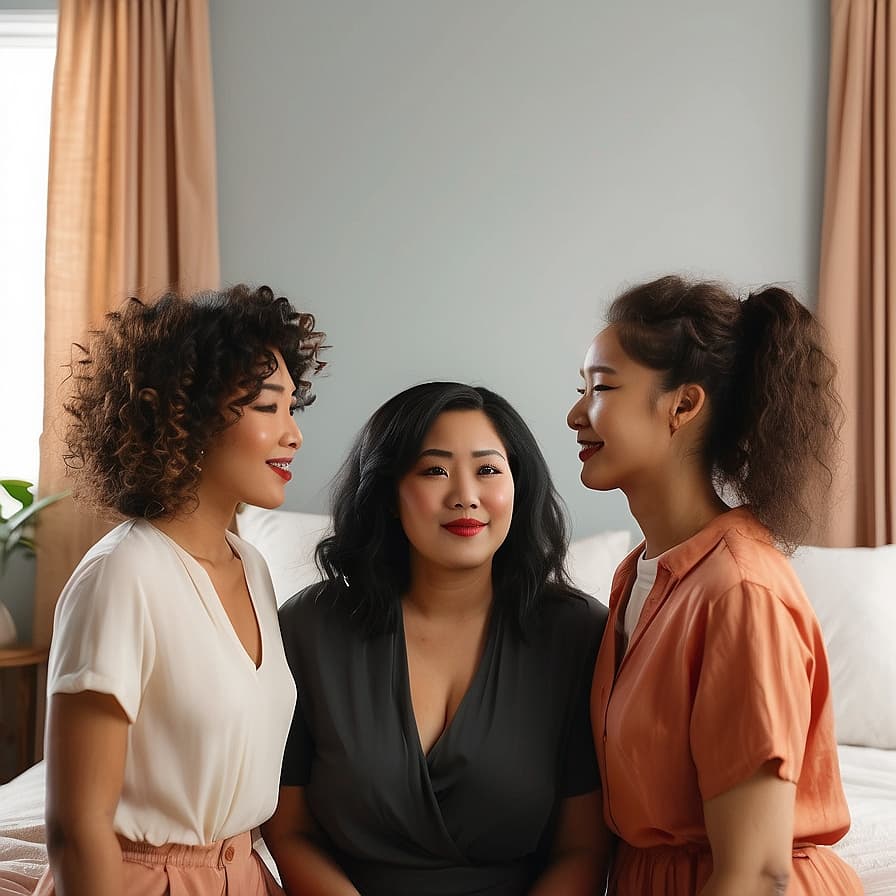

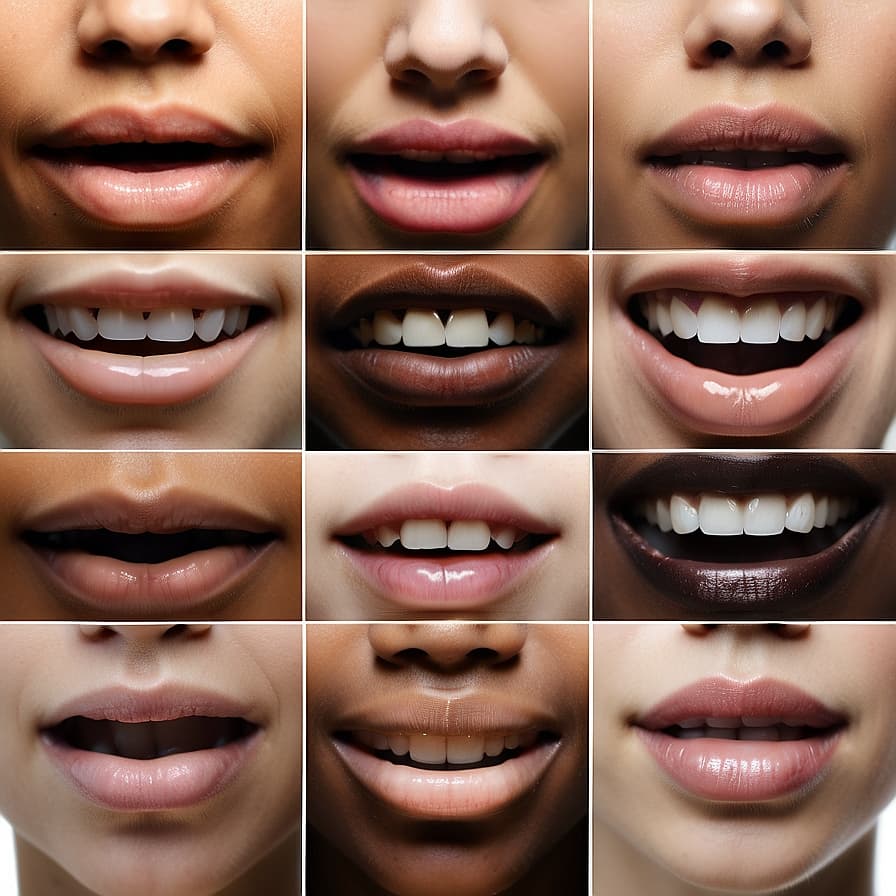
Generate Bidayuh AI Content
Use this ethnicity's phenotype data to create AI-generated content with accurate physical traits and cultural context.
Open Creator Studio