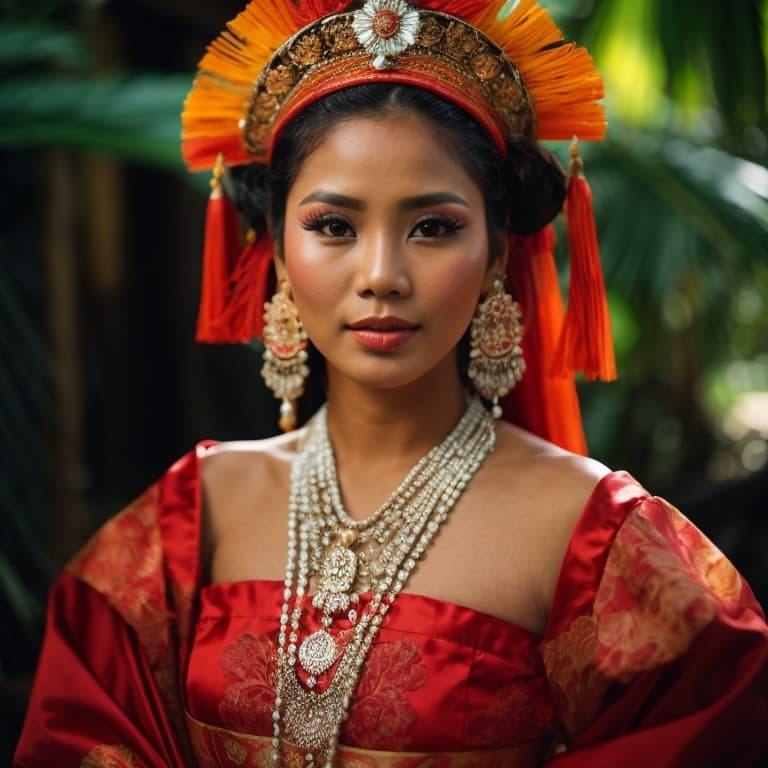
Bicolanos Erotic
Bicol Region (Philippines)
Austronesian / Philippine / Bikol
Christianity / Catholicism
Central Bikol, Sorsoganons, Catandunganons, Rinconada, Albayanon
Southeast Asia
About Bicolanos People
The Bicolanos occupy the long, narrow peninsula at the southeastern tip of Luzon — a corridor of rice plains and coconut groves wedged between the Pacific and the Sibuyan Sea, hemmed in by a string of active volcanoes that includes the near-perfect cone of Mayon. The geography is not incidental. Bicol is one of the most typhoon-battered regions in the Philippines, and life there has been organized around that fact for centuries: settlements that rebuild quickly, agriculture that bends with the weather, a folk Catholicism heavy with patron saints who are asked to intercede against very specific kinds of disaster.
Bikol is not a single language but a small family of them — Central Bikol around Naga and Legazpi, with Rinconada, Albayanon, and the Sorsoganon and Catandunganon varieties shading off into something closer to the Visayan languages spoken further south. They sit inside the broader Philippine branch of Austronesian, related to Tagalog and Cebuano but distinct enough that a Bikolano from Iriga and one from Sorsogon may already need to meet halfway. The internal variation tracks the region's broken-up geography: islands, isolated valleys, coastlines that face different seas.
Catholicism arrived with the Spanish in the sixteenth century and took deep root, but the Bicol version has its own texture. The cult of Our Lady of Peñafrancia in Naga is the largest Marian devotion in the country, drawing a fluvial procession down the Naga River every September that pulls in hundreds of thousands of pilgrims. Beneath the formal religion runs a robust layer of older belief — the aswang, the kapre, the herbalist albularyo consulted alongside, not instead of, the parish priest.
What Bicolanos are most known for at home is food, and specifically a willingness to cook with chili that distinguishes them sharply from the rest of the Philippines. Bicol Express, laing, pinangat — coconut milk and siling labuyo doing work that most other Filipino regional cuisines avoid. The cuisine reads as a small declaration of regional character: not the sweeter, soy-and-vinegar register of the Tagalog north, but something hotter, richer, more insistent. Beyond the kitchen, Bicolanos have a reputation in the rest of the Philippines for being soft-spoken and devout, with a streak of stubbornness that anyone who has tried to evacuate a coastal village before a typhoon will recognize.
Typical Bicolanos Phenotypes
Reference for AI generation — hair, eyes, skin, facial structure, build
Bicolanos sit firmly within the Southern Mongoloid Austronesian phenotype that defines lowland Christian Filipinos, but with a distinct lean toward the deeper-pigmented, more compactly built end of the Filipino range — a result of long settlement in the volcanic, agricultural Bicol Peninsula with comparatively less of the East Asian and Iberian admixture seen further north on Luzon.
Hair is overwhelmingly black or near-black, occasionally with a warm brown cast under sunlight. Texture runs straight to gently wavy in most individuals, with a noticeable minority — particularly in coastal Sorsogon and Catanduanes — showing looser curls or kinks that hint at older Negrito-related substrate ancestry. Eyes are dark brown to near-black; the epicanthic fold is present in most but tends to be lighter and less pronounced than in East Asian populations, producing an almond shape rather than a strongly hooded lid. Double eyelids are common.
Skin spans Fitzpatrick III through V, with the regional median sitting at deeper IV — warmer, more bronze and olive-brown than the lighter Tagalog or Ilocano averages, with golden to reddish undertones. Heavy sun exposure from farming and fishing pushes much of the population toward the darker end in adulthood.
Facial structure is typically broad and softly rounded: moderately wide cheekbones, a relatively short and somewhat flat nasal bridge with medium-to-wide alar base, and full, well-defined lips — often noticeably fuller than the Filipino average. Jawlines tend to be gently squared in men and rounded in women, with a fairly flat midface.
Build is short and compactly muscular. Adult male stature averages around 162–164 cm and female around 150–152 cm — among the shorter regional means in the Philippines. Body composition trends toward a sturdy, slightly stocky frame with shorter limbs relative to torso. Albayanon and Rinconada speakers from inland Mayon-area provinces tend to read slightly lighter-skinned and more East-Asian-featured, while Catandunganon and Sorsoganon coastal populations more often show the deeper pigmentation, broader noses, and curlier hair textures associated with older Aeta-adjacent ancestry.
Data depth
0/100Coverage of image-grounded phenotype observations · drives AI generation diversity
- Sample size
- 0/40· 0 images
- Image quality
- 0/30· 0% high
- Confidence
- 0/20
- Source diversity
- 0/10
- ·No image observations yet
Explore phenotype categories
Structured taxonomy with peer-reviewed scales · 22 anatomical categories




Generate Bicolanos AI Content
Use this ethnicity's phenotype data to create AI-generated content with accurate physical traits and cultural context.
Open Creator Studio