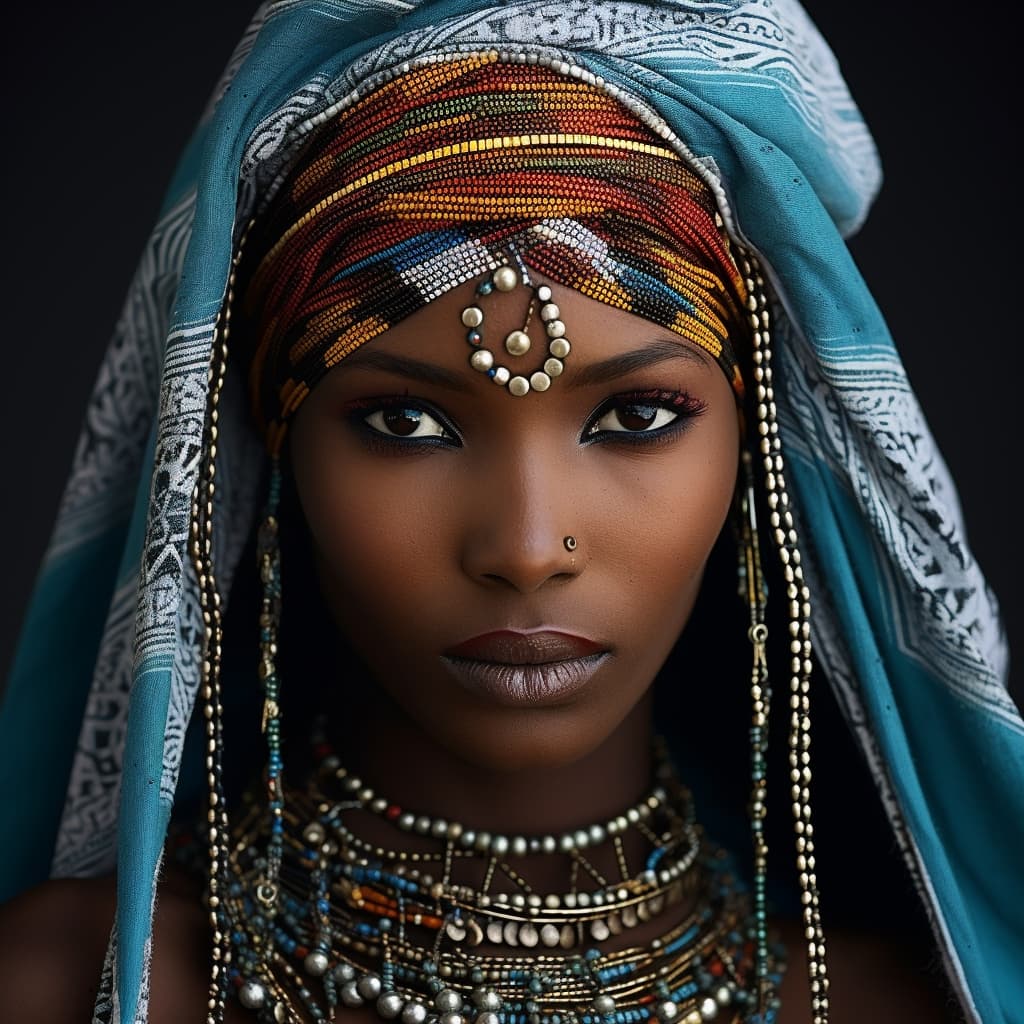
Zaghawa Erotic
Chad, Sudan
Nilo-Saharan / Saharan / Zaghawa
Islam / Sunni Islam
Northern Africa
About Zaghawa People
The Zaghawa call themselves Beri, and the distinction matters: "Zaghawa" is the name outsiders have used for at least a thousand years, while Beri is what binds the group internally across an unforgiving stretch of semi-desert that straddles the Chad–Sudan border. They are camel and cattle pastoralists in country where the rainfall map looks like a smudge — the northern Sahel grading into the Sahara — and their social map is organized around three main branches: the Kobe in Chad, the Wogi in Sudan, and the Tuba further north. Most Beri move seasonally with their herds, but a significant share have been town-dwellers and traders for generations, particularly in the towns ringing the Ennedi and along the old caravan routes that once linked Darfur to the Mediterranean.
The language sits inside the Saharan branch of Nilo-Saharan, putting it in the same small family as Kanuri and Teda rather than with the Arabic of their neighbors or the Fur to their south. It is one of the few Saharan languages with its own script — the Beria alphabet, devised in the 1980s by a Zaghawa schoolteacher who borrowed shapes from the brands burned into livestock. The script is taught patchily and most Zaghawa write in Arabic, but its existence says something about the group's appetite for self-definition.
Islam arrived early by African standards, with the Zaghawa kingdom referenced in Arabic geographies from the eighth and ninth centuries; the conversion was gradual and the Sunni practice that took hold remains relatively unceremonial, layered over older customs around lineage, livestock, and the authority of clan elders. Marriage is exogamous at the clan level and bridewealth is reckoned in camels. A Zaghawa woman traditionally retains her own herd within a marriage, which has given Beri women a degree of economic independence that surprises observers expecting otherwise.
The group's recent history is marked by two political facts that outsiders often blur together but Zaghawa do not. In Chad, Idriss Déby — a Zaghawa of the Bideyat sub-group — seized power in 1990 and ruled until his death in 2021, making the Beri unusually prominent in a country where they are a small minority. In Sudanese Darfur, Zaghawa villages were among the principal targets of the Janjaweed campaigns from 2003 onward, and a substantial portion of the Sudanese Beri population now lives displaced, in camps or across the border in eastern Chad among kin.
Typical Zaghawa Phenotypes
Reference for AI generation — hair, eyes, skin, facial structure, build
The Zaghawa are a Saharan people of the Chad–Sudan borderlands, and their phenotype reflects exactly that geography: a population sitting at the contact zone between Sub-Saharan and North African ancestry, with the Sub-Saharan signal dominant but visibly thinned by long Saharan and Arab interaction. Hair is almost universally tightly coiled — Type 4 textures predominate, jet black, with looser 3C patterns occasionally appearing in individuals with mixed Beri-Arab background. Wavy or straight hair is rare and usually signals recent admixture. Heads are often shaved or kept short under headwraps in traditional contexts, so the texture is less publicly visible than in some neighboring groups.
Eye color sits firmly in the dark-brown to near-black range; lighter eyes are exceptional. The eye shape is almond and deep-set, with no epicanthic fold and a generally open, level lid line. Skin tone runs Fitzpatrick V to VI — a deep red-brown to genuinely dark brown undertone, often with a warm, sun-burnished quality from the desert-edge environment. Truly black-skinned individuals are common; lighter cinnamon tones appear among those with Arab-Sudanese mixing further east.
Facially, the Zaghawa are recognizably distinct from both Nilotic groups to the south and Arab populations to the north. Noses tend to be narrower and more bridged than in equatorial African groups — a moderate, often straight bridge with medium alar width — sitting between Sub-Saharan and Saharan-Arab forms. Lips are full but not protrusive. Cheekbones are high and the jawline is clean and angular, producing the lean, somewhat aquiline look the Beri are known for, exemplified in public figures like former Chadian president Idriss Déby.
Build is the group's most consistent marker: tall, lean, narrow-shouldered, long-limbed, with low body fat shaped by a pastoralist diet and arid climate. Men commonly reach 175–185 cm; women are correspondingly slender and long-legged. The Wagi, Kobé, and Tuer subgroups show only minor phenotype drift — mostly slight skin-tone and feature gradients tracking east-west across the homeland rather than sharp branch differences.
Data depth
0/100Coverage of image-grounded phenotype observations · drives AI generation diversity
- Sample size
- 0/40· 0 images
- Image quality
- 0/30· 0% high
- Confidence
- 0/20
- Source diversity
- 0/10
- ·No image observations yet
Explore phenotype categories
Structured taxonomy with peer-reviewed scales · 22 anatomical categories






Generate Zaghawa AI Content
Use this ethnicity's phenotype data to create AI-generated content with accurate physical traits and cultural context.
Open Creator Studio