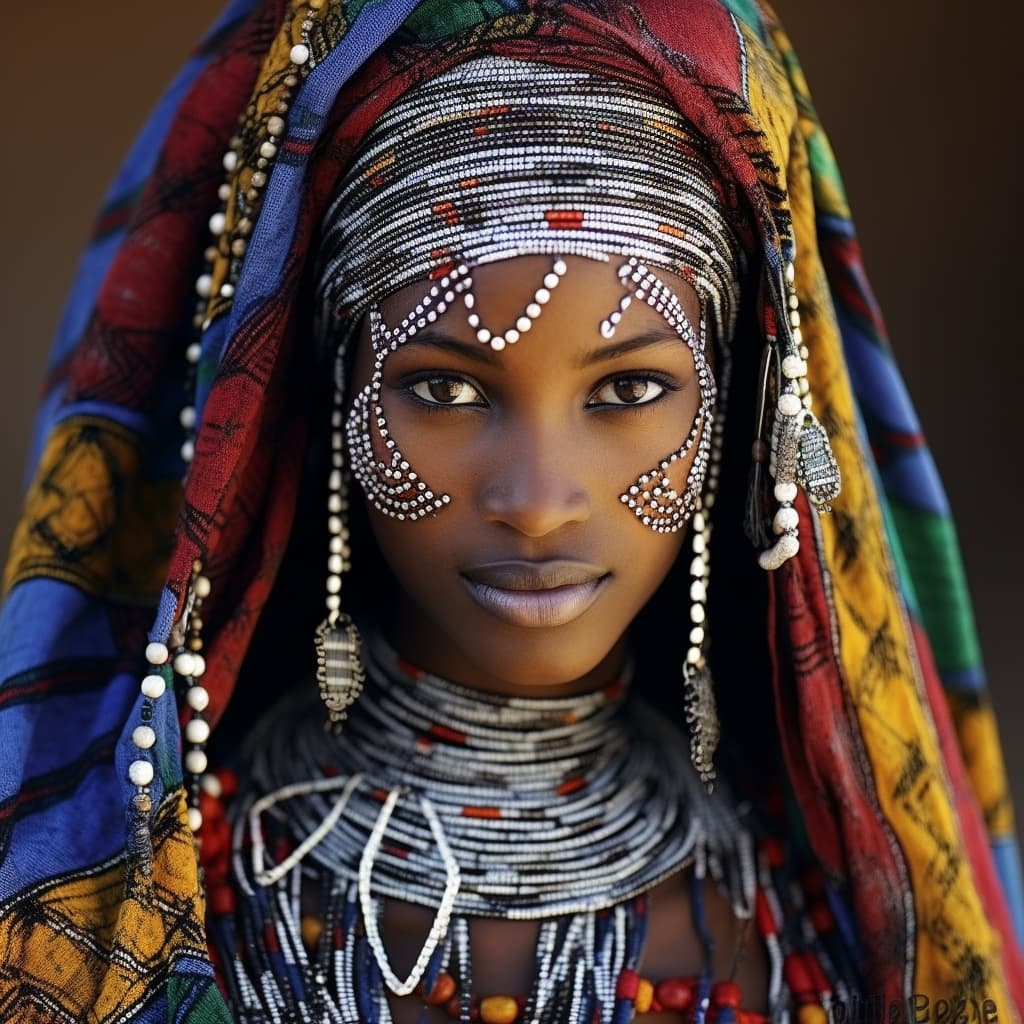
Toubou Erotic
Toubouland (Chad, Niger, Sudan, Libya)
Nilo-Saharan / Saharan / Tebu
Islam / Sunni Islam
Daza, Teda
Northern Africa
About Toubou People
The Toubou are a desert people in the most demanding sense of the term — the Tibesti massif of northern Chad and the Tassili plateaus of southern Libya are among the harshest inhabited landscapes on the continent, and the Toubou have built a whole social architecture around moving through them. They split into two main branches: the Teda in the north, anchored around Tibesti and stretching into Libya and Niger, and the Daza further south in the Borkou and Kanem regions of Chad. The two speak closely related forms of Tebu, a language sitting in the Saharan branch of Nilo-Saharan — distinct from the Arabic of their northern neighbors and from the Chadic and Nilo-Saharan languages to their south, which has helped them stay culturally legible to themselves across centuries of contact with Tuareg, Arab, and Kanuri populations.
They are Sunni Muslim, and have been for a long time, but Islam among the Toubou tends to ride alongside an older code centered on clan obligation, hospitality, and the management of feuds. Lineage matters: a person belongs to a named clan with rights to specific wells, palm groves, and pasture, and those rights are defended fiercely. The Toubou have a reputation among their neighbors — and among themselves — for stubbornness and for an unusual tolerance of physical hardship, which is less folklore than a practical fact of growing up in a place where a misjudged journey kills you.
Economically they are pastoralists and caravaneers, herding camels, goats, and in the south cattle, and historically running the trans-Saharan routes that connected Bilma's salt and Kufra's dates to the Sahel. That caravan economy is largely gone, but the geography that made it work has kept the Toubou strategically placed; through the late twentieth century they were central to the Chadian-Libyan conflicts over the Aouzou Strip, and Toubou figures have remained politically consequential in Chad and, more recently, in post-Gaddafi Libya, where Toubou communities in the Fezzan have been drawn into the long contest over the southern border.
Custom-wise, a few things stand out: marriage is generally clan-exogamous and brideprice is paid in livestock; women retain considerable independence in property and movement, which surprises outsiders who expect otherwise from a Saharan Muslim society; and meals, even sparse ones, are shared — refusing to feed a traveler is a serious breach, because in the Tibesti turning someone away from your fire can be the same as killing them.
Typical Toubou Phenotypes
Reference for AI generation — hair, eyes, skin, facial structure, build
The Toubou are a Saharan people whose phenotype is shaped by long isolation in some of the harshest desert terrain on earth — the Tibesti massif, Ennedi plateau, and the Bilma erg. The look is distinctively Saharan rather than West African or Arab: tall, lean-framed bodies, narrow features, and very dark skin that often carries a cool brown rather than the warm reddish tones common further south. They're frequently described as one of the slimmest populations on the continent.
Hair is uniformly tightly coiled — Type 4, often Type 4B–4C — and almost always black. Many older men and women shave or wear close-cropped styles under turbans and headscarves; women in the Teda branch traditionally wear small braids close to the scalp or longer plaited styles, sometimes oiled with butter. Greying tends to be late and gradual.
Eyes are dark brown to near-black. Epicanthic folds are absent. The eye shape tends to be long and narrow with a slight almond set, often appearing deep under a strong brow — a feature accentuated by the squint habits of desert life.
Skin is consistently in the Fitzpatrick V–VI range, with cool, slightly bluish or ashen undertones rather than the golden or red-brown undertones seen in Sahelian groups to the south. Sun exposure is constant; weathered skin around the eyes and cheekbones is common past middle age.
Facial structure is the most distinctive element: narrow noses with relatively high, straight bridges and modest alar width — closer to Horn-of-Africa or Tuareg morphology than to West African — paired with thinner lips than most Sub-Saharan groups, high cheekbones, and a long, narrow jaw. The overall face is vertically elongated.
Build is tall and notably wiry: men commonly 175–185 cm, women 165–175 cm, both with low body fat, long limbs, and slender wrists and ankles — a body type reputedly capable of crossing the desert on foot for days. Phenotype differences between Teda (mountain-dwelling, northern) and Daza (plains, more southerly and slightly more admixed with Kanuri and Arab neighbors) are subtle: Daza tend to be marginally shorter and broader-featured, Teda taller and finer-boned.
Data depth
0/100Coverage of image-grounded phenotype observations · drives AI generation diversity
- Sample size
- 0/40· 0 images
- Image quality
- 0/30· 0% high
- Confidence
- 0/20
- Source diversity
- 0/10
- ·No image observations yet
Explore phenotype categories
Structured taxonomy with peer-reviewed scales · 22 anatomical categories





Generate Toubou AI Content
Use this ethnicity's phenotype data to create AI-generated content with accurate physical traits and cultural context.
Open Creator Studio