Beja Erotic
Sudan, Egypt, Eritrea
Afroasiatic / Cushitic / Beja
Islam / Sunni Islam
Bishari, Ababda, Hadendoa, Hedareb, Amarar, Beni-Amer
Northern Africa
About Beja People
The Beja have lived between the Nile and the Red Sea for at least four thousand years — a stretch of desert and coastal hill country running from southeastern Egypt through eastern Sudan into northern Eritrea. Greek and Roman writers knew them as the Blemmyes; medieval Arab geographers wrote about them under the name they still use for themselves. They are one of the few peoples in the region whose presence in the historical record is essentially continuous, and whose territory has stayed roughly the same across that span.
Their language, Bedawi (also called Beja or Tu-Bedawie), is the northernmost surviving Cushitic tongue and the only one spoken outside the Horn of Africa. Linguists treat it as its own branch — distinct enough from Somali, Oromo, and Afar that some argue it sits apart from the rest of Cushitic entirely. Most Beja today are bilingual in Arabic, and the Beni-Amer in Eritrea often speak Tigre as a first language, but Bedawi remains the marker of group identity, especially among the camel-herding interior clans like the Bishari and Hadendoa. The Ababda, the northernmost branch, have largely shifted to Arabic over the past century.
Society is organized through patrilineal clans grouped into the larger named branches, and traditionally by transhumant pastoralism — camels in the drier north, mixed herding closer to the highlands. Sunni Islam arrived gradually through trade and Sufi orders rather than conquest; the Khatmiyya order, founded in the nineteenth century, has particularly deep roots among the Beja and continues to shape religious life. Pre-Islamic customs persist underneath, especially in marriage practice, conflict mediation through clan elders, and the distinctive sword-and-shield dance still performed at weddings.
The Hadendoa gave the British colonial army its hardest fighting in the 1880s Mahdist wars — Kipling's "Fuzzy-Wuzzy" was a Hadendoa warrior, and the nickname referred to the elaborate teased hairstyle that remained a Hadendoa signature well into the twentieth century. That history sits uneasily with the present: decades of drought, the Eritrean war of independence, and Sudan's civil conflicts have pushed many Beja off the land and into towns like Port Sudan and Kassala, where they form a visible but politically marginal urban population. The Beja Congress, active since the 1950s, has periodically taken up arms over the region's underdevelopment, and Beja grievances remain a live factor in eastern Sudanese politics.
Typical Beja Phenotypes
Reference for AI generation — hair, eyes, skin, facial structure, build
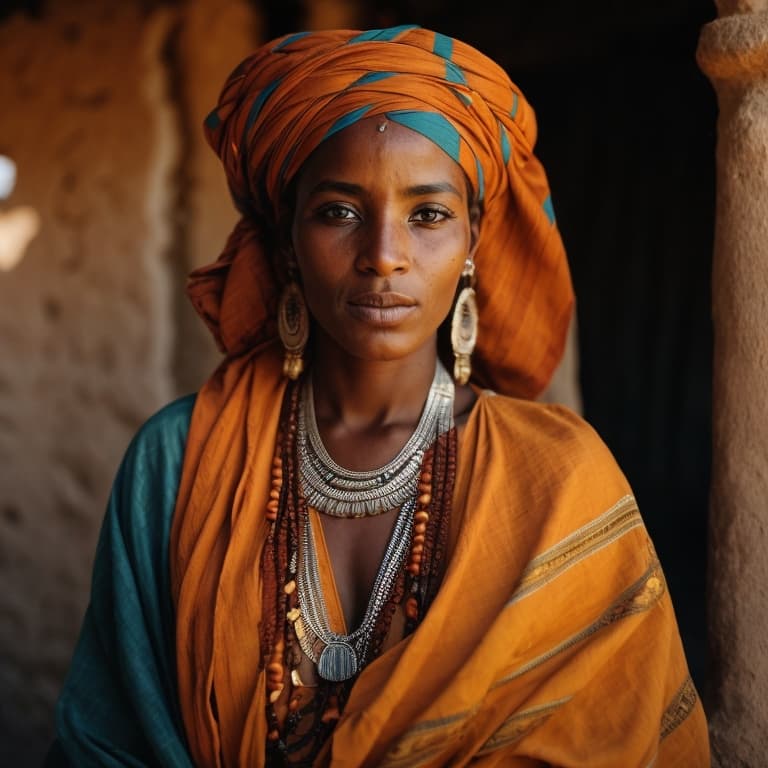
The Beja phenotype is defined by a distinctive Northeast African Cushitic morphology — narrow-built, fine-featured, and often noticeably tall, with coloring that sits between Nilotic Sudan to the south and the Arab-Egyptian populations to the north. The signature trait is the hair: tightly coiled but worn in a particular way the Hadendoa especially are known for — the towering teased halo Rudyard Kipling famously called the "fuzzy-wuzzy," a styling tradition that remains visually iconic. Underlying texture ranges from Type 4 coily to looser Type 3 spirals, more often jet black, with gray arriving late. Outright kink without curl pattern is uncommon; loose Cushitic curl is the norm.
Eyes are typically dark brown to near-black, almond-shaped, deep-set under straight or gently arched brows. Epicanthic folds are absent. The gaze tends to read as sharp and elongated rather than rounded. Skin tones cluster in Fitzpatrick V to VI — warm reddish-brown through deep cool brown — with a coppery or bronze undertone that distinguishes Beja complexion from the bluer-black of southern Nilotes and the olive of Lower Egyptians. Sun-weathering on pastoralists adds a leathered quality to the face and forearms while the torso stays markedly lighter.
Facial structure is the giveaway: narrow, high-bridged noses with thin alar wings, prominent cheekbones, long jaws, and lips of medium fullness — neither the everted fullness of West African groups nor the thin lips of the Levant. The overall face is long, lean, and angular. Builds run tall and gracile — wiry rather than muscular, with long limbs, narrow hips, and low body fat shaped by a pastoralist diet and arid climate; women tend toward slender frames with modest curves rather than pronounced hourglass proportions.
Sub-group variation is real but subtle. Hadendoa and Bishari trend darkest and most classically Cushitic in feature. Beni-Amer, straddling the Eritrean border, show more admixture with Tigre and Tigrinya neighbors — slightly lighter skin, looser curl. Ababda, the northernmost branch in Egypt's Eastern Desert, carry visible Arab influence: lighter complexions, occasional lighter eyes, finer hair texture.
Data depth
0/100Coverage of image-grounded phenotype observations · drives AI generation diversity
- Sample size
- 0/40· 0 images
- Image quality
- 0/30· 0% high
- Confidence
- 0/20
- Source diversity
- 0/10
- ·No image observations yet
Explore phenotype categories
Structured taxonomy with peer-reviewed scales · 22 anatomical categories




Generate Beja AI Content
Use this ethnicity's phenotype data to create AI-generated content with accurate physical traits and cultural context.
Open Creator Studio