Bilala Erotic
Lake Fitri (Chad)
Nilo-Saharan / Central Sudanic / Naba
Islam
Northern Africa
About Bilala People
The Bilala live in the dry country around Lake Fitri, in central Chad — a shallow, seasonal lake that swells in the rains and shrinks to mudflats in the dry months, ringing itself with grass, fish, and the cattle the Bilala herd alongside their farming. They are one of three closely related peoples, with the Kuka and the Medogo, who together speak Naba and trace themselves to a common founding line. Among themselves the distinction matters; to outsiders the three are often lumped, which the Bilala generally tolerate without correcting.
Their language sits inside the Central Sudanic branch of Nilo-Saharan, a family that stretches across a band of central Africa from Chad into the Nile basin. Naba is not a regional lingua franca — that role falls to Chadian Arabic, which most Bilala men speak as a second language for trade, religion, and dealings with the Chadian state. The group's identity is bound up with the medieval Sultanate of Yao, founded in the 14th or 15th century after the Bilala's ancestors moved south from the Lake Chad region following a falling-out with the Kanem-Bornu empire. For a stretch of the 14th century they actually held Kanem itself, before being pushed back east. The sultanate persisted in attenuated form into the colonial period and the office of sultan still exists at Yao, ceremonially recognized within the modern Chadian system.
Islam came with — or shortly after — the founding of the sultanate, and is now universal among the Bilala, generally Sunni and shaped by the Sufi orders that move through the Sahel. It coexists with older practices around the lake itself: Lake Fitri is treated with a measure of reverence that predates Islamic observance, and certain ritual specialists retain authority that runs parallel to the imam's. Daily life is organized around a tight seasonal calendar — millet and sorghum on the receded lakebed, fishing as the waters drop, cattle moved to dry-season pasture — with marriages, naming ceremonies, and the sultan's court providing the social architecture above it. The Bilala are not a large group, perhaps a few hundred thousand, and their territory is remote enough that they have remained relatively legible as a distinct people even as Arabic and the wider Chadian polity press in from every direction.
Typical Bilala Phenotypes
Reference for AI generation — hair, eyes, skin, facial structure, build
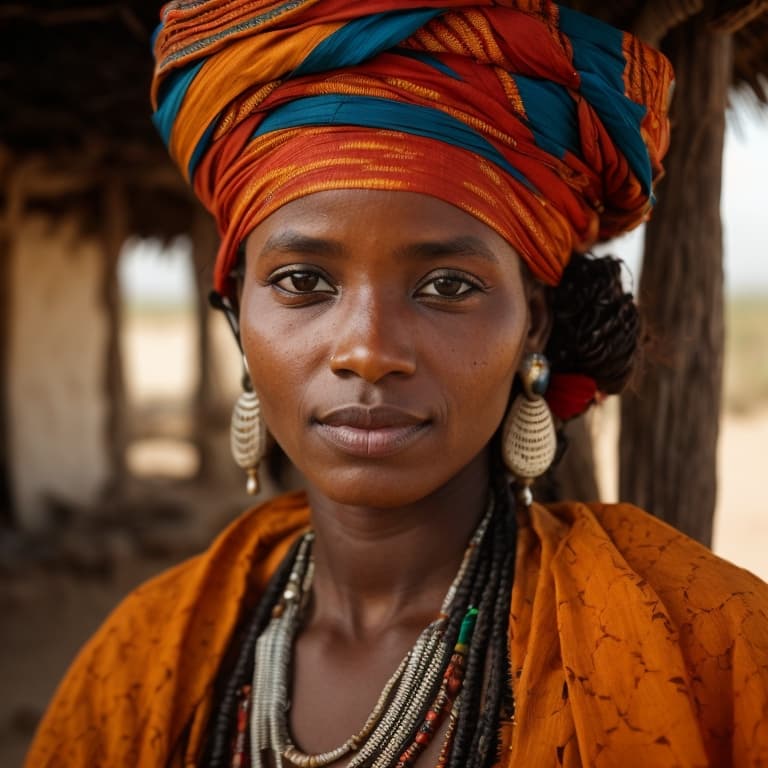
The Bilala are a Naba-speaking, predominantly Muslim population clustered around Lake Fitri in central Chad, sitting at the contact zone between Sahelian Arab populations to the north and Sudanic agricultural peoples to the south. Their phenotype reads as that hybrid: strongly Sub-Saharan in pigment and hair, but with facial architecture often pulled toward the narrower, more elongated forms common across Chadic and Nilo-Saharan groups of the eastern Sahel.
Hair is almost uniformly black and tightly coiled — Type 4 textures dominate, often kept very short on men and worked into braids, twists, or covered with headscarves on women. Premature greying is uncommon; reddish or bronze sun-bleaching shows up on children and on adults who spend long days on the lake or in fields.
Eyes are dark brown to near-black, set under straight or only mildly arched brows. Epicanthic folds are absent. Eye shape tends to be almond, with the outer corner sometimes carried slightly upward, and sclera often shows a warm ivory rather than bright white from chronic sun exposure.
Skin spans Fitzpatrick V to VI, most often a deep warm brown with red-bronze undertones rather than the blue-black register seen further south in the Sudan belt. Sahelian sun and dust give a matte, weathered finish on older adults; younger faces hold a clearer, slightly burnished tone.
Facial structure is the Bilala's most distinctive marker. Noses are typically medium-bridged with moderate alar width — narrower than West African averages, broader than Arab Chadian neighbours. Lips are full but not maximally everted, cheekbones high and laterally placed, jaws often long and tapered toward a defined chin. The overall face reads as elongated rather than round.
Builds are lean and tall, with men commonly in the 175–185 cm range and women proportionately slim-limbed; fishing and cattle-keeping economies around Lake Fitri reinforce a wiry, low-fat composition. Naba-speaking sub-clans show subtle gradients — northern lineages trending slightly lighter and finer-featured, southern ones broader-nosed and darker.
Data depth
0/100Coverage of image-grounded phenotype observations · drives AI generation diversity
- Sample size
- 0/40· 0 images
- Image quality
- 0/30· 0% high
- Confidence
- 0/20
- Source diversity
- 0/10
- ·No image observations yet
Explore phenotype categories
Structured taxonomy with peer-reviewed scales · 22 anatomical categories





Generate Bilala AI Content
Use this ethnicity's phenotype data to create AI-generated content with accurate physical traits and cultural context.
Open Creator Studio