Nagpuri Erotic
Chota Nagpur Plateau (India)
Indo-European / Indo-Aryan / Bihari / Sadri
Hinduism
Chik Baraik
Southern Asian
About Nagpuri People
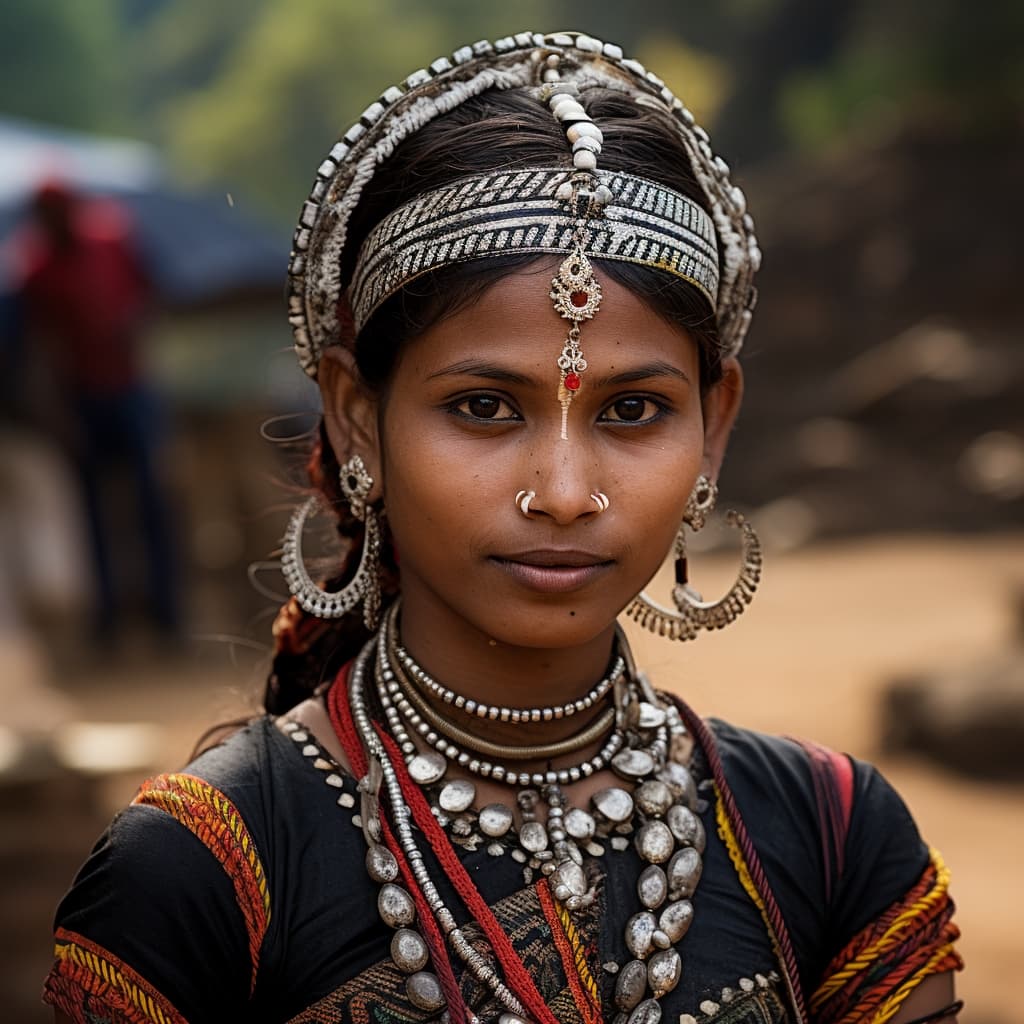
The Nagpuri identity coheres less around a single tribe than around a shared plateau and a shared lingua franca. The Chota Nagpur Plateau — a worn upland of laterite soil, sal forests, and slow rivers cutting across what is now Jharkhand and the eastern fringes of Chhattisgarh, Odisha, and West Bengal — has for centuries been a meeting ground between Adivasi communities (Munda, Oraon, Kharia and others) and the Indo-Aryan-speaking populations who settled among them. Out of that long contact emerged Sadri, also called Nagpuri, an Indo-Aryan language of the Bihari group that took on a regional role no one quite planned: it became the trade tongue, the marriage-negotiation tongue, the bazaar tongue that lets a Munda-speaking villager and an Oraon-speaking neighbour conduct business without either switching to Hindi. Calling someone Nagpuri usually points to that linguistic-cultural belonging — a plateau person whose first or working language is Sadri — rather than to a discrete caste or tribe.
Religion on the plateau is layered rather than tidy. Most Nagpuri-identifying communities are counted as Hindu, but the Hinduism in question sits comfortably alongside village deities, sacred groves (sarna), and ritual specialists whose authority predates any temple. Festivals like Karam, centred on a branch of the karam tree planted in the courtyard and danced around through the night, are observed widely across both Hindu and Sarna households, and the line between the two traditions is often a matter of paperwork rather than practice. Among the named sub-groups, the Chik Baraik are the plateau's traditional weavers — historically the producers of the coarse cotton cloth and the ritual textiles used in tribal ceremonies, a service caste embedded inside the larger Adivasi economy rather than outside it.
The plateau's modern history has been shaped by mineral wealth — coal, iron, bauxite — and the displacement that came with it; the formation of Jharkhand state in 2000 was, in part, an attempt to give the region's communities a political vehicle of their own. Nagpuri music and the Nagpuri-language film industry, both small but stubborn, have carried the language into screens and speakers in a way the colonial-era ethnographers who first wrote it down did not anticipate. It remains, above all, a working culture: spoken in markets, sung at harvests, danced at Karam.
Typical Nagpuri Phenotypes
Reference for AI generation — hair, eyes, skin, facial structure, build
Nagpuri people of the Chota Nagpur Plateau sit at a phenotype crossroads — Indo-Aryan ancestry layered onto an older Austroasiatic and Dravidian-affiliated tribal substrate from the surrounding Jharkhand belt. The result is a population that reads as medium-to-deep brown plateau Indian, structurally distinct from both the lighter Gangetic-plain Bihari neighbors to the north and the more gracile coastal-Bengali populations to the east.
Hair is uniformly black to very dark brown, straight to gently wavy, with coarse-to-medium thickness; tight curl is uncommon. Slight sun-bleaching to brown tips appears in agricultural communities. Greying tends to come late and concentrates at the temples. Eyebrows are typically thick and well-defined, and facial hair on men is moderate — full beard growth is variable rather than universal.
Eyes run dark brown to near-black; lighter hazel and green do appear but are rare enough to be remarked on. The eye is almond-shaped with a level set; epicanthic folds are absent in the majority but show up at low frequency in Chik Baraik and other tribal-affiliated lineages, reflecting that older substrate. Lashes are dense and dark.
Skin spans Fitzpatrick III through V, clustering around IV — warm wheatish to deep brown with olive or red-brown undertones rather than the yellow undertones common further east. Outdoor laborers and rural populations sit a clear shade or two darker than urban Ranchi residents. Tanning is even and rarely freckles.
Facial structure favors a medium-to-broad nasal bridge with moderate alar flare — neither the high narrow Indo-Aryan nose of the northwest nor the markedly broad nose of some Munda-speaking neighbors. Lips are medium-full, cheekbones are moderately prominent, and the jawline is square more often than tapered. The face overall reads as broader and flatter in profile than the typical Hindi-belt phenotype.
Build is short-to-medium — men commonly 5'4"–5'7", women 4'10"–5'2" — with a wiry, compact frame and low body fat in rural populations. Chik Baraik weavers tend toward the same compact tribal build, while Nagvanshi-lineage families like the Shahdeos often sit slightly taller and lighter-skinned, a visible aristocratic admixture overlay on the broader Nagpuri base.
Data depth
37/100Coverage of image-grounded phenotype observations · drives AI generation diversity
- Sample size
- 12/40· 5 images
- Image quality
- 20/30· 40% high
- Confidence
- 5/20· mean 0.53
- Source diversity
- 0/10· wikipedia
- ·Small sample (n<10)
- ·Low overall confidence
- ·Wikipedia-only source — not population-representative
Observed Distribution — Image Sample
Empirical observations from analyzed photographs · supplementary signal, not population truth
Sample: 5 images analyzed (5 wikipedia). Quality: 2 high, 1 medium, 2 low, 0 very_low. Avg analyzer confidence: 0.53.
Skin tone (Fitzpatrick): IV (40%), V (40%), unclear (20%)
Hair color: gray/white (40%), black (40%), unclear (20%)
Hair texture: straight (40%), wavy (20%), covered (40%)
Eye color: dark brown (60%), unclear (40%)
Epicanthic fold: 0% present, 80% absent, 20% unclear
Caveats: Sample size 5 is small — observed distribution should be treated as suggestive, not definitive. Low average analyzer confidence — many photos partially obscured or historical. Sample is 100% Wikipedia notable people — skews toward male, public-life, and modern figures, not population-representative.
Last aggregated: May 7, 2026
Explore phenotype categories
Structured taxonomy with peer-reviewed scales · 22 anatomical categories
Notable Nagpuri People
21 reference figures — sourced from Wikipedia
- Bhuneshwar Anuj — Journalist and Scholar
- Bulu Chik Baraik — Politician
- Girdhari Ram Gonjhu — Litterateur and Scholar
- Govind Sharan Lohra — folk singer
- Shakuntala Mishra — professor and writer
- Mahavir Nayak — folk singer
- Mukund Nayak — folk artist
- Nandlal Nayak — Music composer
- Nikki Pradhan — hockey player
- Praful Kumar Rai — writer and singer
- Bakhtar Say — freedom fighter
- Raghunath Shah — Nagvanshi king and poet
- Ani Nath Shahdeo — King of Barkagarh
- Gopal Sharan Nath Shahdeo — Prince and former M.L.A from Hatia
- Jagannath Shah Deo — Nagvanshi king in 19th century
- Lal Chintamani Sharan Nath Shahdeo — Last Nagvanshi king and politician
- Lal Pingley Nath Shahdeo — Jurist and Political activist
- Lal Ranvijay Nath Shahdeo — Lawyer, writer, poet and political activist
- Udai Pratap Nath Shah Deo — Nagvanshi king
- Vishwanath Shahdeo — Freedom fighter in 1857 rebellion
- Mundal Singh — freedom fighter
Generate Nagpuri AI Content
Use this ethnicity's phenotype data to create AI-generated content with accurate physical traits and cultural context.
Open Creator Studio