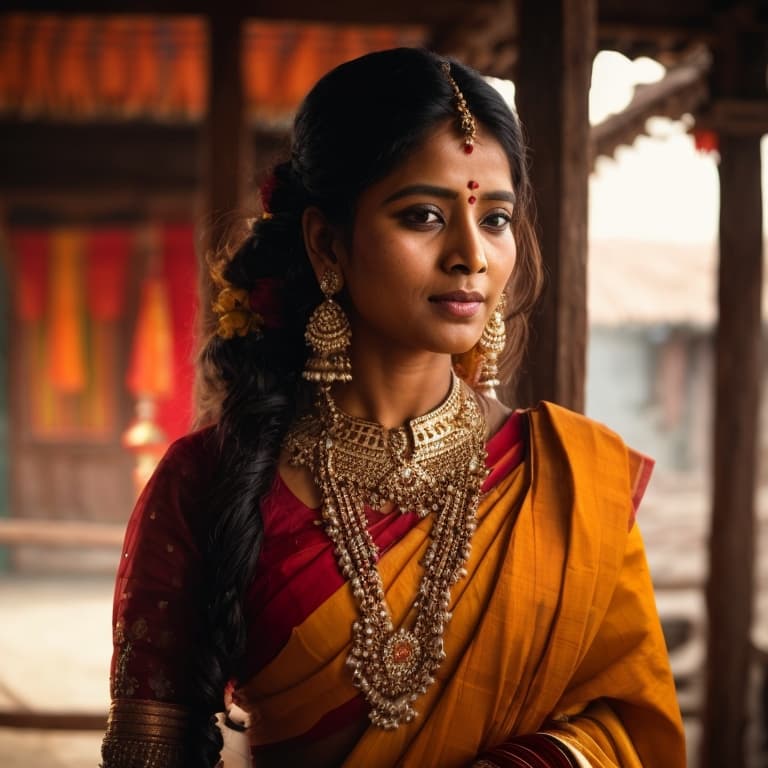
Bhojpuris Erotic
India, Nepal
Indo-European / Indo-Aryan / Bihari / Bhojpuri
Hinduism
Paswan, Thakur, Teli
Southern Asian
About Bhojpuris People
The Bhojpuris are the people of Bhojpur — a stretch of the eastern Gangetic plain straddling western Bihar, eastern Uttar Pradesh, and the Nepalese Terai. The land is flat, river-fed, agriculturally dense, and historically overcrowded; it has been pushing people outward for nearly two centuries. That outward pressure is the single most important fact about Bhojpuri identity. After the abolition of slavery in the British Empire, indenture recruiters drew heavily from this region, and Bhojpuri labourers were shipped to Mauritius, Trinidad, Guyana, Suriname, Fiji, and South Africa. The descendants of those workers still speak recognisable forms of the language, and the music, food, and wedding rituals of the Indo-Caribbean world are essentially Bhojpuri culture preserved in transit.
The language itself is Indo-Aryan, sitting in the Bihari cluster alongside Maithili and Magahi. Indian census practice has long absorbed it under Hindi, and that bureaucratic shadow is a sore point — Bhojpuri has its own literature, its own film industry centred in Patna and Mumbai, and a vocabulary distinct enough that a Hindi speaker from Delhi will catch the gist but miss the texture. Folk forms like chaita, kajri, and the wedding songs known as sohar carry the older registers of the language, and the goddess-festival Chhath Puja — four days of fasting, river-bathing, and offerings to the setting and rising sun — has become the defining Bhojpuri ritual, now visible in any North Indian city with a Bhojpuri diaspora.
Religious life is overwhelmingly Hindu, with strong Shakta and Vaishnava strands, but the social grammar is caste, not theology. The community contains the full vertical range of the caste system: Thakurs as a landowning Rajput stratum, Telis as an oil-presser trading caste that has moved heavily into commerce, and Paswans (Dusadhs) as a Dalit community with deep political organisation in Bihar. These are not subgroups in the ethnographic sense so much as parallel worlds inside the same linguistic group, and Bhojpuri politics — both at home and in the diaspora — is largely the story of how those worlds negotiate one another.
What outsiders most often miss is the tone. Bhojpuri culture is not reserved. It is loud, blunt, full of innuendo, fond of song, suspicious of pretension, and unembarrassed about the body and about labour. The cinema reflects this, sometimes to its own disrepute, but the underlying sensibility — earthy, plainspoken, warm — is the genuine article.
Typical Bhojpuris Phenotypes
Reference for AI generation — hair, eyes, skin, facial structure, build
Bhojpuris occupy the eastern Gangetic plain — Bihar, eastern Uttar Pradesh, and the Nepalese Terai — and their phenotype sits at the meeting point of North Indian Indo-Aryan and the older substrate populations of the middle Ganges. The result is a recognizably North Indian face on a generally compact frame, with skin tones running noticeably warmer and darker than Punjabi or Kashmiri ranges to the northwest.
Hair is almost uniformly black or very dark brown, straight to gently wavy, with coarse-to-medium texture; tight curls are uncommon. Greying tends to come in late and stays salt-and-pepper rather than going fully white. Facial and body hair is moderate to heavy in men — full beards grow in readily — and brow hair is typically thick and well-defined in both sexes.
Eyes are overwhelmingly dark brown to near-black, almond-shaped, set under a defined supraorbital ridge with no epicanthic fold. Lashes are dense. Skin spans Fitzpatrick III through V, with the modal range sitting around IV — a warm olive-to-medium-brown with golden or coppery undertones — and Fitzpatrick V common among agricultural and Dalit-descended sub-populations like the Paswan. Sun exposure deepens the forearms, face, and neck a shade or two past the torso in rural workers.
The face is usually oval to slightly long, with a straight or softly convex nose bridge, narrow-to-medium alar width, and a distinctly defined nasal tip — broader, flatter noses are uncommon. Lips are medium-full, the lower noticeably fuller than the upper. Cheekbones are present but not high-set; jaws are moderate, often softening to a rounded chin. Build is light to medium: men typically 165–172 cm, women 150–158 cm, with a slender-to-wiry frame, narrow shoulders relative to hip, and a tendency toward central adiposity in middle age rather than overall mass.
Sub-group differences are real but subtle — Thakur and other upper-caste lineages skew taller and lighter on average, Teli intermediate, Paswan darker and shorter — though overlap across the three is wide enough that no single feature reliably sorts them. Diaspora Bhojpuris in Mauritius, Guyana, Suriname, Trinidad, and Fiji retain the core phenotype with mild admixture visible at the edges.
Data depth
73/100Coverage of image-grounded phenotype observations · drives AI generation diversity
- Sample size
- 40/40· 82 images
- Image quality
- 18/30· 37% high
- Confidence
- 15/20· mean 0.70
- Source diversity
- 0/10· wikipedia
- ·Wikipedia-only source — not population-representative
Observed Distribution — Image Sample
Empirical observations from analyzed photographs · supplementary signal, not population truth
Sample: 82 images analyzed (82 wikipedia). Quality: 30 high, 30 medium, 20 low, 2 very_low. Avg analyzer confidence: 0.70.
Skin tone (Fitzpatrick): II (1%), III (1%), IV (62%), V (30%), VI (1%), unclear (4%)
Hair color: gray/white (59%), black (33%), light/medium brown (2%), unclear (6%)
Hair texture: straight (55%), wavy (23%), curly (2%), coily (2%), bald (4%), shaved (1%), covered (10%), unclear (2%)
Eye color: dark brown (79%), unclear (21%)
Epicanthic fold: 0% present, 85% absent, 15% unclear
Caveats: Sample is 100% Wikipedia notable people — skews toward male, public-life, and modern figures, not population-representative.
Last aggregated: May 7, 2026
Explore phenotype categories
Structured taxonomy with peer-reviewed scales · 22 anatomical categories
Notable Bhojpuris People
100 reference figures — sourced from Wikipedia
- Mohammad Hidayatullah — 20 July 1969 – 24 August 1969; 6 October 1982 – 31 October 1982), Acting Pres…
- Rajendra Prasad — 26 January 1950 – 13 May 1962), 1st President of India. He was born in Zirade…
- Wavel Ramkalawan — 5th President of Seychelles
- Anerood Jugnauth — 7 October 2003 – 31 March 2012), 4th President of Mauritius
- Kailash Purryag — 21 July 2012 – 29 May 2015), 5th President of Mauritius
- Mohamed Irfaan Ali — 2 August 2020 – ), 10th President of Guyana
- Cheddi Jagan — 9 October 1992 – 6 March 1997), 4th President of Guyana
- Bharrat Jagdeo — 11 August 1999 – 3 December 2011), 7th President of Guyana
- Donald Ramotar — 3 December 2011 – 16 May 2015), 8th President of Guyana
- Fred Ramdat Misier — 8 February 1982 – 25 January 1988), 3rd President of Suriname
- Chan Santokhi — 16 July 2020 – ), 9th President of Suriname
- Ramsewak Shankar — 25 January 1988 – 24 December 1990), 4th President of Suriname
- Noor Mohamed Hassanali — 20 March 1987 – 17 March 1997), 2nd President of Trinidad and Tobago
- Lal Bahadur Shastri — 9 June 1964 – 11 January 1966), 2nd Prime Minister of India
- Chandra Shekhar Singh — 10 November 1990 – 21 June 1991), 8th Prime Minister of India
- Pravind Jugnauth — 5th Prime Minister of Mauritius
- Navin Ramgoolam — 5 July 2005 – 17 December 2014), 3rd Prime Minister of Mauritius
- Seewoosagur Ramgoolam — 12 March 1968 – 30 June 1982), 1st Prime Minister of Mauritius
- Pretaap Radhakishun — 17 July 1986 – 7 April 1987), 6th Prime Minister of Suriname
- Basdeo Panday — 9 November 1995 – 24 December 2001), 5th Prime Minister of Trinidad and Tobago
- Kamla Persad-Bissessar — 26 May 2010 – 9 September 2015), 6th Prime Minister of Trinidad and Tobago
- Harihar Singh — 1969-1969)
- Lalu Prasad Yadav — 1990-1995)
- Rabri Devi — 1997-2005)
- Daroga Prasad Rai — 1970, for 10 months)
- Kedar Pandey — 1972-1973)
- Abdul Ghafoor — 1973-1975)
- Ram Sundar Das — 1979-1980)
- Bindeshwari Dubey — 1985-1988)
- Sampurnanand — 1954-1960)
- Kamlapati Tripathi — 1969–70)
- Anant Sharma — 10 March 1983 – 14 August 1984), 11th governor of West Bengal
- Chandeshwar Prasad Narayan Singh — 18th governor of Uttar Pradesh and 2nd governor of Punjab.
- Kailashpati Mishra — 7 May 2003 – 2 Jul 2004), 15th Governor of Gujarat
- Jagjivan Ram — First Labour Minister of India, first Dalit Deputy PM of India and founder of…
- Tejashwi Yadav — Bihar (2015-2017)
- Ram Jaipal Singh Yadav — Bihar (1971-1972)
- Renu Devi — Bihar (2020-2022)
- Lallan Prasad Singh — Governor of Assam (1973–80), Manipur (1973–80, 1982–83), Meghalaya (1973–80),…
- Anand Satyanand — Governor-General of New Zealand (2006-2011)
- Ram Dulari Sinha — Governor of Kerala (1988-1990)
- Manoj Sinha — Lt. Governor of Jammu and Kashmir ( 2020–Present )
- Meira Kumar — 2009-2014)
- Bali Ram Bhagat — 1976-1977)
- Anjana Om Kashyap — managing editor of Aaj Tak
- Ravish Kumar — former NDTV journalist
- George Orwell — born in Motihari
- Upendra Rai — Chairman, M.D and Editor-in-Chief of Bharat Express
- Ram Bahadur Rai — former editor in Jansatta
- Shaukat Pardesi — poet writer & lyricist
- Vidya Niwas Mishra — Padma Bhushan awardee and journalist
- Zafar ul Islam Khan — editor in The Milli Gazette
- Ananda Prasad — biochemist
- Gupteshwar Pandey — former DGP of Bihar
- Kapil Muni Tiwary — linguist
- Sachchidananda Sinha — lawyer and parliamentarian
- Nazir Hussain — Bollywood actor and pioneer of Bhojpuri fim industry
- Dinesh Lal Yadav — Bhojpuri actor, singer and politician.
- Khesari Lal Yadav — Bhojpuri actor and singer
- Manoj Tiwari — former Bhojpuri actor, singer and politician
- Pawan Singh — Bhojpuri actor, singer and politician.
- Ravi Kishan — Hindi-Bhojpuri film actor and politician
- Kunal Singh — Bollywood-Bhojpuri actor
- Akhilendra Mishra — Hindi film & TV actor
- Baleshwar Yadav — Bhojpuri folk singer
- Bihari Lal Yadav — founder of Biraha genre
- Chandan Tiwari — Bhojpuri singer
- Hiralal Yadav — birha and kajri
- Raj Mohan — Bhojpuri singer
- Ramdew Chaitoe — Bhojpuri folk singer
- Ritesh Pandey — Bhojpuri singer and actor
- Krishna Kant Shukla — physicist, musician, poet, ecologist and educator
- Rajan and Sajan Mishra — singers of the khyal style of Indian classical music
- Pandit Chhannulal Mishra — Hindustani classical singer
- Husna Bai — Thumri singer from Banaras
- Rajkumari Dubey — playback singer worked in Hindi cinema of 1930-40s
- Nirmala Devi — Indian actress, Hindustani classical vocalist and mother of Bollywood actor, …
- Rasoolan Bai — Indian Hindustani classical musician
- Siddheswari Devi — legendary Hindustani singer
- Girija Devi — Indian classical singer of the Seniya and Banaras gharanas
- Kabir — poet, saint and social reformer
- Ravidas — poet, saint and social reformer
- S.H. Bihari — Bollywood Writer
- Shailendra — Bollywood Writer
- Lachhimi Sakhi — saint and poet
- Dariya Saheb — saint, poet and the founder of Dariya or Dariyadasi sect
- Dharani Das — Ramanandi saint and poet
- Acharya Shivpujan Sahay — Hindi and Bhojpuri
- Bhikhari Thakur — Bhojpuri dramatist and writer
- Heera Dom — Bhojpuri writer and pioneer of modern Bhojpuri Dalit literature
- Rahul Sankrityayan — Bhojpuri and Hindi
- Raghuveer Narayan — Bhojpuri, English and Hindi
- Ram Karan Sharma — Sanskrit and English
- Teg Ali Teg — Bhojpuri writer
- Rameshwar Singh Kashyap — playwright, screenwriter and professor
- Premchand — one of the most celebrated writers of the Indian subcontinent
- Agyey — poet, literary critic, journalist and pioneer of the experimentalism movement…
- Hazari Prasad Dwivedi — novelist, essayist, critic
- Doodhnath Singh — poet, writer and critic
- Amarkant — Hindi writer






Generate Bhojpuris AI Content
Use this ethnicity's phenotype data to create AI-generated content with accurate physical traits and cultural context.
Open Creator Studio