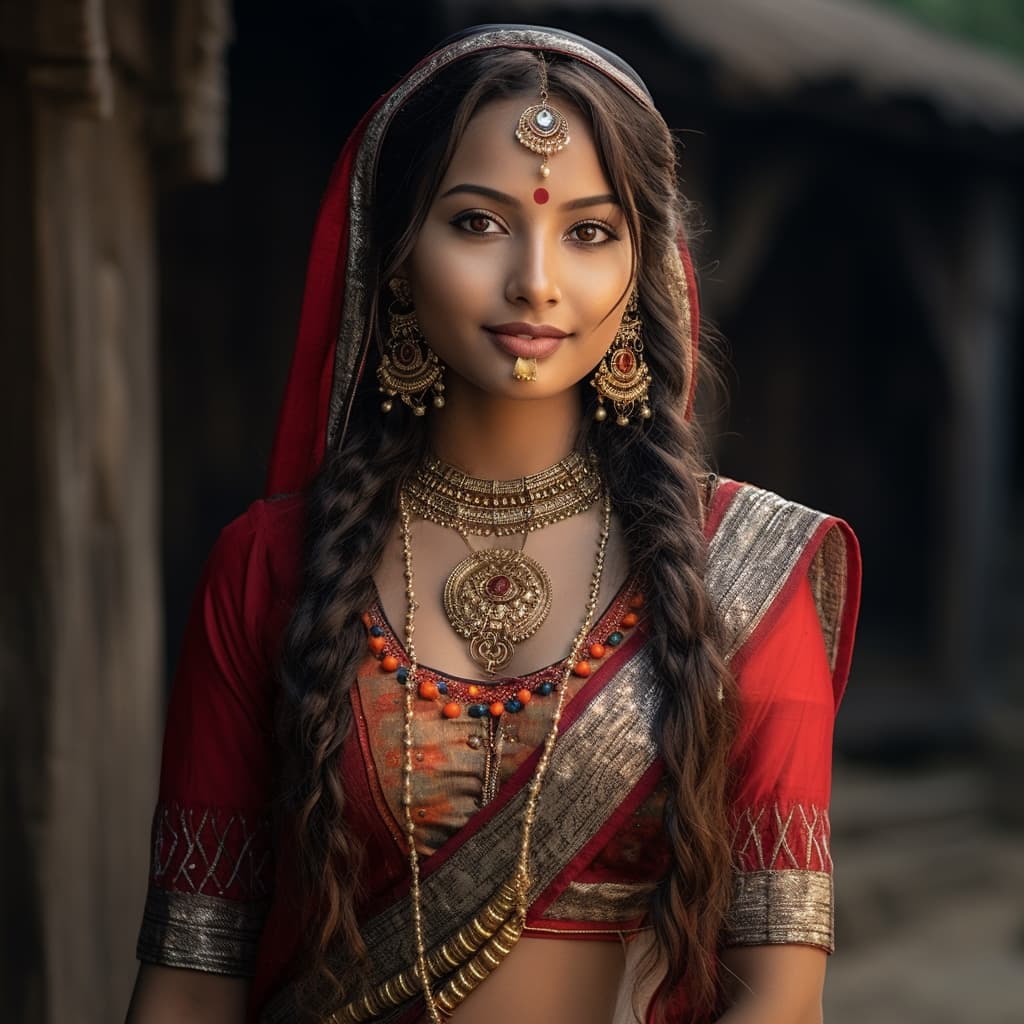
Maithils Erotic
Mithila (India, Nepal)
Indo-European / Indo-Aryan / Bihari / Maithili
Hinduism
Karan Kayastha, Brahmin, Chhetri, Vaisya
Southern Asian
About Maithils People
The Maithils trace themselves to Mithila, the alluvial belt straddling Bihar's northern plain and Nepal's southeastern Tarai, between the Ganges and the Himalayan foothills. The land is flat, river-cut and seasonally flooded, sustained by the Kosi, Bagmati and Kamala — geography that shapes a culture organized around rice, ponds, and the rhythms of monsoon agriculture. What holds the Maithils together more than any political boundary is Mithila itself as an idea: a region with its own classical pedigree, named in the Ramayana as the kingdom of King Janaka and the birthplace of Sita, and still referred to internally as a homeland that predates and ignores the India–Nepal border running through it.
Their language, Maithili, belongs to the Bihari branch of Indo-Aryan and sits between Bhojpuri to the west and Bengali to the east, sharing vocabulary with both but maintaining its own grammar, its own thousand-year literary tradition, and — distinctively — its own historical script, Tirhuta or Mithilakshar, related to early Bengali-Assamese scripts and still used ceremonially even though Devanagari now dominates everyday writing. Maithili is one of the scheduled languages of India and a recognized national language of Nepal, which is unusual: most South Asian languages live entirely on one side of a national border or the other.
Maithil society is stratified along the familiar Hindu lines, with Brahmins and Karan Kayasthas historically dominant in scholarship and administration, alongside Chhetri and Vaisya groupings and the larger body of cultivating and artisan communities. Maithil Brahmins are known across northern India for a strict marriage record-keeping system called panji prabandh, maintained by hereditary genealogists, that traces lineages back many generations to prevent prohibited matches — an institution with few parallels elsewhere. Hindu practice here leans heavily on Shakta worship; the goddess, particularly in her Durga and Kali forms, occupies a more central place in domestic and seasonal ritual than in many other parts of the Hindu world, and Sita is venerated not as a distant mythic figure but as a regional daughter.
The cultural signature most outsiders recognize is Madhubani painting — the wall and floor art done historically by Maithil women, originally on the mud walls of homes during weddings and festivals, using natural pigments and a tight visual vocabulary of fish, peacocks, lotuses and paired figures. It moved onto paper and into the global art market only in the twentieth century, after the 1934 Bihar earthquake exposed the interior walls of damaged houses to outside eyes for the first time.
Typical Maithils Phenotypes
Reference for AI generation — hair, eyes, skin, facial structure, build
Maithils are a North Indian / Terai population from Mithila, straddling Bihar and Nepal's eastern Tarai, and their phenotype reads as classically Indo-Gangetic with a noticeable plains-Aryan tilt rather than the darker, rounder features of further-south Indian groups. Hair is almost universally black to very dark brown, predominantly straight to gently wavy with medium density and a fine-to-medium strand; tight curls are uncommon. Strong premature greying in the late thirties and forties is well documented across Brahmin and Karan Kayastha lines.
Eye color sits firmly in the dark-brown to near-black range, with hazel and lighter brown appearing occasionally in upper-caste Brahmin and Chhetri families with Himalayan admixture. Eyes are typically almond-shaped with a clean, deep-set lid; the epicanthic fold is generally absent in core plains Maithils but appears partially in some Chhetri and Tarai-Nepal subgroups bordering Tibeto-Burman populations. Eyebrows are thick and well-defined.
Skin tone spans Fitzpatrick III to V — wheatish to medium-brown is the modal range, with warm yellow-olive and golden undertones rather than the red undertones common further west in Punjab. Brahmin and Kayastha populations skew lighter on average; Vaisya and rural agrarian Maithils trend a shade or two darker, accentuated by sustained sun exposure in the Tarai plains.
Facial structure is the giveaway: a straight, narrow-to-medium nasal bridge with a moderately refined tip and narrow alar base, oval-to-heart-shaped face, modest cheekbones, and a softer jawline than you see in Western Indian or Pashtun phenotypes. Lips are medium-full and well-defined, rarely thin. Build is light to medium — men typically 5'5"–5'8", women 5'0"–5'3" — with slender bone structure, narrow shoulders, and a tendency toward central adiposity with age rather than overall heaviness. Chhetri and Nepal-side Maithils carry the most visible Himalayan facial influence, while Karan Kayastha and Brahmin lines hold the most consistent plains-Aryan features.
Data depth
50/100Coverage of image-grounded phenotype observations · drives AI generation diversity
- Sample size
- 30/40· 26 images
- Image quality
- 15/30· 31% high
- Confidence
- 5/20· mean 0.40
- Source diversity
- 0/10· wikipedia
- ·Low overall confidence
- ·Wikipedia-only source — not population-representative
Observed Distribution — Image Sample
Empirical observations from analyzed photographs · supplementary signal, not population truth
Sample: 26 images analyzed (26 wikipedia). Quality: 8 high, 9 medium, 8 low, 0 very_low. Avg analyzer confidence: 0.40.
Skin tone (Fitzpatrick): III (4%), IV (35%), V (19%), unclear (42%)
Hair color: black (31%), gray/white (31%), other (4%), red/auburn (4%), unclear (31%)
Hair texture: straight (35%), wavy (15%), bald (4%), covered (23%), unclear (23%)
Eye color: dark brown (46%), brown (4%), unclear (50%)
Epicanthic fold: 4% present, 58% absent, 4% partial, 35% unclear
Caveats: Low average analyzer confidence — many photos partially obscured or historical. Sample is 100% Wikipedia notable people — skews toward male, public-life, and modern figures, not population-representative.
Last aggregated: May 7, 2026
Explore phenotype categories
Structured taxonomy with peer-reviewed scales · 22 anatomical categories
Notable Maithils People
42 reference figures — sourced from Wikipedia
- Karnat dynasty — 1097 CE–1324 CE
- Oiniwar dynasty — 1325 CE–1526 CE
- Dronwara Dynasty — 14th–15th century CE
- Raj Darbhanga — 1557 CE −1947 CE
- Malla dynasty — 1201 CE-1779 CE
- Senas of Makwanpur — 1518 CE –1762 CE
- Darbhanga — in particular played an important role in the history of Mithila and is consi…
- Madhubani — also where Mithila painting originated from which is a major part of Maithili…
- Sitamarhi — is claimed by many to be the birthplace of Goddess Sita with Sita Kund being …
- Balirajgarh — situated in present-day Madhubani district in Bihar is thought to be the capi…
- Baidyanath Temple — Maithils played a major role in building the Baidyanath Temple which is an im…
- Janaka — King of Mithila and Father in Law of King Rama.
- Sita — Princess of Mithila Kingdom and wife of King Rama.
- Udayana — 10th/11th-century philosopher and logician of the Nyaya school.
- Vidyapati — 14th/15th century Maithili and Sanskrit poet-saint.
- Bhanudatta Misra — 15th/16th-century Sanskrit poet from Mithila.
- Harisimhadeva — King of Mithila during the Karnat dynasty from 1304 - 1324 CE.
- Gangadeva — King of Mithila during the Karnat dynasty from 1147-1187 CE.
- Narsimhadeva — King of Mithila during the Karnat dynasty from 1174-1227 CE.
- Ramasimhadeva — King of Mithila during the Karnat dynasty from 1227-1285 CE.
- Jyotirishwar Thakur — 14th-century poet, playwright and musician who composed the earliest prose wo…
- Caṇḍeśvara Ṭhakkura — political theorist and general from the 14th century.
- Gaṅgeśa — 13th/14th century philosopher, logician and mathematician .
- Pakshadhara Mishra — 15th-century philosopher.
- Vāchaspati Misra — 9th/10th-century philosopher of the Advaita Vedanta tradition.
- Lakshmeshwar Singh — zamindar and principal landowner of Raj Darbhanga, 1860–1898.
- Rameshwar Singh — zamindar and principal landowner of Raj Darbhanga, 1898–1929.
- Śāriputra — 15th-century Indian Buddhist monk and the last abbot of the Mahabodhi Temple …
- Balendra Shah — The Prime Minister of Nepal
- Maghfoor Ahmad Ajazi — Indian Freedom fighter, political activist, social worker, poet and writer, b…
- Bimalendra Nidhi — Member of Nepalese parliament, Vice president of ruling party Nepali Congress…
- Ramdhari Singh 'Dinkar' — was an Indian Hindi poet, essayist, patriot and academic.
- Bindheshwari Prasad Mandal — was an Indian parliamentarian and social reformer who served as the chairman …
- C. K. Raut — formerly US-based computer scientist, author and political leader of Nepal.
- Syed Shahnawaz Hussain — Indian politician, born in Supaul
- Bhagwat Jha Azad — was the Chief Minister of Bihar and a member of Lok Sabha.
- Ram Baran Yadav — First president of Nepal
- Tarkishore Prasad — Deputy Chief Minister of Bihar, born in Saharsa district
- Nagarjun — Renowned Maithili Poet
- Phanishwar Nath 'Renu' — A prominent post-Premchand Hindi writer who deeply infused Maithili culture a…
- Acharya Ramlochan Saran — Hindi littérateur, grammarian and publisher
- Vaibhav Sooryavanshi — a young Indian cricketer who plays for Bihar in domestic cricket and Rajastha…



Generate Maithils AI Content
Use this ethnicity's phenotype data to create AI-generated content with accurate physical traits and cultural context.
Open Creator Studio