Chakmas Erotic
Chittagong Hill Tracts (Bangladesh)
Indo-European / Indo-Aryan / Chakma
Buddhism / Theravada Buddhism
Southern Asian
About Chakmas People
The Chakmas are the largest of the indigenous peoples of the Chittagong Hill Tracts, a wedge of forested ridges in southeastern Bangladesh that pushes up against the borders of India and Myanmar. They are an unusual group in South Asian terms: Theravada Buddhists in a country that is overwhelmingly Muslim, speaking an Indo-Aryan language in a region where most of their hill neighbors — Marma, Tripura, Mro — speak Tibeto-Burman tongues. That linguistic crossover is the first puzzle anyone notices about them. Chakma is written in its own Brahmi-derived script, related to the scripts used for Burmese and Mon, even though the language itself is closer to Bengali and Assamese. Script and speech come from different worlds and have been pressed together for centuries.
Chakma society is organized into three traditional circles, each headed by a hereditary chief, with the Chakma Raja at the apex — an institution Bangladesh has not abolished, though it sits awkwardly inside a modern state. Villages are typically built along ridgelines or river banks, houses raised on stilts, and the older subsistence rhythm of jum — swidden cultivation on cleared hillsides — still shapes the agricultural calendar even where it has been pushed back by lowland rice and government discouragement. Buddhism here has the texture of lived practice rather than display: village viharas, monks moving on alms rounds, the lunar festival of Bizu marking the Bengali new year with its three days of cleansing, feasting, and water-throwing.
The defining historical wound is recent. The construction of the Kaptai Dam in the early 1960s flooded roughly forty percent of the Chakmas' arable land and displaced something on the order of a hundred thousand people, many of whom were never adequately resettled; a substantial population crossed into the Indian states of Arunachal Pradesh, Tripura, and Mizoram, where their descendants still live with contested citizenship. The decades that followed saw an armed insurgency by the Shanti Bahini against state-backed Bengali settlement of the Hill Tracts, ending — formally — with a 1997 peace accord whose implementation remains a live political grievance. The Chakmas one meets today carry that history without performing it: textile work in red-and-black pinon-hadi, a quietly maintained literature and music, and an intact sense of being a distinct people whose homeland has been redrawn around them more than once.
Typical Chakmas Phenotypes
Reference for AI generation — hair, eyes, skin, facial structure, build
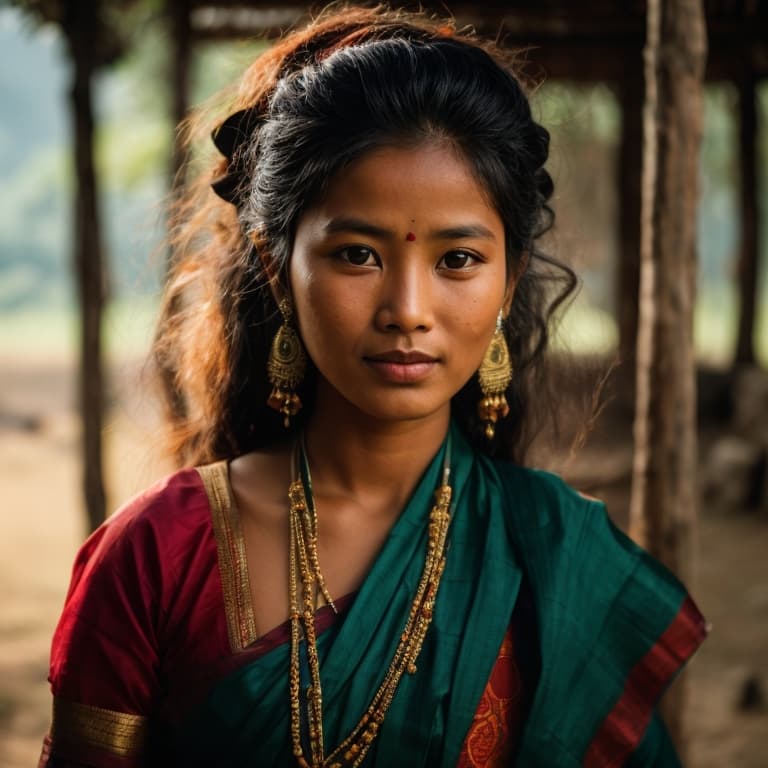
Chakmas sit visually closer to Tibeto-Burman hill peoples than to lowland Bengalis, despite speaking an Indo-Aryan language — a phenotype-language mismatch that's the first thing to register. The dominant look is broadly East/Southeast Asian with a softening South Asian undertone, the legacy of long settlement on the Arakan-Bengal frontier.
Hair is uniformly black to very dark brown, straight to gently wavy, with the heavy, coarse shaft typical of East Asian hair. Greying tends to come late. Curl is rare; tight curl essentially absent. Eyes are dark brown to near-black, almond-shaped, with a moderate to pronounced epicanthic fold present in the great majority — less universal than among Han Chinese populations, but markedly more common than in any plains-Bengali group. Eye openings are narrower and more horizontally set than in surrounding Bengali populations.
Skin tone runs Fitzpatrick III to IV, with warm yellow-olive to light golden-brown undertones rather than the red-brown undertones common in plains South Asia. Hill-cultivator outdoor exposure pushes many adults toward a tanned mid-brown, but the underlying base is noticeably lighter and more yellow than neighboring Bengali populations.
Facial structure is the clearest tell: cheekbones broad and high, faces tending toward round or square rather than oval, jawlines softer and less angular. Noses are short with a low to medium bridge and moderately wide alae — quite distinct from the higher, narrower nasal bridges common in Indo-Aryan groups. Lips are medium-full, well-defined, neither thin nor heavy. Facial hair on men is typically sparse.
Build skews short and compact. Adult male stature commonly falls in the 158–168 cm range, female 148–158 cm — shorter on average than surrounding Bangladeshi populations. Body composition runs lean-muscular in working adults with a tendency toward stockiness rather than slenderness. The combined signature — fold, flat-bridged nose, golden undertone, stocky frame — reads unmistakably as Chittagong-hill rather than plains Bengali, even before language or dress. Sub-group variation across Chakma circles (Anokya, Tongchangya-adjacent) is minor and largely invisible without close familiarity.
Data depth
0/100Coverage of image-grounded phenotype observations · drives AI generation diversity
- Sample size
- 0/40· 0 images
- Image quality
- 0/30· 0% high
- Confidence
- 0/20
- Source diversity
- 0/10
- ·No image observations yet
Explore phenotype categories
Structured taxonomy with peer-reviewed scales · 22 anatomical categories
Notable Chakmas People
4 reference figures — sourced from Wikipedia
- Jan Baksh Khan — The East India Company recognised Jan Baksh Khan as the Raja of the Chakmas
- Kuki — To protect British subjects from the Kuki (the name given to the Lushai by th…
- Jahan, Rounaq — van Schendel, Willem (2002). "Bengalis, Bangladeshis, and Others: Chakma Visi…
- ISBN — Talukder, S. P. (1994) [1984]. Chakmas An Embattled Tribe. New Delhi: Uppal P…





Generate Chakmas AI Content
Use this ethnicity's phenotype data to create AI-generated content with accurate physical traits and cultural context.
Open Creator Studio