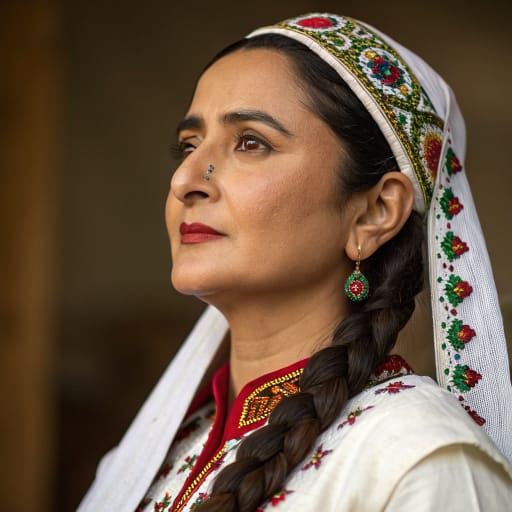
Jat Erotic
Punjab, Haryana, western Uttar Pradesh, Rajasthan, and Pakistani Punjab and Sindh
Indo-Aryan / Punjabi, Haryanvi, Hindi, Sindhi
Hinduism, Sikhism, Islam (regional split)
Hindu Jats, Sikh Jats, Muslim Jats (Mussalman Jat), Jatt Sikh, Bishnoi Jats
About Jat People
The Jats are an agriculturalist and pastoral community of the north Indian and Pakistani plain — one of the largest single named groups in South Asia, with a population estimated between 30 and 40 million across the two countries, concentrated in the Punjab, Haryana, western Uttar Pradesh, Rajasthan, Sindh, and the Pakistani districts of Bahawalpur, Multan, and Sahiwal. Unlike many South Asian groups whose identity is defined narrowly by religion or language, the Jat category cuts across all three of the region's dominant faiths and several of its major language zones, and is held together by a shared agrarian-warrior self-understanding, a recognisable phenotype, an extensive gotra (clan) genealogy, and a tightly bonded land-owning structure that has shaped the politics of north India and Pakistan for four centuries.
The community divides religiously into roughly three streams: Hindu Jats, concentrated in Haryana, western Uttar Pradesh, and eastern Rajasthan; Sikh Jats (also written Jatt), who form the demographic majority of the Sikh community in Indian Punjab and the bulk of the Sikh diaspora in Canada, the United Kingdom, and the United States; and Muslim Jats, the dominant rural community of Pakistani Punjab and parts of Sindh. The split is not adversarial in the way some communal cleavages in the subcontinent are — Jats of different religions across the Punjab border still recognise shared gotras, intermarry rarely but acknowledge a common ancestry, and produced parallel land-owning elites under different imperial dispensations.
History and political ascent
Jats appear in north Indian historiography as a distinct named group from the early medieval period, with references in Arab geographers' accounts (the Zatt of the early Caliphate-era Sindh expeditions) and in the medieval Persianate chronicles. Their decisive entry into the political record came in the seventeenth and eighteenth centuries under the dynasty of Bharatpur (1722–1947): Suraj Mal of Bharatpur (1707–1763) consolidated a Jat polity that briefly held Delhi after the collapse of central Mughal authority in 1761, and the Bharatpur fortress remained one of the few north Indian princely states that the East India Company siege could not reduce in 1805. The Jat military reputation in this period — disciplined infantry, heavy cavalry, fortified rural strongholds — established the warrior self-image that the modern community continues to draw on.
The Sikh Jat trajectory diverged in the same period: Jats who had adopted the Khalsa initiation in the early eighteenth century formed the demographic core of the misls — the federated cavalry bands that filled the political vacuum left by Mughal decline in the Punjab — and then of Ranjit Singh's consolidated Sikh Empire (1799–1849), which at its height controlled the Punjab from the Sutlej to the Khyber. Ranjit Singh himself was a Sansi Jat from the Sukerchakia misl; the post-1849 British Indian Army recruited the Sikh Jat as one of its three flagship "martial races," a category that persists in the recruitment patterns of the contemporary Indian Army's Sikh and Jat Regiments.
Social structure: gotra, khap, and land
The Jat social architecture is built on the gotra — the patrilineal clan, of which the community recognises several hundred named units (Sandhu, Sidhu, Gill, Cheema, Dhillon, Tomar, Malik, Dahiya, Hooda, Chahal, and a long tail of smaller gotras). Marriage is exogamous to the gotra and to the village of the four immediate ancestral gotras — a rule enforced by the khap panchayat system, a clan- and village-based council structure that is one of the most studied features of Jat social life and the source of much of the contemporary political controversy around the community. The khap is also a land-management institution: holdings within a khap's geography are mediated by clan rules, and disputes traditionally resolved by the council before being escalated to the formal court system.
The land-owning identity is the third leg of the social structure. Jats are not historically a landlord-and-tenant caste in the way several of their north Indian neighbours are; the community's dominant tenure form is the owner-cultivator holding of 5–25 acres, worked by family labour with seasonal hired help, planted in wheat, rice, sugarcane, cotton, or fodder according to the agro-climatic zone. The Green Revolution of the 1960s and 1970s, concentrated in Punjab and Haryana, was disproportionately a Jat revolution — the bulk of the high-yielding-variety wheat and rice land was Jat-owned — and the political and economic dividend it produced is one of the reasons the community moved into the dominant rural-and-state political bloc of north India in the post-Green-Revolution period.
Modern politics and the reservation question
The political prominence of the Jat community in independent India is out of proportion to its population share: prime ministers (Chaudhary Charan Singh), chief ministers across Haryana, Punjab, Rajasthan, and western UP, and a continuous presence in the agrarian-policy contests of the post-1991 economic-reform period. The 2014 grant of central Other Backward Classes (OBC) reservation to Jats — struck down by the Supreme Court in March 2015 on the ground that Jats are not socially or educationally backward in the constitutional sense — and the 2016 Jat reservation agitation in Haryana, which paralysed the state for a week and produced 30 deaths, mark the community's contemporary anxiety: politically dominant, agriculturally squeezed by falling commodity prices, and now demanding the affirmative-action category that its own historical land-owning dominance has been used to deny.
The 2020–2021 farmers' protest at the borders of Delhi was led, at the demographic level, by Punjabi Sikh Jat and Haryanvi Hindu Jat farmers in roughly equal measure — the first time in the post-Independence period that the two streams of the community had mobilised at scale around a shared agrarian-economic agenda. The repeal of the three farm laws in November 2021 was, among other things, a recognition that the rural Jat bloc could not be split.
Phenotype, visible markers, and diaspora
The visible phenotype of the Jat community is one of the more consistently identified in north Indian regional ethnography: tall stature relative to the South Asian mean (adult male height frequently cited in regional medical literature as 173–178 cm), a robust skeletal build with broad shoulders and large hands, lighter skin pigmentation than the South Asian mean (a function of the agro-pastoral north Indian gene pool's higher admixture from Central Asian and Iranian-Plateau ancestries documented in the recent ancient-DNA literature), and facial features that the regional anthropological literature characterises as a fair-skinned Indo-Aryan profile with frequent light-eye and brown-hair occurrence in the Punjab and Haryana populations.
The diaspora is heavily Sikh Jat: the Canadian Jat Sikh population concentrated in British Columbia (Surrey, Abbotsford) and the Greater Toronto Area; the United Kingdom Jat Sikh population in the West Midlands (Birmingham, Wolverhampton) and West London (Southall, Hounslow); and a smaller but growing California Sikh Jat population centred in the San Joaquin Valley. The Hindu Jat diaspora is more dispersed and concentrated in the engineering-technical migration streams of the 1990s and 2000s; the Muslim Jat diaspora is largely Pakistani-Gulf and Pakistani-UK.
Jat Body & Anatomy Reference
Per-feature anatomical profile for AI nude generation — Indo-Aryan / Dravidian South Asian phenotype
Jat Boobs & Breasts
Jat tits and boobs run medium-to-large cup, moderate-to-full projection — the classic Indo-Aryan / Dravidian South Asian bust profile. Jat nipples and areolas show medium-brown to dark-brown areolar pigmentation against the wheatish-to-brown skin tone, with areolar diameter typically in the 32-46mm range and forward-set positioning rather than the the smaller East Asian bust profile. Jat breasts trend full and soft, generally fuller than the East Asian norm, a function of the endomorph-to-mesomorph with fuller hip deposition body habitus and the mean adult female BMI 22-25. For anatomically-accurate AI-generated Jat nudes the render preserves: medium-to-large cup, moderate-to-full projection shape, 32-46mm areolas with medium-brown to dark-brown pigmentation, and the torso proportions of the Indo-Aryan / Dravidian South Asian phenotype.
Jat Ass & Hips
Jat ass and hip morphology presents as medium-to-full, moderate-to-high projection, classic curvy hip profile — distinctly different from the slim hip profile of East Asian women. The Jat pelvic profile shows medium-to-wide iliac crests, full gluteal-femoral fat distribution, anchored in the Indo-Aryan / Dravidian South Asian skeletal pattern. Jat butt shots in adult AI imagery should render the medium-to-full, moderate-to-high projection, classic curvy hip profile silhouette with the endomorph-to-mesomorph with fuller hip deposition build and the gluteal-femoral fat distribution typical of the Indo-Aryan / Dravidian South Asian phenotype rather than defaulting to a globally-averaged "ethnic" butt that generic AI generators produce. The hip-to-waist ratio characteristic of Jat women is one of the identifying features of the Indo-Aryan / Dravidian South Asian regional phenotype.
Jat Vagina & Pussy
Jat pussy and vulvar anatomy presents medium-brown to dark-brown labial pigmentation, fuller labia minora projection — consistent with the Indo-Aryan / Dravidian South Asian phenotype's pigmentation pattern. Jat pubic hair is typically straight-to-wavy coarse texture, dense distribution, distributed in the inverted-triangle pattern with regional-typical density. AI-generated Jat nude imagery should preserve the medium-brown to dark-brown labial pigmentation and the straight-to-wavy coarse texture hair texture rather than defaulting to a Western-European pink-and-sparse template. For anatomically-accurate Jat pussy renders the labial pigmentation and coloration should match the surrounding wheatish to brown skin tone of the Indo-Aryan / Dravidian South Asian phenotype, with continuous gradient rather than an abrupt color transition.
Jat Dicks & Penis
Jat dick and penile anatomy in adult AI generation should anchor on the regional reference data: regional mean ~13cm erect, moderate girth, and medium-brown shaft pigmentation. The Jat cock profile reflects the Indo-Aryan / Dravidian South Asian ancestral population's anthropometric measurements rather than a globally-averaged Western-pornography default. For anatomically-accurate Jat nude male imagery the shaft pigmentation should track the surrounding wheatish to brown skin tone, the glans-to-shaft pigmentation transition should be continuous, and the pubic hair pattern should match straight-to-wavy coarse texture texture distributed in the typical inverted-V escutcheon. Circumcision status in Jat populations varies by religious-cultural tradition rather than ancestral phenotype.
Jat Body, Curves & Build
Jat body type and overall build presents as endomorph-to-mesomorph with fuller hip deposition, with mean adult female BMI 22-25 — the characteristic Indo-Aryan / Dravidian South Asian habitus. Jat curves and proportions in adult AI imagery should preserve the regional skeletal frame (height, shoulder-to-hip ratio, limb proportions) rather than scaling to a Western-European mesomorph default. The Jat nude female form, when rendered with anatomical fidelity, shows the height range, frame width, and adipose distribution pattern typical of the Indo-Aryan / Dravidian South Asian phenotype. Generic AI image generators tend to collapse regional body types into a few default shapes; the EthnicErotic phenotype-anchored approach preserves the Jat build as its own reference category.
Jat Skin Tone & Hair Texture
Jat skin tone falls in the wheatish to brown (Fitzpatrick III-V) band — the surface signal most often miscalibrated by generic AI nude generators trained on Western-photographic datasets. Jat hair texture is typically straight-to-wavy 1A-2B, dense, dark-brown to black, characteristic of the Indo-Aryan / Dravidian South Asian phenotype. For anatomically-accurate Jat nude renders the skin should hold the Fitzpatrick band consistently across body surface rather than showing the lighter-than-face body shading that AI generators default to. Jat hair pigmentation and texture on body, pubic, and head should match across the figure rather than mixing textures (a common AI artefact).
Related ethnic groups
Groups that share Jat's homeland, region, language, or religious tradition — likely candidates for comparative phenotype reference.
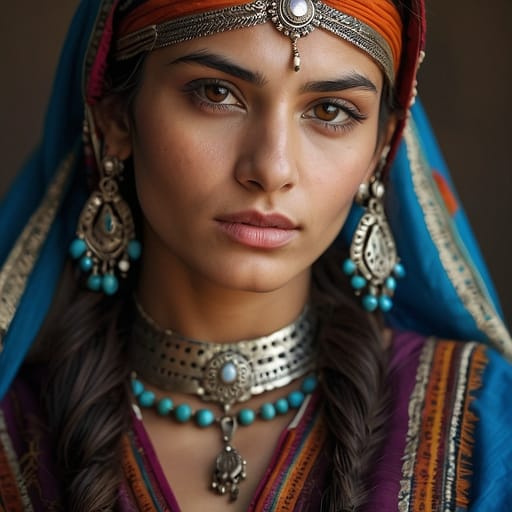
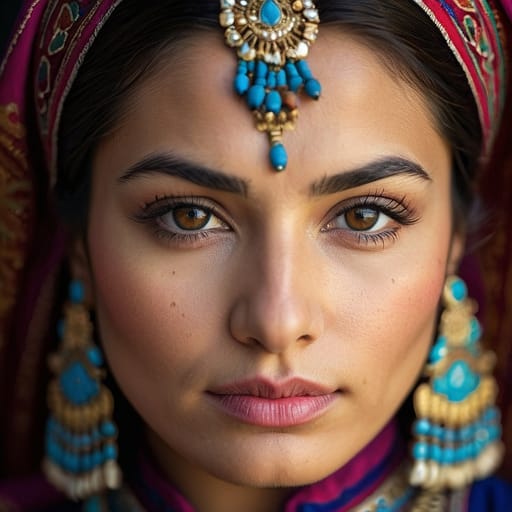
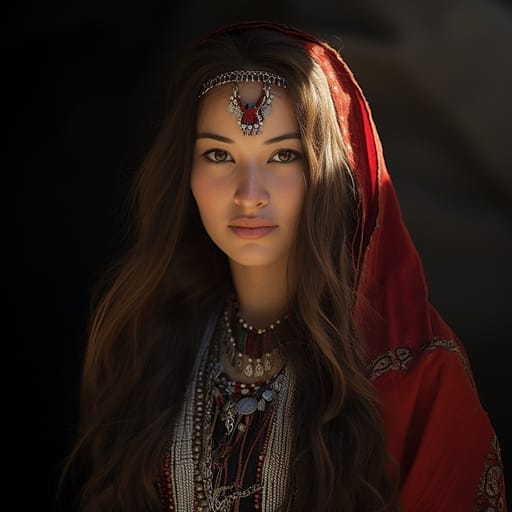
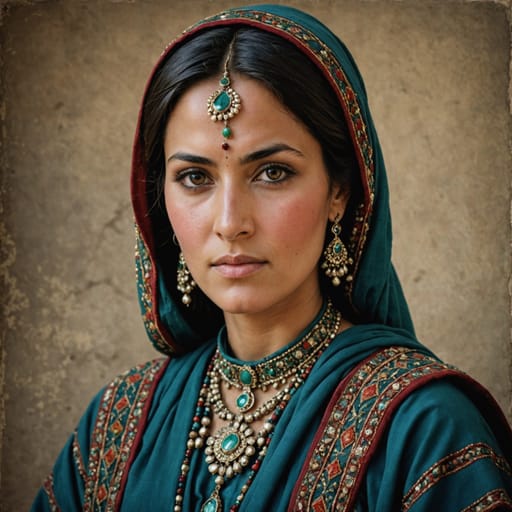
Explore phenotype categories
Structured taxonomy with peer-reviewed scales · 22 anatomical categories
Frequently asked questions about Jat people
Where is the Jat homeland?
The Jat homeland is Punjab, Haryana, western Uttar Pradesh, Rajasthan, and Pakistani Punjab and Sindh in South Asia.
What language do Jat people speak?
Jat people primarily speak Indo-Aryan / Punjabi, Haryanvi, Hindi, Sindhi.
What religion do Jat people practice?
The predominant religion among Jat people is Hinduism, Sikhism, Islam (regional split).




Generate Jat AI Content
Use this ethnicity's phenotype data to create AI-generated content with accurate physical traits and cultural context.
Open Creator Studio