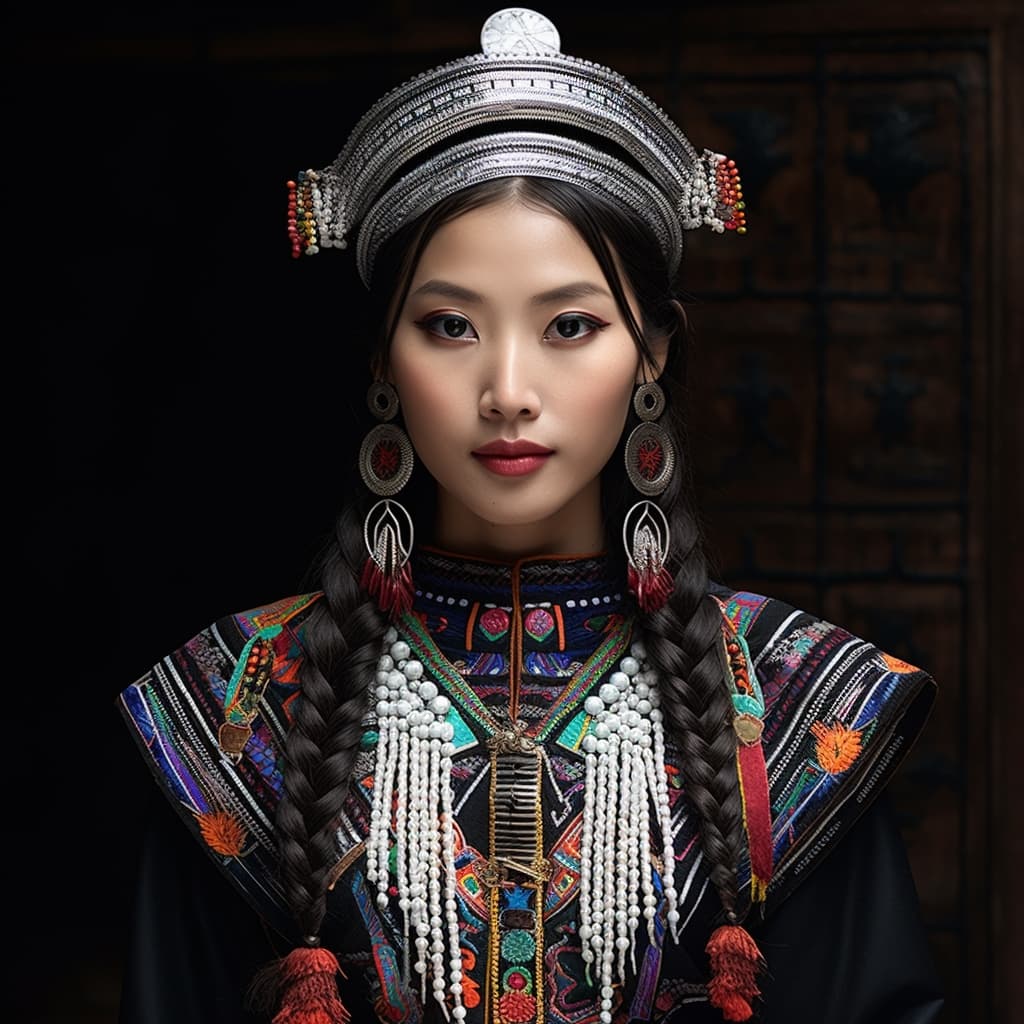
Zhuang Erotic
Zhuangia (China)
Kra–Dai / Tai / Zhuang
Moism
East Asia
About Zhuang People
The Zhuang are China's largest ethnic minority — somewhere around eighteen million people, concentrated in the karst country of Guangxi in the south. That landscape matters: limestone pinnacles, river valleys, terraced rice on slopes that look impossible to farm and have been farmed for two thousand years anyway. The Zhuang are wet-rice cultivators by deep tradition, and a great deal of their material culture, ritual calendar, and village layout still tracks the agricultural year rather than the official one.
Linguistically they sit on the Chinese side of a much larger family. Zhuang is Kra–Dai, the same branch as Thai and Lao, which means their nearest linguistic cousins live across borders to the south rather than among the Han neighbors who surround them. There is no single Zhuang language so much as a chain of related tongues — Northern and Southern Zhuang are not always mutually intelligible — and the standardized written form using Latin letters is a twentieth-century construction. Older Zhuang writing borrowed and reshaped Chinese characters into sawndip, "raw characters," which scholars are still cataloging.
Religion is where the group's separateness from the Han mainstream is most visible. Moism — the indigenous Zhuang faith, sometimes called Shigongism — centers on a creator figure, Buluotuo, and is mediated by ritual specialists who chant from manuscripts handed down within lineages. It absorbed Daoist and Buddhist elements over the centuries without being absorbed by them. Ancestor veneration runs through everything; so does a working belief in spirits attached to particular hills, rivers, and old trees. The bronze drum, cast by Zhuang ancestors as far back as the Warring States period, is still a ritual object rather than a museum piece.
The annual Sanyuesan festival, on the third day of the third lunar month, is the public face of Zhuang culture for outsiders — antiphonal singing matches between young men and women, dyed sticky rice in five colors, courtship that historically led somewhere. Less visible from outside is the matrilineal undertow in some Zhuang sub-groups, the persistence of buluofujia — the practice of a bride not moving permanently into her husband's household until she becomes pregnant — and the network of geomancers, song-masters, and herbalists who hold authority parallel to the official village structure. The Zhuang have been inside the Chinese state for a very long time, and remain, on their own terms, not quite of it.
Typical Zhuang Phenotypes
Reference for AI generation — hair, eyes, skin, facial structure, build
The Zhuang are China's largest ethnic minority, concentrated in Guangxi and stretching into Yunnan, Guangdong, and northern Vietnam. Phenotypically they sit at the southern edge of East Asian variation, closer to Tai and Kra-Dai populations of mainland Southeast Asia than to Han northerners. Hair is uniformly black or very dark brown, straight to slightly wavy, with the coarse round-shafted texture typical of East Asian populations; graying tends to come late, and natural lightening from sun exposure is uncommon. Body and facial hair is sparse in men, and beards are generally thin and patchy.
Eyes are dark brown to near-black. The epicanthic fold is near-universal but often softer and shallower than in northern Han or Korean populations, and double eyelids occur at a noticeably higher rate than in northern East Asia — closer to Thai or Lao frequencies. Eye shape tends toward almond, set slightly wider than the northern Chinese mean. Skin tone ranges across Fitzpatrick III–IV, leaning warmer and more olive-toned than the lighter, cooler complexions of northern Han; rural and agricultural Zhuang frequently sit at the deeper end of that range from sustained sun exposure in the subtropical south.
Facial structure is distinctive: cheekbones are present but less prominent and less broad than in northern East Asians, with softer, more rounded jawlines and a narrower lower face. Noses tend to have a low-to-medium bridge with moderate alar width — broader than the typical Han nose, narrower than Southeast Asian averages. Lips run medium to medium-full, fuller on average than the northern Chinese norm. Stature is on the shorter end of East Asian ranges, with men averaging around 165 cm and women around 154 cm, though urban younger generations are taller. Builds are typically slender and wiry, with low body-fat tendencies and a compact, gracile frame — well demonstrated in the gymnast Li Ning. The Northern and Southern Zhuang branches differ slightly: Southern Zhuang trend marginally darker and shorter, with somewhat fuller features reflecting closer affinity to northern Vietnamese Tai populations.
Data depth
33/100Coverage of image-grounded phenotype observations · drives AI generation diversity
- Sample size
- 3/40· 1 image
- Image quality
- 30/30· 100% high
- Confidence
- 0/20· mean 0.00
- Source diversity
- 0/10· wikipedia
- ·No image observations yet
- ·Low overall confidence
- ·Wikipedia-only source — not population-representative
Explore phenotype categories
Structured taxonomy with peer-reviewed scales · 22 anatomical categories
Notable Zhuang People
23 reference figures — sourced from Wikipedia
- A Nong — c. 1005–1055), Zhuang shaman, matriarch and warrior; mother of Nong Zhigao.
- Huang Wenxiu — Chinese politician and posthumous recipient of the July 1 Medal.
- Lady of Qiao Guo — heroine of the Zhuang people in Southern and Northern Dynasties.
- Liu Sanjie — legendary folk singer from the Song Dynasty.
- Nong Zhigao — hero of the Zhuang people in Song Dynasty.
- Nong Rong — diplomat and former ambassador to Pakistan.
- Shi Dakai — Yi King of the Taiping Rebellion.
- Wei Changhui — North King of the Taiping Rebellion.
- Huang Xianfan — Chinese historian and ethnologist, considered the founder of Zhuang studies.
- Li Ning — Chinese gymnast and entrepreneur.
- Esther Qin — Chinese-Australian diver.
- Shanye Huang — well-known Chinese-American artist whose art is rooted in Zhuang culture.
- Wei Wei — a Mandopop singer and actress.
- Wei Huixiao — a naval officer.
- Tracy Wang — 汪小敏 (zh), a singer.
- Chen Tang — Chinese-American actor
- Zhang Xianzi — a Mandopop singer.
- doi — ——— (1987), "The Zhuang Minority Peoples of the Sino-Vietnamese Frontier in t…
- hdl — Chaisingkananont, Somrak (2014). The Quest for Zhuang Identity: Cultural Poli…
- Oxford University Press — Kiernan, Ben (2019). Việt Nam: a history from earliest time to the present. O…
- ISBN — Taylor, Keith Weller (1983), The Birth of Vietnam, University of California P…
- Taylor, K. W. — 2013). A History of the Vietnamese. Cambridge University Press. ISBN 978-0-52…
- JSTOR — Ng, Candice Sheung Pui (2011). "On "Constructed" Identities: A Dialogue on th…






Generate Zhuang AI Content
Use this ethnicity's phenotype data to create AI-generated content with accurate physical traits and cultural context.
Open Creator Studio