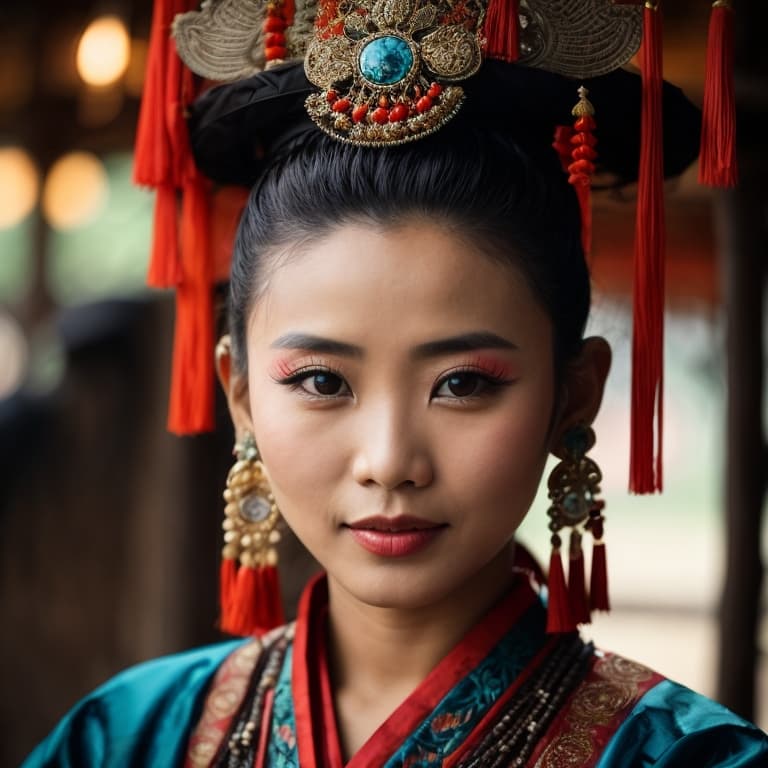
Bouyei Erotic
Guizhou (China)
Kra–Dai / Tai / Bouyei
Moism
Giáy
East Asia
About Bouyei People
The Bouyei live in the karst country of southern Guizhou, where limestone hills, terraced rice valleys and sudden river gorges have shaped a settlement pattern of compact villages built into hillsides — stone-and-timber houses with stilted lower floors, often clustered around a stand of old fengshui trees the village will not cut. Most Bouyei communities sit along the upper reaches of the Pearl River system, in the prefectures of Qianxinan and Qiannan, with smaller populations scattered across Yunnan and Sichuan. Their close relatives, the Giáy of northern Vietnam, are descendants of Bouyei groups who migrated south in waves through the eighteenth and nineteenth centuries; the two communities still recognise each other linguistically and ceremonially.
Their language belongs to the Northern Tai branch of Kra–Dai, which makes it a near neighbour of Zhuang and a more distant cousin of Thai and Lao. A speaker of standard Bouyei can usually follow a Northern Zhuang conversation with effort; Thai or Lao require real study. There is a romanised script, developed in the 1950s and revised since, but in practice most written life happens in Mandarin, and the language is carried mainly by household speech and ritual.
Religious life is organised around Moism — the ancestral tradition served by bumo, ritual specialists who maintain manuscripts in an old logographic script derived from Chinese characters but read in Bouyei. The bumo handle funerals, illness, house-building and the annual rites for ancestors and land spirits; their texts, some hundreds of years old, are among the more remarkable surviving traditions of vernacular religious writing in southwest China. Buddhism and Daoism have left visible deposits, and a minority of Bouyei are Christian, but Moism remains the framework most households default to for the events that matter.
The Bouyei calendar is dense with festivals, and the most distinctive of them is the Sister's Rice Festival in the third lunar month, when young women dye glutinous rice in five colours from wild plants and present it as a coded message — the colour combination signals acceptance, refusal or hesitation to a suitor. Indigo dyeing and batik are old crafts here, still practiced domestically rather than as tourist work, and the dark blue, wax-resist textiles of southern Guizhou are largely Bouyei in origin. Bronze drums, once central to ceremony, surface mainly at funerals now, but they surface.
Typical Bouyei Phenotypes
Reference for AI generation — hair, eyes, skin, facial structure, build
The Bouyei sit within the broader Tai-speaking phenotype band of southwest China, but their long isolation in Guizhou's karst uplands has produced a recognizably distinct look — generally lighter-skinned and finer-featured than lowland Tai-Kadai populations of Yunnan and northern Vietnam, with a strong East Asian craniofacial baseline shared with neighboring Han and Miao.
Hair is uniformly black to very dark brown, straight to faintly wavy, and coarse in shaft diameter. Premature graying is uncommon. Natural lightening or auburn tones are essentially absent; reddish casts only appear under strong sun on the ends. Eyes run from medium-dark brown to near-black, with a near-universal epicanthic fold and a single eyelid (monolid) more common than the double crease. The palpebral fissure tends to be moderately narrow and slightly upslanted, though the dramatic outer-canthus tilt seen in some northeast Asian populations is softer here.
Skin sits in the Fitzpatrick II–IV range, with a noticeably yellow-to-neutral undertone rather than the olive cast typical of Zhuang or Dai groups further south. Rural agricultural Bouyei tan readily into a warm tawny-bronze on exposed surfaces while remaining markedly paler on torso and inner arms — a contrast often visible in older subjects.
Facial structure favors a rounded-to-oval face with moderate malar projection, a relatively low and flat nasal bridge, narrow alar base, and short philtrum. Lips are medium in fullness, the lower fuller than the upper. Jawlines are typically soft rather than angular; chins are small and slightly receded. Singer Huang Xiaoyun shows a characteristic version of this midface and lip set.
Build is small to medium. Adult female stature commonly falls between 150–158 cm and males 162–170 cm, with slender, narrow-shouldered frames, low body-fat distribution centered at the hips, and fine wrists and ankles. The Giáy branch in northern Vietnam shows essentially the same phenotype, occasionally with marginally darker skin tone from lower-elevation residence and heavier sun exposure.
Data depth
39/100Coverage of image-grounded phenotype observations · drives AI generation diversity
- Sample size
- 15/40· 7 images
- Image quality
- 14/30· 29% high
- Confidence
- 10/20· mean 0.62
- Source diversity
- 0/10· wikipedia
- ·Small sample (n<10)
- ·Mostly low-quality source images
- ·Wikipedia-only source — not population-representative
Observed Distribution — Image Sample
Empirical observations from analyzed photographs · supplementary signal, not population truth
Sample: 7 images analyzed (7 wikipedia). Quality: 2 high, 2 medium, 3 low, 0 very_low. Avg analyzer confidence: 0.62.
Skin tone (Fitzpatrick): III (14%), IV (71%), unclear (14%)
Hair color: black (86%), gray/white (14%)
Hair texture: straight (43%), shaved (14%), covered (43%)
Eye color: dark brown (86%), unclear (14%)
Epicanthic fold: 86% present, 0% absent, 14% unclear
Caveats: Sample size 7 is small — observed distribution should be treated as suggestive, not definitive. Quality skews toward older or low-resolution photos; phenotype detail may be lossy. Sample is 100% Wikipedia notable people — skews toward male, public-life, and modern figures, not population-representative.
Last aggregated: May 7, 2026
Explore phenotype categories
Structured taxonomy with peer-reviewed scales · 22 anatomical categories
Notable Bouyei People
9 reference figures — sourced from Wikipedia
- Cen Nanqin — 岑南琴), slalom canoeist
- Guo Jian — 郭健), artist
- Huang Xiaoyun — 黃霄雲), singer and actress
- Wang Nangxian — leader of the anti-Manchu White Lotus Rebellion
- Xiao Sha — 肖莎), gymnast
- Cheng Lianzhen — 郑幺妹), bandit leader and politician
- Meng Sufen — 蒙素芬), politician
- Lu Ruiguang — 陆瑞光), revolutionary
- Publishing House of Minority Nationalities — Yu, Cuirong (喻翠容) (1980). 布依语简志 [Introduction to the Buyi language]. Beijing:…






Generate Bouyei AI Content
Use this ethnicity's phenotype data to create AI-generated content with accurate physical traits and cultural context.
Open Creator Studio