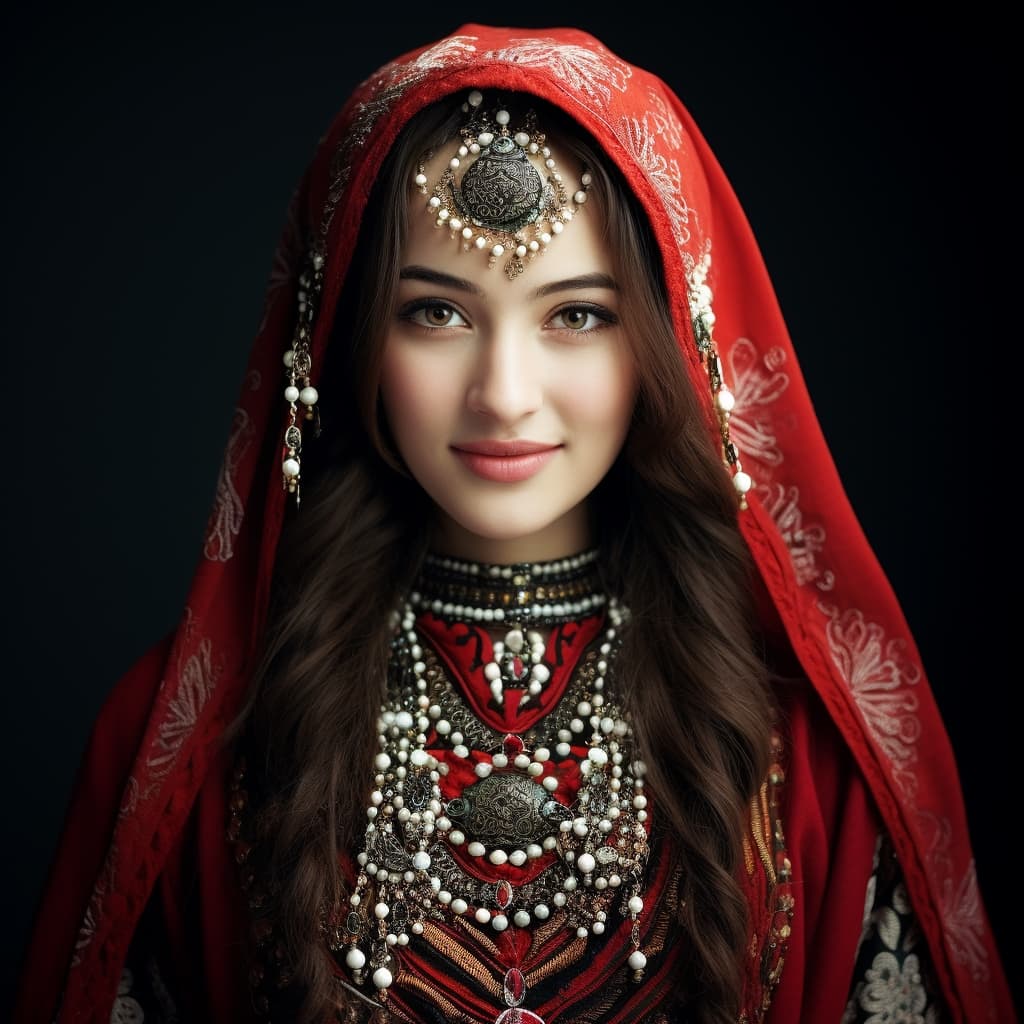
Uyghurs Erotic
Uyghuristan (China)
Turkic / Karluk / Uyghur
Islam / Sunni Islam
Uyghurs in Kazakhstan
Central Asia
About Uyghurs People
The Uyghurs are a Turkic people whose homeland is the oasis belt of the Tarim and Dzungarian basins — the territory the Chinese state administers as Xinjiang and which Uyghurs themselves call East Turkestan or, more loosely, Uyghuristan. Their world is shaped by the geography of the Taklamakan, one of the most forbidding deserts on the planet, ringed by oasis cities — Kashgar, Khotan, Turpan, Ürümchi, Aksu — that for two millennia were nodes on the Silk Road. That trade-route history is not incidental. It is the reason Uyghur culture absorbed Buddhist, Manichaean, and Nestorian Christian layers before settling into Sunni Islam from roughly the tenth century onward, and it is why a distinctly cosmopolitan, mercantile sensibility persists in Uyghur urban life — bazaars, tea-houses, the long musical suites called the muqam.
The language belongs to the Karluk branch of Turkic, which makes Uyghur a close cousin of Uzbek and a more distant relative of Kazakh and Kyrgyz; an Uyghur speaker and an Uzbek speaker can generally follow one another with effort. It is written in a Perso-Arabic script — a marker that Uyghurs read against the Latinized scripts of their Central Asian neighbors and the Han characters of the state they live under. Islam among Uyghurs has historically been Hanafi Sunni with a strong Sufi current, particularly the Naqshbandi order, and shrine pilgrimage to the tombs of saints in the desert was, until recent decades, a defining devotional rhythm.
Uyghurs are not confined to Xinjiang. Substantial communities live across the border in Kazakhstan and Kyrgyzstan, the legacy of nineteenth-century migrations and Soviet-era population movement, and these diaspora Uyghurs have preserved cultural forms that have come under pressure inside China. The historical inflection points worth knowing are the short-lived East Turkestan Republics of 1933 and 1944, the incorporation of the region into the People's Republic in 1949, and the mass internment and surveillance campaigns that began in earnest around 2017 and reshaped daily Uyghur life — the wearing of certain clothes, the speaking of the language in schools, the practice of Ramadan — into matters of state attention.
What identifies Uyghurs as Uyghurs, beyond language and faith, is a particular oasis-Islamic civilizational temperament: poetry recited at meals, melon and mutton at the center of the table, a self-understanding as Central Asians who happen to live east of the Pamirs rather than as a minority of China.
Typical Uyghurs Phenotypes
Reference for AI generation — hair, eyes, skin, facial structure, build
Uyghurs sit at the visible meeting point of East Asian and West Eurasian ancestry, and the phenotype reads that way: a Central Asian population with frequent European-leaning features layered over a Turkic-Mongolic base. Genetic studies consistently place the average Uyghur somewhere around 50/50 East Asian and West Eurasian, and individuals scatter widely on either side of that mean — siblings can look notably different.
Hair is most often dark brown to black, thick, and straight to gently wavy, but light brown is common and natural auburn or chestnut tones turn up at higher rates than in neighboring Han populations. Beards in men grow full, often with reddish cast. Eyes run a wider color range than most Asian groups: dark brown predominates, but hazel, green, and clear gray-blue occur with real frequency, especially in southern Tarim oases like Kashgar and Hotan. The epicanthic fold is variable rather than near-universal — many Uyghurs have an open, double-lidded eye with a soft inner-corner fold or none at all, while others show the fuller fold typical of East Asia.
Skin tones cluster in Fitzpatrick II–IV, warm-olive to light wheat, with a yellow-gold rather than pink undertone; rural southerners tan to a deeper bronze. Faces tend toward a high, broad forehead with prominent but not flat cheekbones, a straight to slightly aquiline nose with a defined bridge — narrower than the Han average — and a moderate alar width. Lips are medium-full, jaws fairly defined, chins on the longer side. The combined effect is often a face that reads as neither clearly East Asian nor clearly Middle Eastern, but recognizably Central Asian.
Build is medium to tall — men commonly 170–180 cm, women 160–168 cm — with sturdier bone structure and broader shoulders than southern East Asian populations. Diaspora Uyghurs in Kazakhstan trend slightly taller and lighter-featured on average, reflecting more sustained admixture with surrounding Turkic and Slavic populations.
Data depth
65/100Coverage of image-grounded phenotype observations · drives AI generation diversity
- Sample size
- 32/40· 30 images
- Image quality
- 18/30· 37% high
- Confidence
- 15/20· mean 0.71
- Source diversity
- 0/10· wikipedia
- ·Wikipedia-only source — not population-representative
Observed Distribution — Image Sample
Empirical observations from analyzed photographs · supplementary signal, not population truth
Sample: 30 images analyzed (30 wikipedia). Quality: 11 high, 15 medium, 4 low, 0 very_low. Avg analyzer confidence: 0.71.
Skin tone (Fitzpatrick): II (20%), III (30%), IV (33%), V (10%), unclear (7%)
Hair color: black (60%), gray/white (30%), dark brown (3%), unclear (7%)
Hair texture: straight (70%), wavy (10%), coily (3%), bald (3%), covered (10%), unclear (3%)
Eye color: dark brown (83%), brown (3%), unclear (13%)
Epicanthic fold: 50% present, 43% absent, 7% unclear
Caveats: Sample is 100% Wikipedia notable people — skews toward male, public-life, and modern figures, not population-representative.
Last aggregated: May 7, 2026
Explore phenotype categories
Structured taxonomy with peer-reviewed scales · 22 anatomical categories
Notable Uyghurs People
100 reference figures — sourced from Wikipedia
- Kutlug Bilge Qaghan — ?–747), the first leader of the Uyghur Khaganate, the successor state to the …
- Bayanchur Qaghan — 713–759), the second leader of the Uyghur Khaganate
- Bogu Qaghan — ?–780), the third leader of the Uyghur Khaganate
- Tun Baga Tarkhan — born c. 737–742; died 789), the fourth leader of the Uyghur Khaganate
- Kulug Bilge Qaghan — born c. 772–773; died 790), the fifth leader of the Uyghur Khaganate
- Bilge Kul Qadir Khan — 840–893)
- Musa Bughra Khan — 955–958)
- Hasan b. Sulayman — Muhammad Toghan Khan (1024–1026), the son of Hasan b. Sulayman
- Böritigin — 1040–1068)
- Alp Arslan — Nasr Shams al-Mulk (1068–1080), married Aisha, the daughter of Alp Arslan
- Akhmad Alach — the Khan of Eastern Moghulistan (Uyghurstan) from 1487 and the Kyrgyz Khanate…
- Makhmud Khan — the Khan of Tashkent from 1487 until c. 1502 or 1503 and of the Moghuls of we…
- Tughlugh Timur — the Khan of Moghulistan from c. 1347 and the Chagatai Khanate from c. 1360 un…
- Muhammad Khan — ?–1415), the Khan of Moghulistan from 1408 until 1415
- Mansur Khan — born c. 1482–1483; died 1543), the last Khan of a united Moghulistan from 150…
- Yunus Khan — born c. 1462; died 1487), the Khan of Moghulistan from 1462 until 1487
- Abdurashid Khan — 1508–1560), the ruler of the Yarkent Khanate from 1533 until 1560
- Abdul Karim Khan — 1529–1591), the ruler of the Yarkent Khanate from 1560 until 1591
- Muhammad Sultan — 1538–1610), the 5th son of Abdurashid Khan and the ruler of the Yarkent Khana…
- Shudja ad Din Ahmad Khan — 1570–1680), the son of Muhammad Sultan and the Khan of the Yarkent Khanate fr…
- Kuraysh Sultan — the son of Yunus Khan and the ruler of the Yarkent Khanate for 9 days before …
- Abd al-Latif (Afak) Khan — born c. 1605; died 1630), the ruler of the Yarkent Khanate from 1618 until 16…
- Sultan Ahmad Khan (Pulat Khan) — ?–1615), the first son of Timur Sultan
- Mahmud Sultan (Qilich Khan) — born c. 1614; died 1636), the second son of Timur Sultan and the founder of I…
- Abdullah Khan — in Turfan 1634/5–1638/9) 1638–1669, the eldest son of Abduraim Khan, grandson…
- Nur ad-Din Sultan — in Aksu 1649–1667) 1667–1668 in Kashgar and Yengisar, the youngest son of Abd…
- Ismail Khan — in Chalish 1666–1669, in Aksu 1669–1670) 1669, the 5th son of Abduraim Khan, …
- YuIbars Khan — In Kashgar 1638–1667, since age of 8) 1669–1670, the eldest son of Abdullah K…
- Abd al Latif Sultan — 1670, son of Yulbars Khan, who was set up on khanship by Ak Taghliks, was kil…
- Abd ar-Rashid Khan II — 1678–1682, the eldest son of Sultan Said Baba Khan, set up on khanship by Dzu…
- Muhammad Imin Khan — 1682–1692 (1680–1682 in Chalish, 1682 in Turfan), second son of Sultan Said B…
- Yahiya Khoja — in Kashgar 1690–1692) 1692–1695, son of Appak Khoja, set up on khanship by Ap…
- Hanim Padsha — Khanum Padshah) 1695, sister of Muhammad Imin Khan, widow of Appak Khoja, was…
- Akbash Khan — Muhammad Mumin Khan (Akbash Khan) 1695–1705, the youngest son of Sultan Said …
- Eretna — was the first sultan of the Eretnids
- Hala Bashi — Ming dynasty general during the 1370s Miao Rebellions
- Iparhan — is a figure in Chinese legend
- Rabban Bar Sauma — was a Uyghur monk turned diplomat of the "Nestorian" Church of the East in Ch…
- Mar Yaballaha III — was Patriarch of the East
- Jakhangir Khoja — was a member of the influential Afaqi khoja clan
- Alijan Ibragimov — 1953–2021), Kazakh oligarch and former billionaire
- Alimzhan Tokhtakhunov — born 1949), Russian businessman, billionaire, and suspected criminal
- Nury Turkel — American politician
- Karim Massimov — Kazakh politician
- Sadia Rashid — Pakistani politician
- Arfiya Eri — Japanese politician
- Tata-tonga — Mongolian scribe who adapted the Old Uyghur alphabet in the form of the Mongo…
- Yuldash Akhunbabaev — 1885–1943), Soviet Uzbek politician and founding father of the Uzbek Soviet S…
- Yusuf Balasaghuni — born c. 1019; died 1077), poet, statesman, vizier, Maturidi theologian and ph…
- Kahar Barat — born 1950), Uyghur-American historian known for his work on Buddhism and Isla…
- Musa Sayrami — 1836–1917), historian from Xinjiang known for his account of the Dungan Revolt
- Dadash Babazhanov — 1922–1985), awarded the title Hero of the Soviet Union in 1945
- Masim Yakobov — 1914–1974), awarded the title Hero of the Soviet Union in 1945
- Anwar Yusuf Turani — born 1962), Uyghur separatist leader
- Shoukhrat Mitalipov — born 1961), American microbiologist at the Oregon Health & Science University…
- Wushour Silamu — born 1941), computer scientist and professor at Xinjiang University in Ürümqi
- Idris Hasan — computer engineer and activist
- Ilham Tohti — Uyghur economist
- Ibrahim Muti'i — was a well-known linguist
- Tashpolat Tiyip — Chinese geographer of Uyghur ethnicity who was president of Xinjiang University
- Hakeem Muhammad Saeed — 1920–1998), Pakistani medical researcher
- Hakim Abdul Hameed — 1908–1999), Indian medical researcher
- Rahile Dawut — Uyghur ethnographer known for her expertise in Uyghur folklore and traditions.
- Lekim Ibragimov — graphic artist, painter, professor and academician of the Arts Academy of Uzb…
- Erkin Abdulla — Uyghur-American singer
- XLOV — Wumuti (Umut Tursun), member of Korea-based group XLOV
- Abdurahim Hamidov — Uzbek musician
- Benjamin Yusupov — born 1962), classical composer, conductor, and pianist
- Yulduz Usmonova — born 1963), Uzbek singer, songwriter, composer, and actress
- Nëghmet Raxman — born 1983)
- Dilraba Dilmurat — born 1992)
- Gülnezer Bextiyar — born 1992)
- Madina Memet — born 1987)
- Merxat Yalkun — born 1991), Chinese actor
- Hankiz Omar — born 1996), Chinese actress
- Kurban Tulum — 1887–1975), promoted by the Chinese Communist Party as a symbol of unity
- Adiljan Jun — retired professional basketball player
- Abudushalamu Abudurexiti — professional basketball player
- Shirelijan Muxtar — professional basketball player
- Adiljan Suleyman — Chinese basketballer
- Şükür Toğrak — Turkish football player
- Emirhan İlkhan — Turkish football player
- Akmal Bakhtiyarov — Kazakh footballer
- Dzhamaldin Khodzhaniyazov — Turkmen-Russian professional football player
- Ilzat Akhmetov — Kyrgyz-Russian professional football player, midfielder of the Russia nationa…
- Khojiakbar Alijonov — Uzbek professional footballer
- Nematjan Zakirov — Kyrgyz football coach
- Ruslan Baltiyev — former Kazakh footballer
- Abduhamit Abdugheni — Chinese footballer
- Abdulla Abduwal — Chinese footballer
- Abduwali Ablet — Chinese footballer
- Abdurasul Abudulam — Chinese footballer
- Haliq Abraham — Chinese footballer
- Anwar Memet-Ali — Chinese footballer
- Bari Mohamedali — Chinese footballer
- Bebet Murat — Chinese footballer
- Behtiyar Memetimin — Chinese footballer
- Bughrahan Skandar — Chinese footballer
- Danyar Musajan — Chinese footballer
- Dilmurat Batur — Chinese footballer

Generate Uyghurs AI Content
Use this ethnicity's phenotype data to create AI-generated content with accurate physical traits and cultural context.
Open Creator Studio