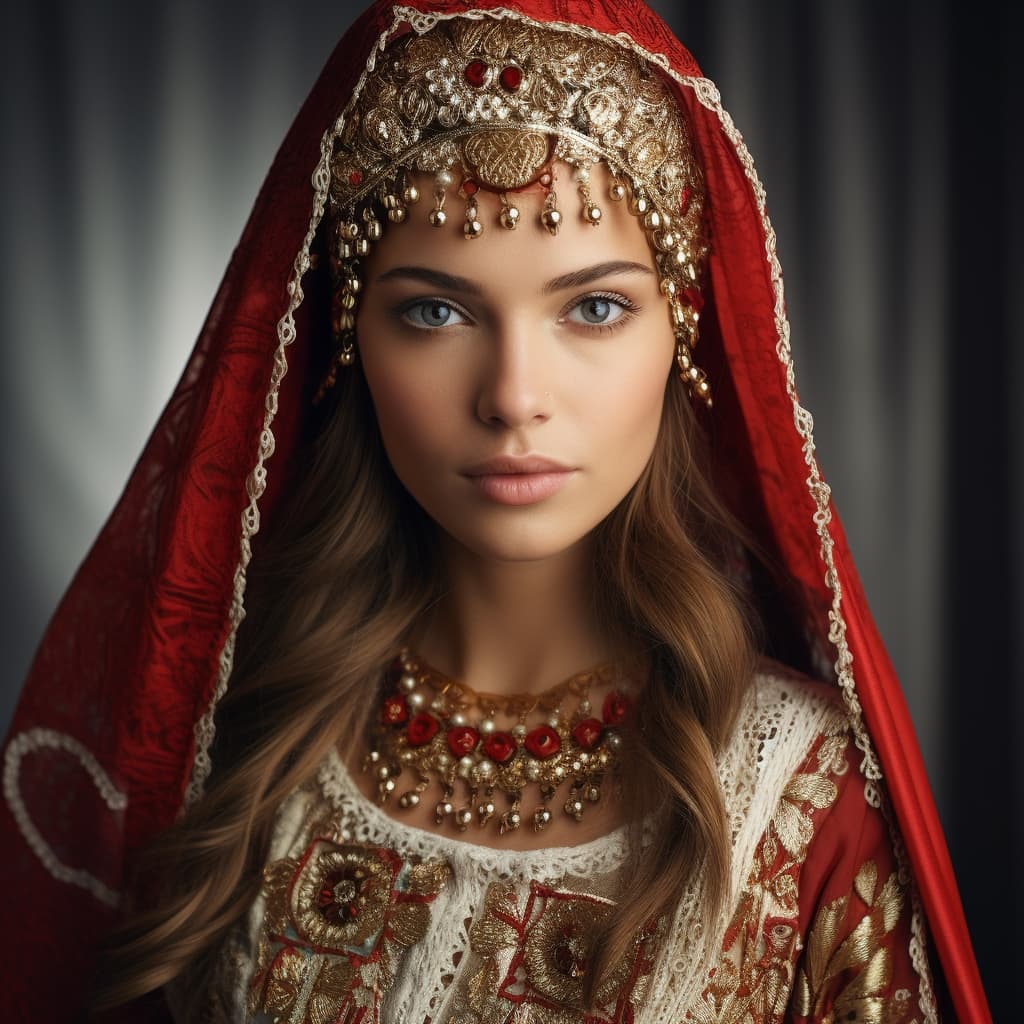
Turks Erotic
Turkey
Turkic / Oghuz / Turkish
Islam / Sunni Islam
Turkish Cypriots, Meskhetian Turks, Yörüks, along with significant populations in Bulgaria, Greece, North Macedonia, Germany, France, the United Kingdom, the Netherlands, Austria, Belgium, Sweden, the United States, Syria, and Iraq
Western Asia
About Turks People
The Turks are an Oghuz Turkic people whose modern identity was shaped, more than anything, by a long migration west out of Central Asia and the centuries of empire that followed. They are the demographic core of the Republic of Turkey, but the category bleeds well past those borders: Turkish Cypriots in the north of Cyprus, Meskhetian Turks scattered by Stalin-era deportation across the former Soviet space, the semi-nomadic Yörüks of the southern Anatolian uplands, and large settled communities in the Balkans and across western Europe — Germany above all, where postwar guest-worker recruitment built a Turkish presence now several generations deep. Anatolia itself is the through-line: a peninsula of dry plateau, mountain rim, and two long coastlines that has been, in turn, Hittite, Greek, Roman, Byzantine, Seljuk, and Ottoman, with each layer still legible in the place-names and the food.
Turkish belongs to the Oghuz branch of the Turkic family, closely related to Azerbaijani and Turkmen and mutually intelligible with them in stretches; it is agglutinative, vowel-harmonic, and famously resistant to direct translation into Indo-European syntax. The language went through one of the twentieth century's more aggressive engineering projects under Atatürk — a 1928 switch from Arabic to Latin script and a sustained purge of Arabic and Persian loanwords in favor of Turkic coinages — which is why a Turk reading Ottoman documents from a century ago needs help, while a Turk reading a modern Azerbaijani newspaper largely does not. Most Turks are Sunni Muslims of the Hanafi school, but a substantial minority, perhaps a fifth of the population, are Alevi, a heterodox tradition with its own ritual life, music, and historical relationship to Shi'ism that sits uneasily with Sunni orthodoxy. The official secularism inherited from the early republic remains a live political question rather than a settled one.
Day-to-day, what tends to mark Turkish life is a particular weight given to hospitality and to the household — the obligation to feed a guest properly, the elaborate grammar of tea-drinking, the kinship terms that extend into neighbors and shopkeepers. Coffeehouse culture, the meyhane, the public bath, the wedding-week customs that vary sharply between the Aegean coast and the eastern provinces — these still organize a great deal of social time. Regional difference inside Turkey is genuine and not decorative: a Black Sea villager, an Istanbul professional, and a southeastern farmer share a state and a language but not always much else.
Typical Turks Phenotypes
Reference for AI generation — hair, eyes, skin, facial structure, build
Turkish phenotype reflects the population's deep Anatolian substrate layered with Central Asian Turkic, Balkan, Caucasian, and Levantine inputs — the result is a population that reads as Mediterranean–West Asian rather than East Asian, despite the Turkic linguistic origin. Hair is overwhelmingly dark: chestnut and near-black brown dominate, with true jet black less common than in South Asia. Natural blondness shows up in maybe 5–10% of the population, concentrated along the Black Sea coast and in pockets of European Turkey, while red hair appears in low single digits, often as auburn highlights rather than full ginger. Texture runs straight to loose wave, with tighter curl patterns showing in southeastern populations near the Syrian border.
Eye color is mostly brown — warm honey to dark hazel — but light eyes (green, gray, blue) appear in roughly 20–25% of Turks, one of the higher rates in the broader Middle East. Epicanthic folds are absent in the vast majority; the Central Asian morphology largely faded over a millennium of Anatolian admixture. Eye shape tends almond, set under defined brows that are themselves a recognizable feature.
Skin spans Fitzpatrick II through IV, with olive undertones predominant. Coastal Aegean and Black Sea Turks lean lighter; southeastern Anatolians trend deeper, sometimes into Type V. Faces typically show a straight or slightly aquiline nose with a defined bridge, medium alar width, full but not maximally everted lips, and strong jawlines — cheekbones are present but less prominent than in Central Asian Turkic peoples like Kazakhs or Kyrgyz.
Build is medium: men average around 174 cm, women 161 cm, with a tendency toward broader-shouldered, mesomorphic frames rather than slender. Sub-group variation is real but subtle. Yörüks (semi-nomadic Anatolian Turkmens) often retain slightly more visible Central Asian features — broader face, occasional slight epicanthic suggestion. Turkish Cypriots skew Mediterranean. Meskhetian Turks carry Caucasian inputs and frequently show lighter coloring.
Data depth
43/100Coverage of image-grounded phenotype observations · drives AI generation diversity
- Sample size
- 24/40· 16 images
- Image quality
- 9/30· 19% high
- Confidence
- 10/20· mean 0.59
- Source diversity
- 0/10· wikipedia
- ·Modest sample (n<25)
- ·Mostly low-quality source images
- ·Wikipedia-only source — not population-representative
Observed Distribution — Image Sample
Empirical observations from analyzed photographs · supplementary signal, not population truth
Sample: 16 images analyzed (16 wikipedia). Quality: 3 high, 7 medium, 6 low, 0 very_low. Avg analyzer confidence: 0.59.
Skin tone (Fitzpatrick): II (31%), III (44%), IV (6%), V (6%), unclear (13%)
Hair color: black (44%), gray/white (38%), brown (6%), unclear (13%)
Hair texture: straight (38%), wavy (44%), covered (6%), unclear (13%)
Eye color: dark brown (56%), blue (6%), brown (6%), unclear (31%)
Epicanthic fold: 6% present, 81% absent, 13% unclear
Caveats: Sample size 16 is modest — secondary patterns may not be reliable. Quality skews toward older or low-resolution photos; phenotype detail may be lossy. Sample is 100% Wikipedia notable people — skews toward male, public-life, and modern figures, not population-representative.
Last aggregated: May 7, 2026
Explore phenotype categories
Structured taxonomy with peer-reviewed scales · 22 anatomical categories
Notable Turks People
37 reference figures — sourced from Wikipedia
- Sportspeople — Weightlifters
- Yahşi Baraz — born 1944)
- Sabiha Gökçen — 1913–2001)
- Vecihi Hürkuş — 1895–1969)
- Irfan Orga — 1908–1970)
- Ali İsmet Öztürk — born 1964)
- Murat Öztürk (aviator) — 1953–2013)
- Nezihe Viranyalı — 1925–2004)
- Ahmet Ali Çelikten — 1883–1969)
- Tülin Şahin — model and actress
- Lalla Yacout — Mother of king Mohammed V of Morocco
- Muazzez İlmiye Çığ — sumerologist)
- Atok Karaali — Karaali Rocks
- John Komnenos the Fat — was a Byzantine noble
- Ali Ferit Gören — 1913–1987), Austrian-Turkish Olympic sprinter
- Turgut Atakol — FIBA Hall of Fame
- Turgay Demirel — 4th President of FIBA Europe
- İrem Karamete — born 1993), Olympic fencer
- Mehmet Yılmaz — striker)
- Ridvan Aydemir — ex-Muslim activist, YouTuber
- Bajkam — military commander
- Sadun Boro — sailor and global circumnavigator
- Hasan Çelebi — calligrapher
- Araksi Çetinyan — Turkish beauty pageant winner
- Nejat Eczacıbaşı — pharmaceutical entrepreneur
- Hadi Elazzi — talent manager
- İlhan Erdost — publisher
- Erden Eruç — completed first solo human-powered circumnavigation of the Earth by rowboat, …
- Kara Fatma — female hero
- Ghias ad-Din — was a member of the Seljuq dynasty of Rum
- Cem Karsan — volatility expert, hedge fund manager, social media personality
- Levent Kazak — scriptwriter
- Nasuh Mahruki — first Turkish summiteer of Mt. Everest
- Janet Akyüz Mattei — astronomer
- Mehmet Baybaşin — drug trafficker
- Mehmet Ali Arslan — Newspaper Writer publisher
- Tatikios — c. 1048 - died after 1110), Byzantine general
Generate Turks AI Content
Use this ethnicity's phenotype data to create AI-generated content with accurate physical traits and cultural context.
Open Creator Studio