Qiang Erotic
Ngawa Tibetan and Qiang Autonomous Prefecture (China)
Sino-Tibetan / Qiangic
Qiang folk religion
Central Asia
About Qiang People
The Qiang live in the steep upper valleys of the Min River where Sichuan crumples into the eastern edge of the Tibetan Plateau — a world of stone watchtowers, terraced slopes, and villages clinging to ridgelines above 2,000 meters. They call themselves Rma, and the name "Qiang" is older than almost any other ethnonym in Chinese records: it appears on Shang dynasty oracle bones more than three thousand years ago, applied to herding peoples to the west. The modern Qiang are not a direct continuation of those ancient Qiang in any simple sense, but the linguistic thread is real, and the sense of long residence in these mountains is part of how the community sees itself.
Their language belongs to the Qiangic branch of Sino-Tibetan, a small and internally varied group that sits between Tibetan proper and the Sinitic languages without fitting comfortably with either. Northern and Southern Qiang are different enough that speakers from opposite ends of the range often switch to Mandarin to communicate — a fact that shapes village identity as much as it complicates any tidy notion of a single Qiang tongue. Writing is recent and limited; the tradition has been overwhelmingly oral, carried by ritual specialists called shibi who memorize epic chants running to tens of thousands of lines.
The shibi are the keystone of Qiang folk religion, a system with no temples, no scripture, and no priesthood in the institutional sense. Worship centers on white stones placed on rooftops and shrines — emblems of a sky god and of the mountains themselves — and on a layered cosmology of ancestral spirits, household deities, and the protective powers of specific peaks. Buddhism and Daoism press in from the surrounding regions and have been absorbed in patches, but the core practice remains stubbornly local: a religion of village and valley rather than of any larger church.
The 2008 Sichuan earthquake hit the Qiang heartland with particular violence, destroying ancestral villages and killing a disproportionate share of the elder shibi who held the unwritten ritual corpus. Reconstruction has been substantial, and a generation of younger Qiang have taken up the work of recording chants, rebuilding watchtowers, and teaching the language in schools. Whether that effort can outpace the pull of cities and Mandarin-medium education is the open question of the present moment, and one the community is acutely aware of.
Typical Qiang Phenotypes
Reference for AI generation — hair, eyes, skin, facial structure, build
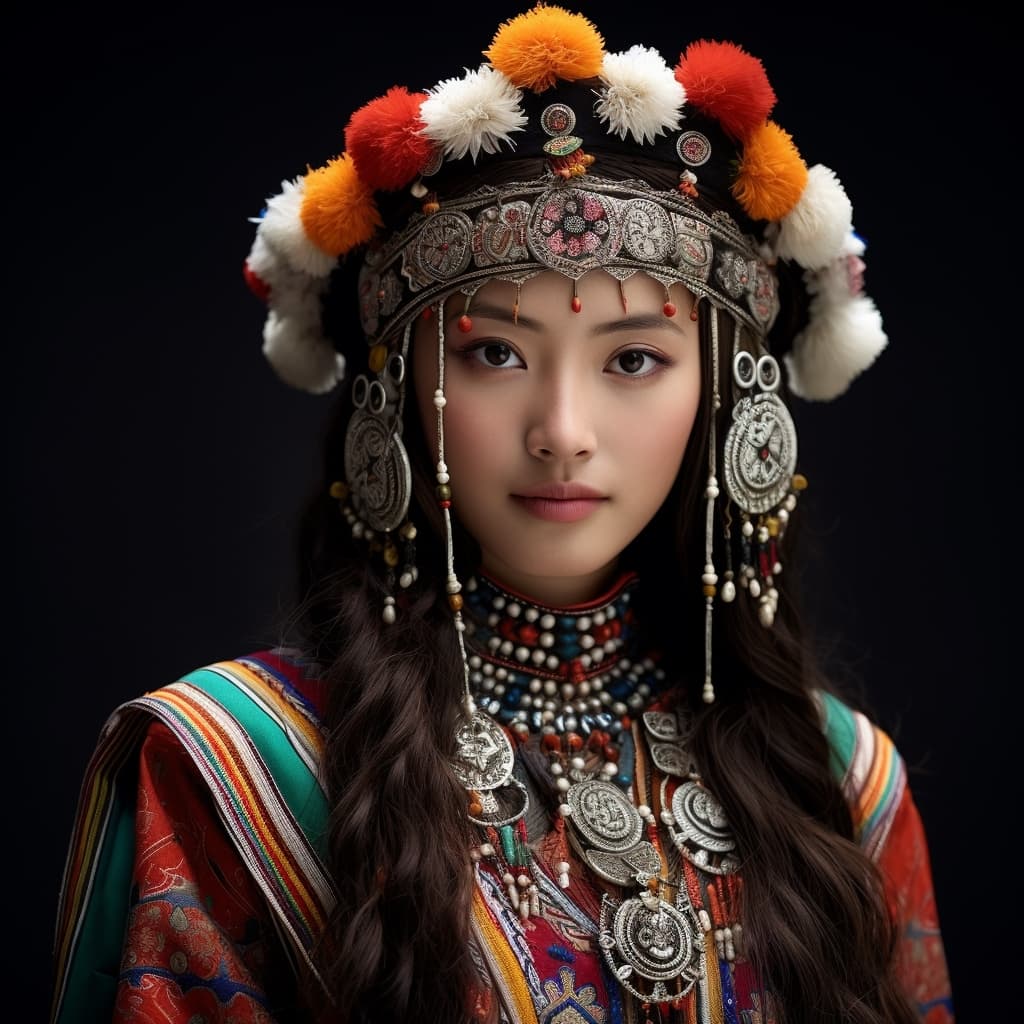
The Qiang are a Sino-Tibetan highland population concentrated in the upper Min River valleys of northwestern Sichuan, and their phenotype reflects long isolation at altitude rather than the Han-typical lowland template. The face tends to be broad and bone-structured, with prominent malar bones, a relatively flat midface, and a square or slightly tapered jaw. The nasal bridge is generally low to medium — flatter than Tibetan plateau norms but less projected than Han Chinese averages — with moderate alar width and rounded tips. Lips are medium in fullness, often with a defined upper vermilion border.
Hair is uniformly black or very dark brown, coarse and straight, occasionally with a slight wave; early graying is uncommon and beard growth on men is sparse to moderate. Eyes are dark brown to near-black. The epicanthic fold is near-universal but tends to be softer and less pronounced than in northern Han or Mongolic populations, and the palpebral fissure runs more horizontally than slanted. Eye shape reads as almond rather than narrow.
Skin tone sits in the Fitzpatrick III–IV range with warm yellow-bronze undertones, but high-altitude UV exposure produces visibly weathered cheeks — the so-called "high-plateau flush" of permanent capillary redness across the malar area is common in rural villagers, especially women, and is one of the more distinctive Qiang markers. Hands and faces of older highland Qiang often show pronounced sun damage that contrasts with sun-protected torso skin.
Build is compact and barrel-chested, an adaptation to elevations of 2,000–3,500 meters. Average stature is modest — men typically 165–170 cm, women 153–158 cm — but musculature is dense, with strong legs and broad shoulders relative to height. Body fat distribution leans toward the trunk. Northern Qiang from Mao County tend to show slightly more Tibetan-leaning features (stronger cheekbones, deeper-set eyes), while southern Qiang nearer Wenchuan trend marginally closer to Sichuan Han norms in nose projection and skin tone.
Data depth
0/100Coverage of image-grounded phenotype observations · drives AI generation diversity
- Sample size
- 0/40· 0 images
- Image quality
- 0/30· 0% high
- Confidence
- 0/20
- Source diversity
- 0/10
- ·No image observations yet
Explore phenotype categories
Structured taxonomy with peer-reviewed scales · 22 anatomical categories






Generate Qiang AI Content
Use this ethnicity's phenotype data to create AI-generated content with accurate physical traits and cultural context.
Open Creator Studio